Thank you for visiting SNEWPapers!
Sign up free
Daily Independent
Elko, Elko County, Nevada
What is this article about?
Historical account of heavy taxation in England during the Napoleonic Wars, including 10% income tax on all incomes over $1,000, taxes on sugar, wig powdering ($5/year), hats (stamped), household clocks ($1.25), gold watches ($2.50/year), and earlier poll taxes scaled by social rank, later replaced by a 2-cent weekly contribution from able-bodied men.
Clipping
OCR Quality
Full Text
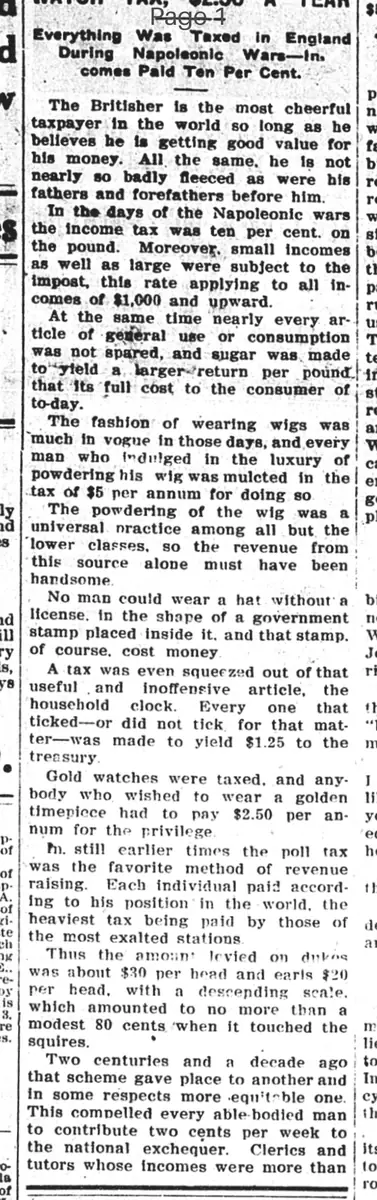
The Britisher is the most cheerful taxpayer in the world so long as he believes he is getting good value for his money. All the same, he is not nearly so badly fleeced as were his fathers and forefathers before him.
In the days of the Napoleonic wars the income tax was ten per cent. on the pound. Moreover, small incomes as well as large were subject to the impost, this rate applying to all incomes of $1,000 and upward.
At the same time nearly every article of general use or consumption was not spared, and sugar was made to yield a larger return per pound than its full cost to the consumer of to-day.
The fashion of wearing wigs was much in vogue in those days, and every man who indulged in the luxury of powdering his wig was mulcted in the tax of $5 per annum for doing so. The powdering of the wig was a universal practice among all but the lower classes, so the revenue from this source alone must have been handsome.
No man could wear a hat without a license, in the shape of a government stamp placed inside it, and that stamp, of course, cost money.
A tax was even squeezed out of that useful and inoffensive article, the household clock. Every one that ticked—or did not tick, for that matter—was made to yield $1.25 to the treasury.
Gold watches were taxed, and anybody who wished to wear a golden timepiece had to pay $2.50 per annum for the privilege.
In still earlier times the poll tax was the favorite method of revenue raising. Each individual paid according to his position in the world, the heaviest tax being paid by those of the most exalted stations. Thus the amount levied on dukes was about $30 per head and earls $20 per head, with a descending scale, which amounted to no more than a modest 80 cents when it touched the squires.
Two centuries and a decade ago that scheme gave place to another and in some respects more equitable one. This compelled every able-bodied man to contribute two cents per week to the national exchequer. Clerics and tutors whose incomes were more than
What sub-type of article is it?
What themes does it cover?
What keywords are associated?
Where did it happen?
Story Details
Location
England
Event Date
Napoleonic Wars
Story Details
During the Napoleonic Wars, England imposed a 10% income tax on all incomes over $1,000, plus taxes on sugar, wig powdering ($5/year), hats (stamped), clocks ($1.25), and gold watches ($2.50/year). Earlier, poll taxes varied by social rank (dukes $30, earls $20, down to squires 80 cents), replaced about 210 years ago by a 2-cent weekly levy on able-bodied men.