Thank you for visiting SNEWPapers!
Sign up free
Editorial
December 17, 1936
The Lincoln Times
Lincolnton, Lincoln County, North Carolina
What is this article about?
American editorial sympathizes with King Edward VIII's clash with British government over marrying divorced Mrs. Simpson, viewing it as parliamentary power grab. Discusses unwritten British constitution, historical crises like James II's abdication and George III's role in Revolution, and critiques hypocrisy on divorce.
Clipping
OCR Quality
98%
Excellent
Full Text
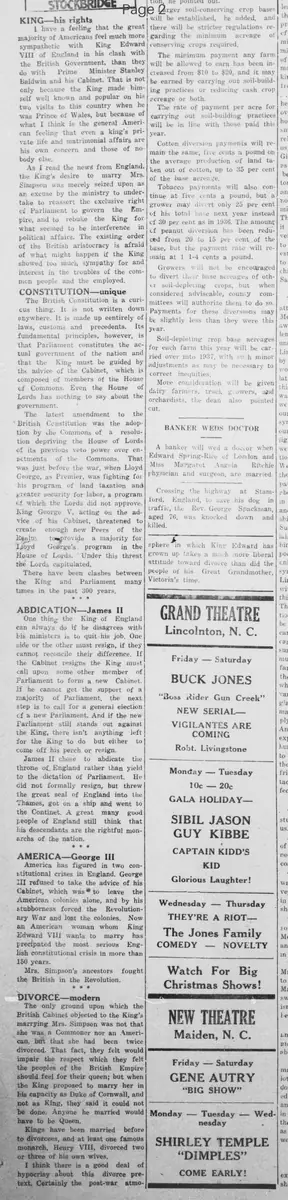
KING—his rights
I have a feeling that the great majority of Americans feel much more sympathetic with King Edward VIII of England in his clash with the British Government, than they do with Prime Minister Stanley Baldwin and his Cabinet. That is not only because the King made himself well known and popular on his two visits to this country when he was Prince of Wales, but because of what I think is the general American feeling that even a king's private life and matrimonial affairs are his own concern and those of nobody else.
As I read the news from England, the King's desire to marry Mrs. Simpson was merely seized upon as an excuse by the ministry to undertake to reassert the exclusive right of Parliament to govern the Empire, and to rebuke the King for what seemed to be interference in political affairs. The existing order of the British aristocracy is afraid of what might happen if the King showed too much sympathy for and interest in the troubles of the common people and the employed.
CONSTITUTION—unique
The British Constitution is a curious thing. It is not written down anywhere. It is made up entirely of laws, customs and precedents. Its fundamental principle, however, is that Parliament constitutes the actual government of the nation and that the King must be guided by the advice of the Cabinet, which is composed of members of the House of Commons. Even the House of Lords has nothing to say about the government.
The latest amendment to the British Constitution was the adoption by the Commons of a resolution depriving the House of Lords of its previous veto power over enactments of the Commons. That was just before the war, when Lloyd George, as Premier, was fighting for his program of land taxation and greater security for labor, a program of which the Lords did not approve. King George V, acting on the advice of his Cabinet, threatened to create enough new Peers of the Realm to provide a majority for Lloyd George's program in the House of Lords. Under this threat the Lords capitulated.
There have been clashes between the King and Parliament many times in the past 300 years.
ABDICATION—James II
One thing the King of England can always do if he disagrees with his ministers is to quit his job. One side or the other must resign, if they cannot reconcile their difference. If the Cabinet resigns the King must call upon some other member of Parliament to form a new Cabinet. If he cannot get the support of a majority of Parliament, the next step is to call for a general election of a new Parliament. And if the new Parliament still stands out against the King, there isn't anything left for the King to do but either to come off his perch or resign.
James II chose to abdicate the throne of England rather than yield to the dictation of Parliament. He did not formally resign, but threw the great seal of England into the Thames, got on a ship and went to the Continent. A great many good people of England still think that his descendants are the rightful monarchs of the nation.
AMERICA—George III
America has figured in two constitutional crises in England. George III refused to take the advice of his Cabinet, which was to leave the American colonies alone, and by his stubbornness forced the Revolutionary War and lost the colonies. Now an American woman whom King Edward VIII wants to marry has precipitated the most serious English constitutional crisis in more than 150 years.
Mrs. Simpson's ancestors fought the British in the Revolution.
DIVORCE—modern
The only ground upon which the British Cabinet objected to the King's marrying Mrs. Simpson was not that she was a Commoner nor an American, but that she had been twice divorced. That fact, they felt would impair the respect which they felt the peoples of the British Empire should feel for their queen; but when the King proposed to marry her in his capacity as Duke of Cornwall, and not as King, they said it could not be done. Anyone he married would have to be Queen.
Kings have been married before to divorcees, and at least one famous monarch, Henry VIII, divorced two or three of his own wives.
I think there is a good deal of hypocrisy about this divorce pretext. Certainly the post-war atmosphere in which King Edward has grown up takes a much more liberal attitude toward divorce than did the people of his Great Grandmother, Victoria's time.
I have a feeling that the great majority of Americans feel much more sympathetic with King Edward VIII of England in his clash with the British Government, than they do with Prime Minister Stanley Baldwin and his Cabinet. That is not only because the King made himself well known and popular on his two visits to this country when he was Prince of Wales, but because of what I think is the general American feeling that even a king's private life and matrimonial affairs are his own concern and those of nobody else.
As I read the news from England, the King's desire to marry Mrs. Simpson was merely seized upon as an excuse by the ministry to undertake to reassert the exclusive right of Parliament to govern the Empire, and to rebuke the King for what seemed to be interference in political affairs. The existing order of the British aristocracy is afraid of what might happen if the King showed too much sympathy for and interest in the troubles of the common people and the employed.
CONSTITUTION—unique
The British Constitution is a curious thing. It is not written down anywhere. It is made up entirely of laws, customs and precedents. Its fundamental principle, however, is that Parliament constitutes the actual government of the nation and that the King must be guided by the advice of the Cabinet, which is composed of members of the House of Commons. Even the House of Lords has nothing to say about the government.
The latest amendment to the British Constitution was the adoption by the Commons of a resolution depriving the House of Lords of its previous veto power over enactments of the Commons. That was just before the war, when Lloyd George, as Premier, was fighting for his program of land taxation and greater security for labor, a program of which the Lords did not approve. King George V, acting on the advice of his Cabinet, threatened to create enough new Peers of the Realm to provide a majority for Lloyd George's program in the House of Lords. Under this threat the Lords capitulated.
There have been clashes between the King and Parliament many times in the past 300 years.
ABDICATION—James II
One thing the King of England can always do if he disagrees with his ministers is to quit his job. One side or the other must resign, if they cannot reconcile their difference. If the Cabinet resigns the King must call upon some other member of Parliament to form a new Cabinet. If he cannot get the support of a majority of Parliament, the next step is to call for a general election of a new Parliament. And if the new Parliament still stands out against the King, there isn't anything left for the King to do but either to come off his perch or resign.
James II chose to abdicate the throne of England rather than yield to the dictation of Parliament. He did not formally resign, but threw the great seal of England into the Thames, got on a ship and went to the Continent. A great many good people of England still think that his descendants are the rightful monarchs of the nation.
AMERICA—George III
America has figured in two constitutional crises in England. George III refused to take the advice of his Cabinet, which was to leave the American colonies alone, and by his stubbornness forced the Revolutionary War and lost the colonies. Now an American woman whom King Edward VIII wants to marry has precipitated the most serious English constitutional crisis in more than 150 years.
Mrs. Simpson's ancestors fought the British in the Revolution.
DIVORCE—modern
The only ground upon which the British Cabinet objected to the King's marrying Mrs. Simpson was not that she was a Commoner nor an American, but that she had been twice divorced. That fact, they felt would impair the respect which they felt the peoples of the British Empire should feel for their queen; but when the King proposed to marry her in his capacity as Duke of Cornwall, and not as King, they said it could not be done. Anyone he married would have to be Queen.
Kings have been married before to divorcees, and at least one famous monarch, Henry VIII, divorced two or three of his own wives.
I think there is a good deal of hypocrisy about this divorce pretext. Certainly the post-war atmosphere in which King Edward has grown up takes a much more liberal attitude toward divorce than did the people of his Great Grandmother, Victoria's time.
What sub-type of article is it?
Constitutional
Foreign Affairs
Social Reform
What keywords are associated?
King Edward Viii
Abdication Crisis
Mrs Simpson
British Constitution
Parliamentary Power
Divorce Hypocrisy
American Sympathy
What entities or persons were involved?
King Edward Viii
Mrs. Simpson
Stanley Baldwin
British Parliament
James Ii
George Iii
Henry Viii
Lloyd George
King George V
Editorial Details
Primary Topic
Sympathy For King Edward Viii Amid Abdication Crisis Over Marriage To Mrs. Simpson
Stance / Tone
Sympathetic To The King, Critical Of British Parliament And Aristocracy
Key Figures
King Edward Viii
Mrs. Simpson
Stanley Baldwin
British Parliament
James Ii
George Iii
Henry Viii
Lloyd George
King George V
Key Arguments
Americans Sympathize With King Over His Personal Affairs
Parliament Uses Marriage Issue To Reassert Power And Rebuke King's Interest In Common People
British Constitution Unwritten, Parliament Supreme, King Guided By Cabinet
Historical Clashes Include Lords' Veto Loss Under Lloyd George
King Can Abdicate If Disagreeing With Ministers, As James Ii Did
George Iii's Stubbornness Led To American Revolution
Objection To Marriage Based On Divorce Is Hypocritical Given Historical Precedents And Modern Attitudes