Thank you for visiting SNEWPapers!
Sign up free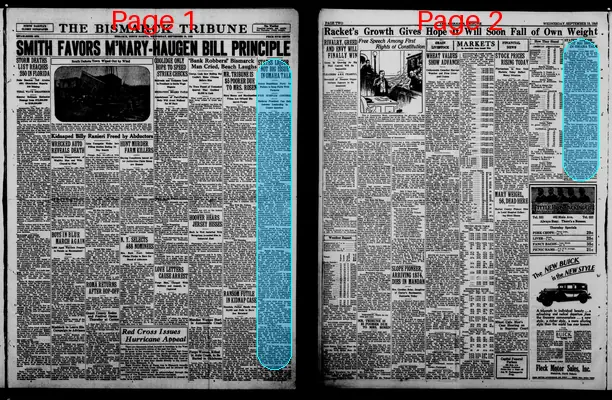
The Bismarck Tribune
Bismarck, Mandan, Burleigh County, Morton County, North Dakota
What is this article about?
In his first western campaign speech in Omaha on Sept. 19, Democratic nominee Governor Alfred E. Smith advocates McNary-Haugen principles for farm relief, blasts Republicans like Hoover and Coolidge for failing farmers, downplays liquor as a major issue, and pledges a nonpartisan commission.
Merged-components note: Political speech by Governor Smith on liquor and farm relief; explicit 'Continued from page one' confirms single article across pages.
Clippings

1 of 2
OCR Quality
Full Text
Scores Republican Party for Failure to Keep Faith With Farmers
FOR SURPLUS CONTROL
Declares President Can Only Assume Leadership in Liquor Question
Omaha, Neb., Sept. 19. (P) -- With a flat declaration that he favors the "principle" embodied in the twice vetoed McNary-Haugen bill as a working basis for adequate farm relief legislation and that he did not consider liquor "the great issue" in the present campaign, Governor Smith has opened his drive for the presidency in the west.
In an auditorium crowded to the doors and as millions listened in throughout the nation over the radio, the Democratic presidential nominee, in his first campaign speech in the heart of the corn belt, last night tore into the Republican party for what he termed its failure to keep faith with the farmer, including by name his opponent, Herbert Hoover, and President Coolidge in his indictment.
His own solution, he said, and one on which he and the Democratic platform stand squarely, was the principle laid down in the McNary-Haugen bill to "establish an effective control of the sale of exportable surplus with the cost imposed upon the commodity benefited." He added, however, that he did not limit himself to the "exact mechanics and method embodied in that bill" and proposed, if elected, immediately to name a nonpartisan commission to work out the details of the problem. The equalization fee was not mentioned.
Answers 10 Questions.
The nominee's references to prohibition came at the end of his hour address, which was delivered for the most part extemporaneously with the aid at times of a previously prepared manuscript, when he answered a series of eight questions propounded to him in a full page advertisement in the morning newspapers by ten Nebraskans who styled themselves "citizens of both parties." Smith adherents classified all of them as Republicans.
In his replies, he declared in substance that the president can do nothing about liquor, except to make recommendations to congress and assume a leadership on the question, and further that he would not attempt to persuade any Democratic member of congress to go against his constituents if they wanted prohibition.
"Various people have attempted to misrepresent and confuse my attitude with respect to the McNary-Haugen bill," he said. "I do not propose to leave the slightest doubt in anybody's mind on that subject.
As I read the McNary-Haugen bill, its fundamental purpose is to establish an effective control of the sale of exportable surplus with cost imposed upon the commodity benefited.
Stands For Principle
"For that principle the Democratic platform squarely stands, and for that principle I squarely stand. Mr. Hoover stands squarely opposed to this principle by which the farmer could get the benefit of the tariff. What remains of the McNary-Haugen bill is a mere matter of method, and I do not limit myself to the exact mechanics and methods embodied in that bill."
"I have pledged myself to name a nonpartisan commission of farm leaders and students of the problem to work out these details. I shall make that appointment, if I am elected -- not when I take the oath of office as president, but immediately after election; and I pledge to the farmers and to the people of this country that no stone will be left unturned to give immediate and adequate farm relief by legislation carrying into practice this definite principle for which my party and I stand.
"This course alone gives promise of rescuing the farmers of this country from the complete ruin which threatens them today."
Asked how he could square his support of Democratic candidates for congress "pledged against liquor with what you say you will do for liquor," he replied that he could not understand how anyone could ask such a question, since "there is nothing that the president can do about liquor."
Can Only Lead
"All he can do," he said, "is recommend to the congress, and he can assume the leadership of the American people in an effort to show them that his recommendation is right. That is what I propose to do, and let the American people make the decision, as they will have to do." Loud applause greeted this statement.
Asked if he thought the country would be more prosperous "liquor or without" the governor brought another cheer when he responded: Nobody, no living person, no matter how wise, no man well informed no matter how well informed, could make any answer to that question.
STATES LIQUOR 'NOT BIG ISSUE' IN OMAHA TALK
(Continued from page one)
as I read the record I can see only one decision for the 6th of November and that is an overwhelming Democratic victory."
Traces Republican Reign
Tracing the record of the Republican administration in the last seven and a half years, Governor Smith, defined the platform declarations of that party in the last three campaigns as amounting to nothing more than "promises."
Calling the Republican candidate "the trusted adviser" of the administration on agricultural questions the governor said Hoover "assumed full responsibility and still assumes it, by the fulsome praise that he accords to the Coolidge policies, one of which was to knock dead every effort by everybody else to aid agriculture and to have no policy of his own."
The nominee quoted the statement by Senator Norris, Republican, Nebraska, attacking the Republican platform as a "direct slap" at the farmer and asked why Governor McMullen, of Nebraska, a Republican, had threatened to invade the Kansas City convention with "a half million men and batter down the doors of the committee on resolutions in a demand for some definite promise of farmer relief."
"Just what they are talking about, just what they all admit: the distress of the farmer," the governor said.
"The best thought on agriculture, after a careful study of it," he asserted, "claims that in the last 18 years there has been a decrease in the purchasing power of agricultural products of over 20 per cent. That is the trouble. The trouble is that the farmer is buying in a highly protected market and he is selling in an unprotected one."
The tariff standing by itself, he continued, will never solve the farm problem, because it "does not operate."
Governor Smith left Omaha at 9:37 o'clock this morning for Oklahoma City, where tomorrow night he will deliver the second speech of his two-weeks campaign in the middle and far west.
The long special train carrying the Democratic presidential nominee will not reach Oklahoma City until 9 o'clock tomorrow morning. En route eight stops were scheduled in Nebraska and Kansas, the first being at 11:05 this morning at Lincoln, Neb., where the governor has accepted an invitation to visit the state capitol, extended by Governor McMullen.
What sub-type of article is it?
What themes does it cover?
What keywords are associated?
What entities or persons were involved?
Where did it happen?
Story Details
Key Persons
Location
Omaha, Neb.
Event Date
Sept. 19
Story Details
Governor Smith opens western presidential campaign in Omaha, endorsing McNary-Haugen bill principle for farm surplus control and relief, criticizing Republican failures including Hoover and Coolidge, and declaring liquor not the central campaign issue, proposing a nonpartisan commission if elected.