Thank you for visiting SNEWPapers!
Sign up free
The New Hampshire Gazette
Portsmouth, Rockingham County, New Hampshire
What is this article about?
Samuel Haines defends his arrest of deserter Jonathan Eastman in a letter to New Hampshire Attorney General William K. Atkinson, accusing the year-long prosecution of being a politically motivated persecution involving perjury, and criticizes the AG's misconduct in pursuing it despite evidence of innocence, which ended in nolle prosequi.
Merged-components note: Merged continuation of the letter to the editor across pages, including the appended documents, as they form a single coherent component.
Clippings
1 of 2
OCR Quality
Full Text
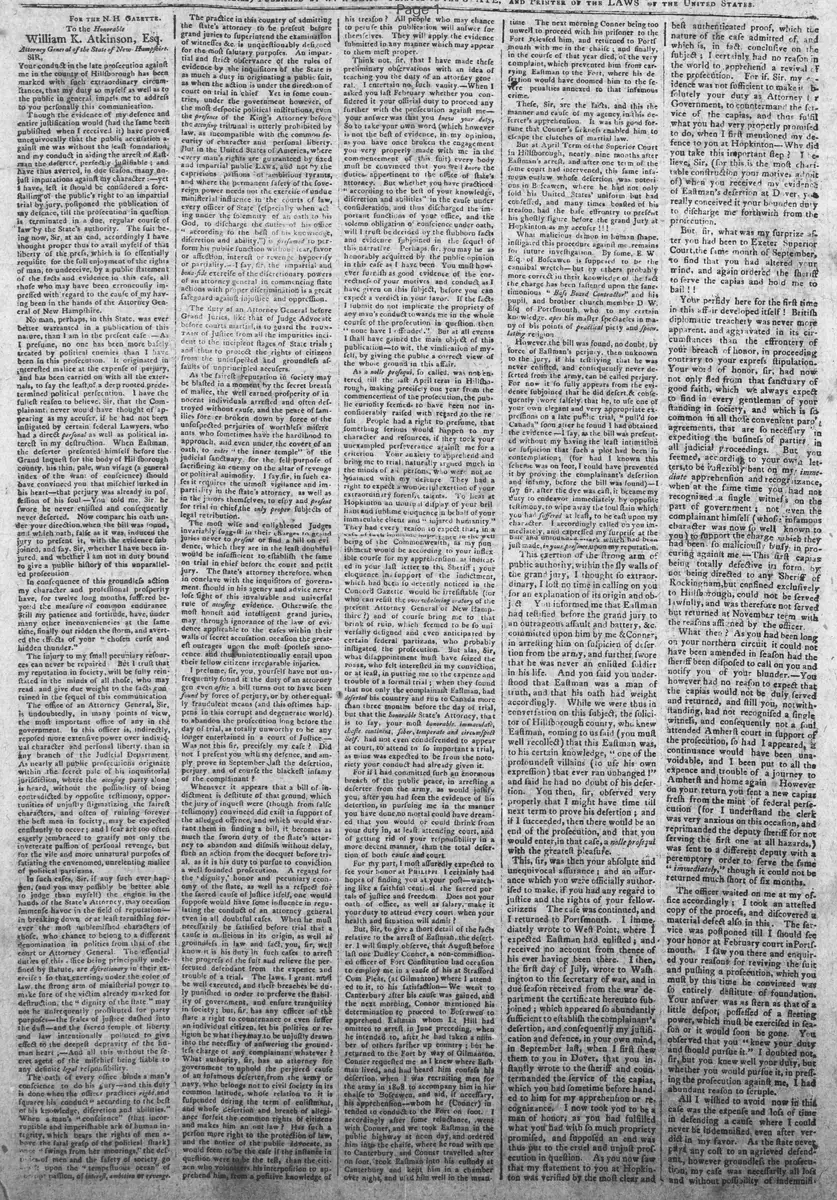
To the Honorable
William K. Atkinson, Esq.
Attorney General of the State of New-Hampshire.
SIR,
Your conduct in the late prosecution against
me in the county of Hillsborough has been
marked with such extraordinary circum-
stances, that my duty to myself as well as to
the public in general, impels me to address
to you personally this communication.
Though the evidence of my defence and
entire justification would (had the same been
published when I received it) have proved
unequivocally that the public accusation a-
gainst me was without the least foundation,
and my conduct in aiding the arrest of East-
man the deserter, perfectly justifiable; and
have thus averted, in due season, many no-
just imputations against my character; yet
I have, lest it should be considered a fore-
stalling of the public's right to an impartial
trial by jury, postponed the publication of
my defence, till the prosecution in question
is terminated, in a due, regular course of
Law by the State's authority. The suit be-
ing now, Sir, at an end, accordingly I have
sought proper thus to avail myself of that
liberty of the press, which is so essentially
requisite for the full enjoyment of the rights
of man; to undeceive, by a public statement
of the facts and evidence in this case, all
those who may have been erroneously im-
pressed with regard to the cause of my hav-
ing been in the hands of the Attorney Gen-
eral of New Hampshire.
No man, perhaps, in this State, was ever
better warranted in a publication of this
nature, than I am in the present case—As
I presume, no one has been more basely
treated by political enemies than I have
been in this prosecution. It originated in
interested malice at the expense of perjury,
and has been carried on with all the exter-
nals, to say the least, of a deep rooted, pre-
determined political persecution. I have the
fullest reason to believe, Sir, that the Com-
plainant, never would have thought of ap-
pearing as my accuser, if he had not been
instigated by certain federal Lawyers, who
had a direct personal as well as political in.
terest in my destruction. When Eastman,
the deserter presented himself before the
Grand Inquest for the body of Hillsborough
county, his thin, pale, wan visage (a general
index of the want of conscience) should
have convinced you that mischief lurked in
his heart—that perjury was already in pos-
session of his soul—You told me, Sir, he
swore he never enlisted and consequently
never deserted. Now compare his oath un-
der your direction, when the bill was found,
and which oath, false as it was, induced the
jury to present it, with the evidence sub-
joined, and say, Sir, whether I have been in-
jured, and whether I am not in duty bound
to give a public history of this unparallel-
ed prosecution.
In consequence of this groundless action
my character and professional property
have, for twelve long months, suffered be-
yond the measure of common endurance.
Gritty patience and fortitude, have, under
many other inconveniences at the same
time, finally out ridden the storm, and avert-
ed the effects of your "chosen curse and
hidden thunder."
The injury to my small pecuniary resour-
ces can never be repaired. But I trust that
my reputation in society, will be fully rein-
tated in the minds of all those, who may
read, and give due weight to the facts con-
tained in the sequel of this communication.
The office of an Attorney General, Sir,
is undoubtedly, in many points of view,
the most important office of any in the
government. In this officer is, indirectly,
reposed more extensive power over individ-
ual character and personal liberty, than in
any branch of the Judicial Department,
As nearly all public prosecutions originate
within the secret pale of his inquisitorial
jurisdiction, where the accusing party alone
is heard, without the possibility of being
contradicted by opposite testimony, oppor-
tunities of injustice, stigmatizing the fairest
characters, and often of ruining forever
the best men in society, may be expected
constantly to occur; and I fear are too often
eagerly embraced to gratify not only the
inveterate passion of personal revenge, but
for the vile and more unnatural purposes of
stimulating the envenomed, unrelenting malice
of political partisans.
In such cases, Sir, if any such ever hap-
pen, (and you may possibly be better able
to judge than myself) the engine in the
hands of the State's Attorney, may occasion
immense havoc in the field of reputation
in breaking down, or at least tarnishing for-
ever the most unblemished characters of
those, who chance to belong to a different
denomination in politics from that of the
court or Attorney General. The essential
duties of this office being principally unde-
fined by statute, are discretionary in their ex-
ercise: so that exerting, under the color of
law, the strong arm of ministerial power to
make sure of the victim already marked for
destruction, the "dignity of the state," may
not be unfrequently prostituted for party
purposes—the scales of justice dashed into
the dust—and the sacred temple of liberty
and law intentionally polluted to give
effect to the deepest depravity of the hu-
man heart ;—And all this without the se-
cret agent of the mischief being liable to
any definite legal responsibility.
The oath of every office binds a man's
conscience to do his duty—and this duty
is done when the officer practices right, and
squares his conduct "according to the best
of his knowledge, discretion and abilities."
When a man's "conscience" (that incor-
ruptible and imperishable ark of human in-
tegrity, which bears the rights of men a-
bove the fatal grasp of the political shark)
and "wings from her moorings," the des-
tinies of men and the safety of society go
adrift upon the "tempestuous ocean" of
kept passion, of interest, ambition or revenge.
The practice in this country of admitting
the state's attorney to be present before
grand juries to superintend the examination
of witnesses &c. is unquestionably designed
for the most salutary purposes. An impar-
tial and strict observance of the rules of
evidence by the inquisitors of the State is
as much a duty in originating a public suit,
as when the action is under the direction of
court on trial in chief. Yet in some coun-
tries, under the government however, of
the most despotic political institutions, even
the presence of the King's Attorney before
the accusing tribunal is utterly prohibited by
law, as incompatible with the common se-
curity of character and personal liberty.
But in the United States of America, where
-every man's rights are guaranteed by fixed
and impartial public Laws, and not by the
capricious passions of ambitious tyrants,
and where the permanent safety of the sov-
ereign power needs not the exercise of undue
ministerial influence in the courts of law,
every officer of State (especially when act-
ing under the solemnity of an oath to his
God, to discharge the duties of his office
"according to the best of his knowledge,
discretion and ability,") is presumed to per-
form his public function without fear, favor
or affection, interest or revenge, hypocrisy
or partiality.—I say, Sir, the impartial and
bona-fide exercise of the discretionary powers
of an attorney general in commencing state
actions with proper discrimination is a great
safeguard against injustice and oppression.
The duty of an Attorney General before
Grand Juries, like that of Judge Advocate
before courts martial, is to guard the foun-
dation of Justice from all the impurities inci-
dent to the incipient stages of State trials ;
and thus to protect the rights of citizens
from the unprincipled and groundless as-
saults of unprincipled accusers.
As the fairest Reputation in society may
be blasted in a moment by the secret breath
of malice, the well earned property of in-
nocent individuals arrested and often de-
stroked without cause, and the peace of fam-
iles forever broken down by force of the
unexpected perjuries of worthless miscre-
ants who sometimes have the hardihood to
approach, and even under the covert of an
oath, to enter "the inner temple" of the
judicial sanctuary, for the fell purpose of
sacrificing an enemy on the altar of revenge
or political animosity. I say, Sir, in such cas-
es it requires the utmost vigilance and im-
partiality in the state's attorney, as well as
in the jurors themselves, to espy and present
for trial in chief, the only proper subjects of
legal retribution.
The most wise and enlightened Judges
invariably suggest in their charges to grand
juries never to present or find a bill on evi-
dence, which they are in the least doubtful
would be insufficient to establish the same
on trial in chief before the court and petit
jury. The state's attorney therefore, when
in conclave with the inquisitors of govern-
ment, should in his agency and advice never
lose sight of this invaluable and universal
rule of accusing evidence. Otherwise the
most honest and intelligent grand juries,
may through ignorance of the law of evi-
dence applicable to the cases within their
walls of secret accusation, occasion the great-
est outrages upon the most spotless inno-
cence, and thus unintentionally entail upon
their fellow citizens irreparable injuries.
I presume, Sir, you yourself have not un-
frequently found it the duty of an attorney
general even after a bill turns out to have been
found by force of perjury, or by other equal-
ly fraudulent means (and this oftimes hap-
pens in this corrupt and degenerate world)
to abandon the prosecution long before the
day of trial, as totally unworthy to be any
longer entertained in a court of Justice.—
Was not this, Sir, precisely my case? Did
not I present you with my defence, and am-
ply prove in September last the desertion,
perjury and of course the blackest infamy
of the complainant?
Whenever it appears that a bill of in-
dictment is destitute of that ground, which
the jury of inquest were (though from false
testimony) convinced did exist in support of
the alleged offence, and which would war-
rant them in finding a bill, it becomes as
much the sworn duty of the state's attor-
ey to abandon and dismiss without delay,
such an action from the docket before tri-
al, as it is his duty to pursue to conviction
a well founded prosecution. A regard for
the 'dignity,' honor and pecuniary econ-
omy of the state, as well as a respect for
the sacred cause of justice itself, one would
suppose would have some influence in regu-
lating the conduct of an attorney general
even in all doubtful cases. When he must
necessarily be satisfied before trial that a
cause is malicious in its origin, as well as
groundless in law and fact, you, Sir, well
know it is his duty in such cases to arrest
the progress of the suit and relieve the per-
secuted defendant from the expense and
trouble of a trial. The laws, I grant, must
be well executed, and their breaches be du-
ly punished in order to preserve the sta-
bility of government, and ensure tranquility
in society; but, Sir, has any officer of the
state a right to countenance or even suffer
an individual citizen, let his politics or re-
ligion be what they may, to be unjustly drawn
into the necessity of answering the ground-
less charge of any complainant whatever?
What authority, Sir, has an attorney for
government to uphold the perjured cause
of an infamous deserter from the army or
navy, who belongs not to civil society in its
common latitude, whose relation to it is
suspended during the term of enlistment,
and whose desertion and breach of allegi-
ance forfeit the common rights of citizens
and makes him an outlaw? Has such a
person more right to the protection of law
and the notice of the public advocate, as
would seem to be the case if the instance in
question were to be the test, than the citi-
zen who volunteers his interposition to ap-
prehend him, from a positive knowledge of
his treason? All people who may chance
to peruse this publication will answer for
themselves. They will apply the evidence
submitted in any manner which may appear
to them most proper.
Think not, Sir, that I have made these
preliminary observations with an idea of
teaching you the duty of an attorney general.
I entertain no such vanity.—When I
asked you last February whether you con-
sidered it your official duty to proceed any
further with the prosecution against me—
your answer was that you knew your duty,
So to take your own word (which however
is not the best of evidence, in my opinion,
as you have once broken the engagement
you very properly made with me in the
commencement of this suit) every body
must be convinced that you well know the
duties appertaining to the office of state's
attorney. But whether you have practiced
"according to the best of your knowledge,
discretion and abilities" in the case under
consideration, and thus discharged the im-
portant functions of your office, and the
solemn obligation of conscience under oath,
will I trust be decided by the stubborn facts
and evidence subjoined in the sequel of
this narrative. Perhaps, Sir, you may be as
honorably acquitted by the public opinion
in this case as I have been. You must how-
ever furnish as good evidence of the cor-
rectness of your motives and conduct as I
have given on this subject, before you can
expect a verdict in your favor. If the facts
I submit do not implicate the propriety of
any man's conduct towards me in the whole
course of the prosecution in question, then
"none have I offended." But at all events
I shall have gained the main object of this
publication—to wit, the vindication of my-
self, by giving the public a correct view of
the whole ground in this affair.
As a nolle prosequi, so called, was not en-
tered till the last April term in Hillsbor-
ough, making precisely one year from the
commencement of the prosecution, the pub-
lic curiosity seemed to have been not in-
considerably raised with regard to the re-
sult. People had a right to presume, that
something serious would happen to my
character and resources, if they took your
unexampled perseverance against me for a
criterion. Your anxiety to apprehend and
bring me to trial, naturally argued much in
the minds of all persons, who were not ac-
quainted with my defence. They had a
right to expect a wonderful exertion of your
extraordinary forensic talents. To hear at
Hopkinton an unusual display of your bril-
liant and sublime eloquence in behalf of your
immaculate client and "injured humanity."
They had every reason to expect that, in a
case of such immense importance to the well
being of the Commonwealth, as my pun-
ishment would be according to your inflex-
ible course for my apprehension, as indicat-
ed in your last letter to the Sheriff; your
eloquence in support of the indictment,
which had been so decently noticed in the
Concord Gazette would be irresistible (for
who can resist the overwhelming oratory of the
present Attorney General of New Hamp-
shire ?) and of course bring me to that
brink of ruin, which seemed to be so uni-
versally designed and even anticipated by
certain federal partisans, who probably
instigated the prosecution. But alas, Sir,
what disappointment must have seized the
Posse, who felt interested in my conviction
or at least, in putting me to the expense and
trouble of a formal trial; when they found
that not only the complainant Eastman, had
deserted his country and run to Canada more
than three months before the day of trial,
but that the honorable State's Attorney, that
is to say, your most honorable, immaculate,
chaste, continent, sober, temperate and circumspect
Self, had not even condescended to appear
at court, to attend to so important a trial,
as mine was expected to be from the noto-
riety your conduct had already given it.
For if I had committed such an enormous
breach of the public peace, in arresting a
deserter from the army, as would justify
you, after you had seen the evidence of his
desertion, in pursuing me in the manner
you have done, no mortal could have dream-
ed that you would or could shrink from
your duty in, at least, attending court, and
of getting rid of your responsibility in a
more decent manner, than the total deser-
tion of both cause and court.
For my part, I most assuredly expected to
see your honor at Jaffrey. I certainly had
hopes of finding you at your post—watch-
ing like a faithful sentinel the sacred por-
tals of justice and freedom. Does not your
oath of office, as well as salary, make it
your duty to attend every court, when your
health and situation will admit?
But, Sir, to give a short detail of the facts
relative to the arrest of Eastman, the des-
ter, I will simply observe, that August before
last one Dudley Connor, a non-commission-
ed officer of Fort Constitution had occasion
to employ me in a cause of his at Strafford
Com. Pleas, (at Gilmanton) where I attend-
ed to it, to his satisfaction—We went to
Canterbury after his cause was gained, and
the next morning, Connor mentioned his
determination to proceed to Boscawen to
apprehend Eastman whom Lt. Hill had
omitted to arrest in June preceding, when
he intended to, after he had taken a num-
ber of others farther up country ; but he
returned to the Fort by way of Gilmanton.
Connor requested me as I knew where East-
man lived, and had heard him confess his
desertion, when I was recruiting men for
the army in 1808, to accompany him in his
chaise to Boscawen, and aid, if necessary,
his apprehension—whom he (Connor) in-
tended to conduct to the Fort on foot. I
accordingly after some reluctance, went
with Connor, and we took Eastman in the
public highway at noon day, and ordered
him into the chaise, where he rode with me
to Canterbury, and Connor travelled after
on foot, took Eastman into his custody at
Canterbury and kept him in a chamber
over night, and used him well in the mean-
time. The next morning Connor being too
unwell to proceed with his prisoner to the
Fort released him, and returned to Ports-
-mouth with me in the chaise ; and finally,
in the course of that year died, of the very
complaint, which prevented him from car-
rying Eastman to the Fort, where his des-
ertion would have doomed him to the se-
vere penalties annexed to that infamous
crime.
These, Sir, are the facts, and this the
manner and cause of my agency in this des-
ter's apprehension. It was his good for-
tune that Connor's sickness enabled him to
escape the clutches of martial law.
But at April Term of the Superior Court
in Hillsborough, nearly nine months after
Eastman's arrest, and after one term of the
same court had intervened, this same infa-
mous outlaw, whose desertion was notori-
ous in Boscawen, where he had not only
sold his United States' uniform but had
confessed, and many times boasted of his
treason, had the base effrontery to present
his ghastly figure before the grand Jury at
Hopkinton as my accuser !!!
What malicious demon in human shape,
instigated this procedure against me remains
for future investigation. By some, E. W.
Esq. of Boscawen is supposed to be the
cannibal wretch—but by others probably
more correct in their knowledge of the facts
the charge has been fastened upon the an-
timonious "Beef Board Contractor" and his
pupil, and brother church member D. W.
Esq. of Portsmouth, who, to my certain
knowledge, apes his master spectacles in ma-
ny of his points of practical piety and specu-
lating religion.
However, the bill was found, no doubt, by
force of Eastman's perjury, then unknown
to the jury, if his testifying that he was
never enlisted, and consequently never des-
erted from the army, can be called perjury.
For now it so fully appears from the evi-
dence subjoined that he did desert, & con-
sequently swore falsely, that he, to use one of
your own elegant and very appropriate ex-
pressions on a late public trial, "pull'd for
Canada" soon after he found I had obtained
the evidence—I say, as the bill was presen-
ted without my having the least intimation
or suspicion that such a plot had been in
contemplation; (for had I known this
scheme was on foot, I could have prevented
it by proving the complainant's desertion
and infamy, before the bill was found)—I
say Sir, after the dye was cast, it became my
duty to endeavor immediately, by opposite
testimony, to wipe away the foul stain which
you had suffered at least, to be cast upon my
character. I accordingly called on you im-
mediately, and expressed my surprise at the
base and unfounded attack which had been
just made, in your presence, upon my reputation.
This exertion of the strong arm of
public authority, within the holy walls of
the grand jury, I thought so extraor-
dinary, I lost no time in calling on you
for an explanation of its origin and ob-
ject. You informed me that Eastman
had testified before the grand jury to
an outrageous assault and battery, &c.
committed upon him by me & Connor;
in arresting him on suspicion of deser-
tion from the army, and further swore
that he was never an enlisted soldier
in his life. And you said you under-
stood that Eastman was a man of
truth, and that his oath had weight
accordingly. While we were thus in
conversation on this subject, the solici-
tor of Hillsborough county, who knew
Eastman, coming to us said (you must
well recollect) that this Eastman was,
to his certain knowledge, "one of the
profoundest villains (to use his own
expression) that ever ran unhanged!"
and said he had no doubt of his deser-
tion. You then, Sir, observed very
properly that I might have time till
next term to prove his desertion : and
if I succeeded, then there would be an
end of the prosecution, and that you
would enter, in that case, a nolle prosequi
with the greatest pleasure.
This, Sir, was then your absolute and
unequivocal assurance; and an as-
surance which you were officially author-
ized to make, if you had any regard to
justice and the rights of your fellow
citizens. The case was continued, and
I returned to Portsmouth. I imme-
diately wrote to West Point; where I
expected Eastman had enlisted: and
received no account from thence of
his ever having been there. I then,
the first day of July, wrote to Wash-
-ington to the secretary of war, and in
due season received from the war de-
partment the certificate hereunto sub-
joined; which appeared so abundantly
sufficient to establish the complainant's
desertion, and consequently my justifi-
cation and defence, in your own mind,
in September last, when I first shew
them to you in Dover, that you in-
stantsly wrote to the sheriff and coun-
termmanded the service of the capias,
which you had sometime before hand-
ed to him for my apprehension or re-
cognizance. I now took you to be a
man of honor; as you had fulfilled
what you had with so much propriety
promised, and supposed an end was
thus put to the cruel and unjust pro-
secution in question. As you now saw
that my statement to you at Hopkin-
ton was verified by the most clear and
best authenticated proof, which the
nature of the case admitted of, and
which is, in fact, conclusive on the
subject ; I certainly had no reason in
the world to apprehend a revival of
the prosecution. For if, Sir, my evi-
dence was not sufficient to make it ab-
solutely your duty as Attorney for
Government, to countermand the ser-
vice of the capias, and thus fulfill
what you had very properly promised
to do, when I first mentioned my de-
fence to you at Hopkinton— Why did
you take this important step ? I be-
lieve, Sir, (for this is the most chari-
table construction your motives admit
of) when you received my evidence
of Eastman's desertion at Dover, you
really conceived it your bounden duty
to discharge me forthwith from the
prosecution.
But, Sir, what was my surprise af-
ter you had been to Exeter Superior
Court, the same month of September,
to find that you had altered your
mind, and again ordered the sheriff
to serve the capias and hold me to
bail !! Your perfidy here for the first time
in this affair developed itself ! British
diplomatic treachery was never more
apparent, and aggravated in its cir-
cumstances than the effrontery of
your breach of honor, in proceeding
contrary to your express stipulation.
Your word of honor, Sir, had now
not only led from that sanctuary of
good faith, which we always expect
to find in every gentleman of your
standing in society, and which is so
common in all those convenient par-
-agreements, that are so necessary in
expediting the business of parties, in
all judicial proceedings. But you
seemed, according to your own let-
-ters, to be inflexibly bent on my imme-
-diate apprehension and recognizance,
when at the same time you, had not
recognized a single witness on the
part of government; not even the
complainant himself (whose infamous
character was now so well known to
you) to support the charge which they
had been so maliciously busy; in pro-
-curing against me. This first capias
being totally defective in form, by
not being directed to any Sheriff of
Rockingham, but confined exclusively
to Hillsborough, could not be served
lawfully, and was therefore not served
but returned at November term with
the reasons assigned by the officer.
What then ? As you had been long
on your northern circuit it could not
have been amended in season had the
sheriff been disposed to call on you and
notify you of your blunder.—You
however had no reason to expect that
the capias would not be duly served
and returned, and still you, notwith-
standing, had not recognized a single
witness, and consequently not a soul
attended Amherst court in support of
the prosecution, so had I appeared,
continuance would have been una-
voidable, and I been put to all the
expense and trouble of a journey to
Amherst and home again. However
on your return you sent a new capias
fresh from the mint of federal perse-
-cution (for I understand the clerk
was very anxious on this occasion, and
reprimanded the deputy sheriff for not
serving the first one at all hazards,)
was sent to a different deputy with a
peremptory order to serve the same
"immediately," though it could not be
returned much short of six months.
The officer waited on me at my of-
-fice accordingly; I took an attested
copy of the process, and discovered a
material defect also in this. The ser-
-vice was postponed till I should see
your honor at February court in Ports-
-mouth. I saw you there and enquired
your reasons for reviving the suit
and pushing a prosecution, which you
must by this time be convinced was
so entirely destitute of foundation.
Your answer was as stern as that of a
little despot; possessed of a fleeting
power, which must be exercised in sea-
-son or it would soon be gone. 'You
observed that you "knew your duty
and should pursue it." I doubted not,
Sir, but you knew well your duty, but
whether you would pursue it, in pre-
-ssing the prosecution against me, I had
abundant reason to scruple.
All I wished to avoid now in this
case was the expense and loss of time
in defending a cause where I could
never be indemnified even after ver-
-dict in my favor. As the state never
pays any cost to an aggrieved defend-
-ant, however groundless the prosecu-
-tion, my case was necessarily all loss
and without possibility of indemnifi-
-cation, it could not be wondered that I was desirous that you should enter a nolle prosequi and dismiss the action according to your original promise. But, like Pharaoh's of old, your heart was hardened. Your high mightiness could not condescend to emancipate me from that cruel bondage, which now so unjustly enthralled my person as well as the business of my profession.
Your last act in this affair was the letter of April the 8th, which is subjoined, and which was handed to the Sheriff in person with the most studied caution by some person unknown to him. One would suppose from the tone of this last edict of yours, that my apprehension and trial were matters of the first moment for the well being of New-Hampshire. So patriotic also was your beardless son-in-law, J. W. M. a warm disciple of juntotism, that he could not refrain from stopping the Sheriff in the streets of Portsmouth, to enquire whether he had "received a letter from the Attorney General," (to arrest Haines without delay,) though he had never spoken to the Sheriff before in his life; and probably would not now, had not his political feelings been equally interested with many others, who were managing the wires behind the curtain.
Did not this then indicate a systematic federal persecution purposely planned for my destruction? And well understood by certain Junto partizans, who possessed malice and meanness enough to aid, abet, and rejoice in my downfall? Why was not Connor indicted, who was the principal in arresting and imprisoning the deserter? The answer is obvious—every man knows the reason. It was not the difference in the supposed offence, of assault, &c. but the difference in the men, that made the difference in the election for trial. Was this, Sir, an attempt at impartial justice, and the enjoyment of equal rights?
When the Sheriff received your third mandate, I lost no time in recognizing according to the exigency of the capias. Though not to appear at Hopkinton, as the process required me to recognize for my appearance at Amherst on the last Tuesday of April, where and when no court was held. Consequently had I not appeared at Hopkinton, my recognizance would not have been forfeited. But, Sir, I had no disposition to take advantage of this second blunder in the capias; I went on to Hopkinton in full expectation of seeing you there—of finding you at your post at an early hour; where one would naturally suppose, as you receive annually a large sum of the good people's money, as a compensation, you would constantly stand to guard the public morals, and protect the rights of the State. Sed mirabile dictu! But wonderful to relate! the honorable Attorney for the State, (though in perfect health) after putting me to all this expense and trouble, never deigned to show his intelligent face at court that term, nor raise his eloquent voice in behalf of his injured client, whose lamentable tale of woe, might have wrung many a crocodile tear from behind your sympathetic spectacles, had he not long before taken leg bail for his security and appearance among his kindred traitors and outlaws in Canada. Under these circumstances, Sir, there being no witnesses present to support the charge against me but ample proof being furnished of my justification and defence, the Solicitor of the County thought it his duty to enter a nolle prosequi, and thus discharge me from all further accountability to the public for arresting the deserter in question—all your wonderful official fuss and your client's oath, to the contrary notwithstanding.
Thus, Sir, ends my narration of the facts, relative to the rise, progress, and downfall of the most extraordinary prosecution, perhaps that ever disgraced the judicial annals of the State of New-Hampshire. In vindication of myself, as well as to undeceive the public mind, which may have been very erroneously impressed not only with certain malicious, partial and scurrilous remarks on this subject in the Concord Gazette just before the last annual election, but by the influence of your official, but futile exertions against me for one whole year. I have thought it my duty to address to you these facts and sentiments in this public manner. As the injury even to my profession, has certainly been more than five hundred dollars by reason of this unfounded indictment, which you must know, when ever so ale, for a time magnifies mole hills to mountains against any man's character; no one I presume, can censure me for thus publishing to the world a thorough history and report of the whole transaction.
And, Sir, as a pledge of the sincerity of my motives and of the incontrovertible truth of this communication, as well as of my willingness to meet you before the public in a fair and honorable manner, (or in any private manner and place your chivalry may point out.) I have without fear or affection, Sir, hereunto subscribed myself, your obedient and very humble servant,
SAMUEL HAINES
Portsmouth, June 1, 1811.
The following are the documents above alluded to.
War Department July 12, 1810.
Sir—In compliance with the request stated in your letter of the 21st inst. the certificate of the paymaster of the army relative to the enlistment and desertion of Jonathan Eastman is enclosed.
I am respectfully, Sir, your ob't servant,
W. EUSTIS.
Samuel Haines, Esq. Portsmouth, N. H.
Received of William Laidley, Lieut. 2d Regiment U.S. Infantry, eight dollars, it being part of my bounty which the law allows me previous to my joining the Regiment to which I belong, having signed triplicate receipts for the same.
JONATHAN EASTMAN.
Witness, Luke Brown,
WM. Laidley, Lieut 2d Reg't U S Inf.
(Copy)
January 15, 1801,
City of Washington, Pay Office, July 12 1810
The receipt hereunto annexed is copied from the original receipt of Jonathan Eastman, which is filed with the recruiting account of Sgt James Richmond. While acting as paymaster—he appears to have been recruited by Lt William Laidley, and on the muster roll of Capt. Cornelius Lyman for the month of March 1801. The following remarks appear against his name—that he was enlisted on the 15th January 1801 and "deserted from the rendezvous at Westminster March 1, 1801."—The name of Eastman to the receipt is not plainly written.
ROBERT BRENT,
P. M. United States Army.
Fort Independence. March 10, 1811.
Sir—In answer to yours of the 5th inst. to Col Boyd, I am directed by him to state to you that Capt. Walback is directed to attend to the apprehension of Eastman, if it can be ascertained that the one you allude to is the same that deserted from the army of the United States.
I am Sir, with respect yours &c.
JAMES MILLER, Major 4th Reg't Inf'y.
Samuel Haines, Esq.
Dover, April 8 1811.
Esq. Butler,
Sir—I delivered to your Deputy, T. Gerrish on my return from the circuit the last fall, a capias v. Samuel Haines, Esq. with directions to have it served immediately I was much surprised to find when the Superior Court sat, that it had not been done I pray you it may not fail of being served this week and the recognizance duly returned to the Superior Court by the first of next week at the sitting of the Superior Court at Hopkinton or delivered to the clerk this week. I shall be really happy if it shall appear that the accused is innocent and the prosecution unfounded.
I am, Sir, very respectfully
your obedient serv't
WM. K. ATKINSON
What sub-type of article is it?
What themes does it cover?
What keywords are associated?
What entities or persons were involved?
Letter to Editor Details
Author
Samuel Haines
Recipient
The Honorable William K. Atkinson, Esq. Attorney General Of The State Of New Hampshire
Main Argument
the prosecution against haines for arresting deserter jonathan eastman was a baseless, politically motivated persecution involving perjury, and atkinson failed in his duty by pursuing it despite evidence of haines' innocence, leading to unnecessary harm; haines uses the press to vindicate himself and expose the misconduct.
Notable Details