Thank you for visiting SNEWPapers!
Sign up free
The Daily Dispatch
Richmond, Virginia
What is this article about?
Report of the Court of Exchequer proceedings on May 6 in the case of Gibbs et al. vs. Fremont, involving disputed bills of exchange drawn by Col. Fremont in 1847 for U.S. troops in Mexico. Fremont argues no personal liability and seeks inspection of plaintiffs' documents; court refers back to chambers for amendment.
Clipping
OCR Quality
Full Text
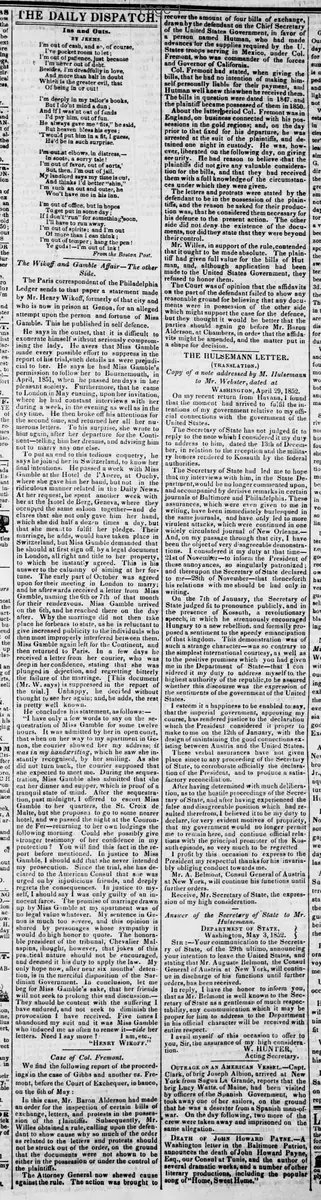
We find the following report of the proceedings in the case of Gibbs and another vs. Fremont, before the Court of Exchequer, in banco, on the 6th of May:
In this case, Mr. Baron Alderson had made an order for the inspection of certain bills of exchange, letters, and protests in the possession of the Plaintiffs. Subsequently, Mr. Willes obtained a rule, calling upon the defendant to show cause why so much of the order as related to the letters and protests should not be struck out of the order, on the ground that the documents were not shown to be either in the possession or under the control of the plaintiffs.
The Attorney General now showed cause against the rule. The action was brought to recover the amount of four bills of exchange, drawn by the defendant on the Chief Secretary of the United States Government, in favor of a person named Hutman, who had made advances for the supplies required by the U. States troops serving in Mexico, under Col. Fremont, who was commander of the forces and Governor of California.
Col. Fremont had stated, when giving the bills, that he had no intention of making himself personally liable for their payment, and Hutman well knew this when he received them. The bills in question were dated in 1847, and the plaintiff became possessed of them in 1850. About the latter period Col. Fremont was in England, on business connected with his possessions in the gold regions; and, on the day prior to that fixed for his departure, he was arrested at the suit of the plaintiffs, and detained one night in custody. He was, however, liberated on the following day, on giving security. He had reason to believe that the plaintiffs did not give any valuable consideration for the bills, and that they had received them with a full knowledge of the circumstances under which they were given.
The letters and protests were stated by the defendant to be in the possession of the plaintiffs, and the reason he asked for their production was, that he considered them necessary for his defence to the present action. The other side did not deny the existence of the documents, nor did they state that they were beyond their control.
Mr. Willes, in support of the rule, contended that it ought to be made absolute. The plaintiff had given full value for the bills of Hutman, and, although application had been made to the United States Government, they refused to honor them.
The Court was of opinion that the affidavits on the part of the defendant failed to show any reasonable ground for believing that any documents were in possession of the other side which might support the case for the defence, but they thought it would be better that the parties should again go before Mr. Baron Alderson, at Chambers, in order that the affidavits might be amended, and the matter put in a shape for decision.
What sub-type of article is it?
What themes does it cover?
What keywords are associated?
What entities or persons were involved?
Where did it happen?
Story Details
Key Persons
Location
Court Of Exchequer, In Banco
Event Date
6th Of May
Story Details
Legal dispute over four bills of exchange drawn by Col. Fremont in 1847 on the U.S. Government for supplies in Mexico, transferred to plaintiffs in 1850. Fremont denies personal liability, claims plaintiffs knew circumstances, and seeks production of letters and protests for defense. Court rules to amend affidavits before Baron Alderson.