Thank you for visiting SNEWPapers!
Sign up free
Anti Slavery Bugle
New Lisbon, Salem, Columbiana County, Ohio
What is this article about?
Colonel Mason's 1848 dispatch details his visit to California's Sacramento gold mines, describing the discovery by Marshall at Sutter's sawmill, mining operations yielding high daily profits, societal upheaval with desertions and economic boom, and recommendations for a mint and garrison increases.
Merged-components note: Direct textual continuation of Colonel Mason's dispatch on the California gold mines and related government considerations across pages 1 and 2; original label of second component as foreign_news is incorrect as content is domestic/U.S.-focused exploration report.
Clippings
1 of 2
OCR Quality
Full Text
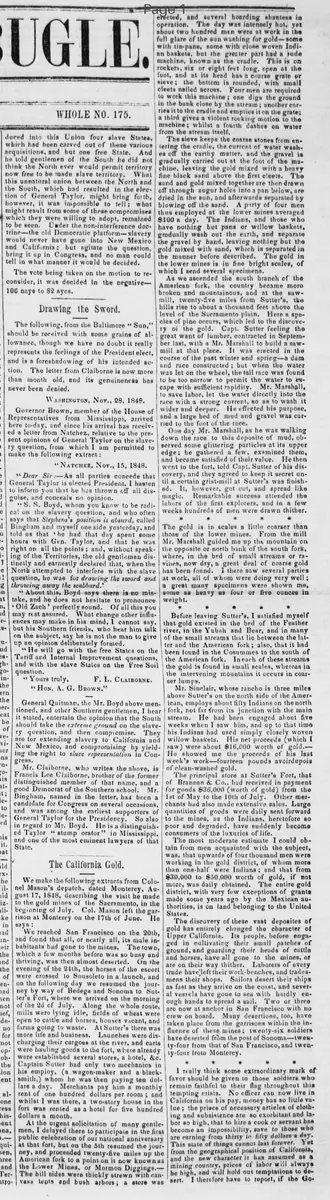
We make the following extracts from Colonel Mason's dispatch, dated Monterey, August 17, 1848, describing the visit he made to the gold mines of the Sacramento, in the beginning of July. Col. Mason left the garrison at Monterey on the 17th of June. He says:
We reached San Francisco on the 20th, and found that all, or nearly all, its male inhabitants had gone to the mines. The town, which a few months before was so busy and thriving, was then almost deserted. On the evening of the 24th, the horses of the escort were crossed to Saucelito in a launch, and on the following day we resumed the journey by way of Bodega and Sonoma to Sutter's Fort, where we arrived on the morning of the 2d of July. Along the whole route, mills were lying idle, fields of wheat were open to cattle and horses, houses vacant, and farms going to waste. At Sutter's there was more life and business. Launches were discharging their cargoes at the river, and carts were hauling goods to the fort, where already were established several stores, a hotel, &c. Captain Sutter had only two mechanics in his employ, (a wagon-maker and a blacksmith,) whom he was then paying ten dollars a day. Merchants pay him a monthly rent of one hundred dollars per room; and whilst I was there, a two-story house in the fort was rented as a hotel for five hundred dollars a month.
At the urgent solicitation of many gentlemen, I delayed there to participate in the first public celebration of our national anniversary at that fort, but on the 5th resumed the journey, and proceeded twenty-five miles up the American fork to a point on it now known as the Lower Mines, or Mormon Diggings. The hillsides were thickly strewn with canvas tents and bush arbors; a store was erected, and several boarding shanties in operation. The day was intensely hot, yet about two hundred men were at work in the full glare of the sun washing for gold—some with tin-pans, some with close woven Indian baskets, but the greater part had a rude machine, known as the cradle. This is on rockers, six or eight feet long, open at the foot, and at its head has a coarse grate or sieve; the bottom is rounded, with small cleets nailed across. Four men are required to work this machine; one digs the ground in the bank close by the stream; another carries it to the cradle and empties it on the grate: a third gives a violent rocking motion to the machine; whilst a fourth dashes on water from the stream itself. The sieve keeps the coarse stones from entering the cradle, the current of water washes off the earthy matter, and the gravel is gradually carried out at the foot of the machine, leaving the gold mixed with a heavy fine black sand above the first cleets. The sand and gold mixed together are then drawn off through augur holes into a pan below, are dried in the sun, and afterwards separated by blowing off the sand. A party of four men thus employed at the lower mines averaged $100 a day. The Indians, and those who have nothing but pans or willow baskets, gradually wash out the earth, and separate the gravel by hand, leaving nothing but the gold mixed with sand, which is separated in the manner before described. The gold in the lower mines is in fine bright scales, of which I send several specimens.
As we ascended the south branch of the American fork, the country became more broken and mountainous, and at the saw-mill, twenty-five miles from Sutter's, the hills rise to about a thousand feet above the level of the Sacramento plain. Here a species of pine occurs, which led to the discovery of the gold. Capt. Sutter feeling the great want of lumber, contracted in September last, with a Mr. Marshall to build a saw-mill at that place. It was erected in the course of the past winter and spring—a dam and race constructed; but when the water was let on the wheel, the tail race was found to be too narrow to permit the water to escape with sufficient rapidity. Mr. Marshall, to save labor, let the water directly into the race with a strong current, so as to wash it wider and deeper. He effected his purpose, and a large bed of mud and gravel was carried to the foot of the race. One day Mr. Marshall, as he was walking down the race to this deposit of mud, observed some glittering particles at its upper edge; he gathered a few, examined them, and became satisfied of their value. He then went to the fort, told Capt. Sutter of his discovery, and they agreed to keep it secret until a certain grist-mill at Sutter's was finished. It, however, got out, and spread like magic. Remarkable success attended the labors of the first explorers, and in a few weeks hundreds of men were drawn thither. The gold is in scales a little coarser than those of the lower mines. From the mill Mr. Marshall guided me up the mountain on the opposite or north bank of the south fork, where, in the bed of small streams or ravines, now dry, a great deal of coarse gold has been found. I there saw several parties at work, all of whom were doing very well; a great many specimens were shown me, some as heavy as four or five ounces in weight.
Before leaving Sutter's, I satisfied myself that gold existed in the bed of the Feather river, in the Yuba and Bear, and in many of the small streams that lie between the latter and the American fork: also, that it had been found in the Cosumnes to the south of the American fork. In each of these streams the gold is found in small scales, whereas in the intervening mountains it occurs in coarser lumps.
Mr. Sinclair, whose rancho is three miles above Sutter's on the north side of the American, employs about fifty Indians on the north fork, not far from its junction with the main stream. He had been engaged about five weeks when I saw him, and up to that time his Indians had used simply closely woven willow baskets. His net proceeds (which I saw) were about $16,000 worth of gold. He showed me the proceeds of his last week's work—fourteen pounds avoirdupois of clean-washed gold.
The principal store at Sutter's Fort, that of Brannan & Co., had received in payment for goods $36,000 (worth of gold) from the 1st of May to the 10th of July. Other merchants had also made extensive sales. Large quantities of goods were daily sent forward to the mines, as the Indians, heretofore so poor and degraded, have suddenly become consumers of the luxuries of life.
The most moderate estimate I could obtain from men acquainted with the subject, was, that upwards of four thousand men were working in the gold district, of whom more than one-half were Indians; and that from $30,000 to $50,000 worth of gold, if not more, was daily obtained. The entire gold district, with very few exceptions of grants made some years ago by the Mexican authorities, is on land belonging to the United States.
The discovery of these vast deposits of gold has entirely changed the character of Upper California. Its people, before engaged in cultivating their small patches of ground, and guarding their herds of cattle and horses, have all gone to the mines, or are on their way thither. Laborers of every trade have left their work-benches, and tradesmen their shops. Sailors desert their ships as fast as they arrive on the coast, and several vessels have gone to sea with hardly enough hands to spread a sail. Two or three are now at anchor in San Francisco with no crew on board. Many desertions, too, have taken place from the garrisons within the influence of these mines; twenty-six soldiers have deserted from the post of Sonoma—twenty-four from that of San Francisco, and twenty-four from Monterey.
I really think some extraordinary mark of favor should be given to those soldiers who remain faithful to their flag throughout this tempting crisis. No officer can now live in California on his pay, money has so little value; the prices of necessary articles of clothing and subsistence are so exorbitant and labor so high, that to hire a cook or servant has become an impossibility, save to those who are earning from thirty to fifty dollars a day.
This state of things cannot last forever. Yet from the geographical position of California, and the new character it has assumed as a mining country, prices of labor will always be high, and will hold out temptations to desert. I therefore have to report, if the Government will manifest a determination to protect the rights of the United States, and put an end to desertions, that a small addition to the garrison of California will enable the commanding officer to maintain order, and to punish crime, and that the acquisition of California is worth a large expenditure.
Government wish to prevent desertions here on the part of men, and to secure zeal on the part of officers, their pay must be increased very materially.
Mr. Dye, a gentleman residing in Monterey, and worthy of every credit, has just returned from Feather River. He tells me that the company to which he belonged worked seven weeks and two days, with an average of fifty Indians (washers), and that their gross product was two hundred and seventy-three pounds of gold. His share (one-seventh), after paying all expenses, is about thirty-seven pounds, which he brought with him and exhibited in Monterey. I see no laboring man from the mines who does not show his two, three, or four pounds of gold. A soldier of the artillery company returned here a few days ago from the mines, having been absent on furlough twenty days. He made by trading and working during that time $1,500. During these twenty days he was travelling ten or eleven days, leaving but a week, in which he made a sum of money greater than he received in pay, clothes and rations, during a whole enlistment of five years.
Gold is also believed to exist on the eastern slope of the Sierra Nevada; and when at the mines I was informed by an intelligent Mormon, that it had been found near the Great Salt Lake by some of his fraternity. Nearly all the Mormons are leaving California to go to the Salt Lake; and this they surely would not do, unless they were sure of finding gold there in the same abundance as they now do on the Sacramento.
The gold 'placer' near the mission of San Fernando has long been known, but has been little wrought for want of water. This is in a spur that puts off from the Sierra Nevada (see Fremont's map), the same in which the present mines occur. There is, therefore, every reason to believe, that in the intervening spaces of five hundred miles (entirely unexplored) there must be many hidden and rich deposites. The 'placer' gold is now substituted as the currency of this country.
I would recommend that a mint be established at some eligible point of the bay of San Francisco; and that machinery and all the necessary apparatus and workmen, be sent on by sea. These workmen must be bound by high wages; and even bonds to secure their faithful services, else the whole plan may be frustrated by their going to the mines as soon as they arrive in California.
Before leaving the subject of mines I will mention, that on my return from the Sacramento, I touched at New Almadén the quicksilver mine of Mr. Alexander Forbes, Consul of her Britannic Majesty at Tepic. This mine is in a spur of mountains one thousand feet above the level of the Bay of San Francisco, and is distant in a southern direction from the Pueblo de San José about twelve miles. The ore (cinnabar) occurs in a large vein dipping at a strong angle to the horizon. Mexican miners are employed in working it, and driving shafts, and galleries about six feet by seven, following the vein.
The fragments of rock and ore are removed on the backs of Indians, in a raw-hide sacks. The ore is then hauled in an ox-wagon, from the mouth of the mine down to a valley well supplied with wood and water, in which the furnaces are situated. The furnaces are of the simplest construction—exactly like a common bake oven, in the crown of which is inserted a whaler's trying-kettle: another inverted kettle forms the lid. From a hole in the lid a small brick channel leads to an apartment, or chamber, in the bottom of which is inserted a small iron kettle. This chamber has a chimney.
In the morning of each day the kettles are filled with the mineral (broken in small pieces) mixed with lime; fire is then applied and kept up all day. The mercury is volatilized, passes into the chamber, is condensed on the sides and bottom of the chamber, and flows into the pot prepared for it. No water is used to condense the mercury.
During a visit I made last spring, four such ovens were in operation, and yielded in the two days I was there, six hundred and fifty pounds of quicksilver, worth at Mazatlán $1.80 per lb. Mr. Walkinshaw, the gentleman now in charge of the mine, tells me that the vein is improving, and that he can afford to keep his people employed even in these extraordinary times. This mine is very valuable of itself, and becomes the more so as mercury is extensively used in obtaining gold. It is not at present used in California for that purpose, but it will be at some future time. When I was at this mine last spring, other parties were engaged in searching for veins; but none have been discovered that are worth following up, although the earth in that whole range of hills are highly discolored, indicating the presence of this ore. I send several beautiful specimens, properly labelled. The amount of quicksilver in Mr. Forbes' vats on the 15th of July was about two thousand five hundred lbs.
What sub-type of article is it?
What themes does it cover?
What keywords are associated?
What entities or persons were involved?
Where did it happen?
Story Details
Key Persons
Location
California, Sacramento Gold Mines, Sutter's Fort, American Fork, Monterey, San Francisco
Event Date
1848
Story Details
Colonel Mason visits the newly discovered gold mines in July 1848, details the accidental discovery by Marshall at Sutter's sawmill, describes mining techniques and yields up to $100/day per group, societal impacts including desertions and economic boom, and notes potential for more deposits; also describes the New Almaden quicksilver mine.