Thank you for visiting SNEWPapers!
Sign up free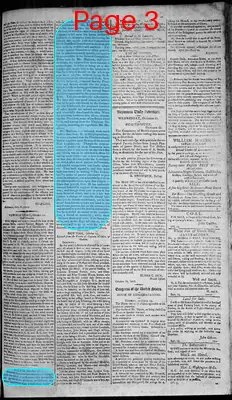
Editorial
October 19, 1803
Alexandria Daily Advertiser
Alexandria, Virginia
What is this article about?
An editorial defends Alexander Hamilton and John Adams against accusations of favoring monarchy, citing their roles in the Constitutional Convention, support for the Constitution via The Federalist, and ongoing advocacy, while criticizing opponents for undermining it.
Clipping
OCR Quality
95%
Excellent
Full Text
SALEM, October 13.
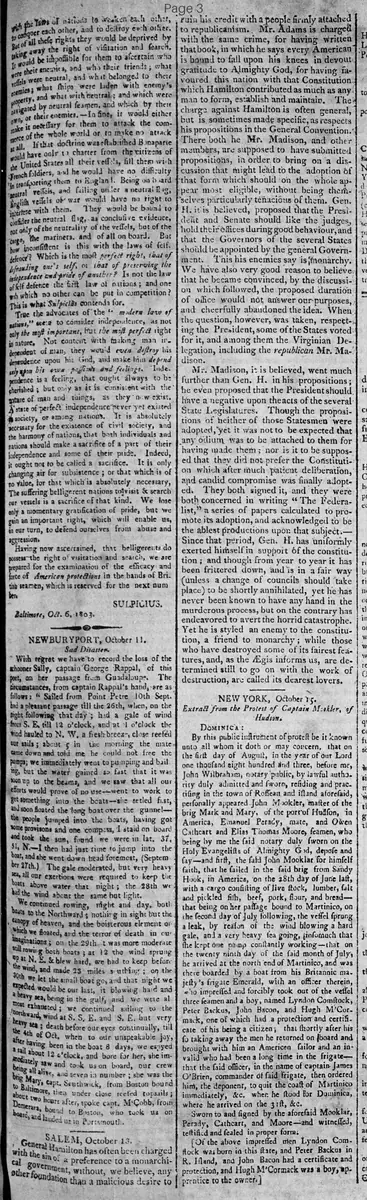
General Hamilton has often been charged with the sin of a preference to a monarchical government, without, we believe, any other foundation than a malicious desire to ruin his credit with a people firmly attached to republicanism. Mr. Adams is charged with the same crime, for having written that book, in which he says every American is bound to fall upon his knees in devout gratitude to Almighty God, for having favoured this nation with that Constitution which Hamilton contributed as much as any man to form, establish and maintain. The charge against Hamilton is often general, but is sometimes made specific, as respects his propositions in the General Convention. There both he, Mr. Madison, and other members, are supposed to have submitted propositions, in order to bring on a discussion that might lead to the adoption of that form which should on the whole appear most eligible, without being themselves particularly tenacious of them. Gen. H. it is believed, proposed that the President and Senate should like the judges, hold their offices during good behaviour, and that the Governors of the several States should be appointed by the general Government. This his enemies say is monarchy. We have also very good reason to believe that he became convinced, by the discussion which followed, the proposed duration of office would not answer our purposes, and cheerfully abandoned the idea. When the question, however, was taken, respecting the President, some of the States voted for it, and among them the Virginian Delegation, including the republican Mr. Madison. 5.. 7 Mr. Madison, it is believed, went much further than Gen. H. in his propositions; he even proposed that the President should have a negative upon the acts of the several State Legislatures. Though the propositions of neither of those Statesmen were adopted, yet it was not to be expected that any odium was to be attached to them for having made them; nor is it to be supposed that they did not prefer the Constitution which after much patient deliberation, and candid compromise was finally adopted. They both signed it, and they were both concerned in writing "The Federalist," a series of papers calculated to promote its adoption, and acknowledged to be the ablest productions upon that subject.-- Since that period, Gen. H. has uniformly exerted himself in support of the constitution; and though from year to year it has been frittered down, and is in a fair way (unless a change of councils should take place) to be shortly annihilated, yet he has never been known to have any hand in the murderous process, but on the contrary has endeavored to avert the horrid catastrophe. Yet he is styled an enemy to the constitution, a friend to monarchy; while those who have destroyed some of its fairest features, and, as the Aegis informs us, are determined still to go on with the work of destruction, are called its dearest lovers.
General Hamilton has often been charged with the sin of a preference to a monarchical government, without, we believe, any other foundation than a malicious desire to ruin his credit with a people firmly attached to republicanism. Mr. Adams is charged with the same crime, for having written that book, in which he says every American is bound to fall upon his knees in devout gratitude to Almighty God, for having favoured this nation with that Constitution which Hamilton contributed as much as any man to form, establish and maintain. The charge against Hamilton is often general, but is sometimes made specific, as respects his propositions in the General Convention. There both he, Mr. Madison, and other members, are supposed to have submitted propositions, in order to bring on a discussion that might lead to the adoption of that form which should on the whole appear most eligible, without being themselves particularly tenacious of them. Gen. H. it is believed, proposed that the President and Senate should like the judges, hold their offices during good behaviour, and that the Governors of the several States should be appointed by the general Government. This his enemies say is monarchy. We have also very good reason to believe that he became convinced, by the discussion which followed, the proposed duration of office would not answer our purposes, and cheerfully abandoned the idea. When the question, however, was taken, respecting the President, some of the States voted for it, and among them the Virginian Delegation, including the republican Mr. Madison. 5.. 7 Mr. Madison, it is believed, went much further than Gen. H. in his propositions; he even proposed that the President should have a negative upon the acts of the several State Legislatures. Though the propositions of neither of those Statesmen were adopted, yet it was not to be expected that any odium was to be attached to them for having made them; nor is it to be supposed that they did not prefer the Constitution which after much patient deliberation, and candid compromise was finally adopted. They both signed it, and they were both concerned in writing "The Federalist," a series of papers calculated to promote its adoption, and acknowledged to be the ablest productions upon that subject.-- Since that period, Gen. H. has uniformly exerted himself in support of the constitution; and though from year to year it has been frittered down, and is in a fair way (unless a change of councils should take place) to be shortly annihilated, yet he has never been known to have any hand in the murderous process, but on the contrary has endeavored to avert the horrid catastrophe. Yet he is styled an enemy to the constitution, a friend to monarchy; while those who have destroyed some of its fairest features, and, as the Aegis informs us, are determined still to go on with the work of destruction, are called its dearest lovers.
What sub-type of article is it?
Constitutional
Partisan Politics
What keywords are associated?
Hamilton Defense
Adams Charges
Constitutional Convention
Monarchy Accusations
Federalist Papers
Republicanism
What entities or persons were involved?
General Hamilton
Mr. Adams
Mr. Madison
Virginian Delegation
Editorial Details
Primary Topic
Defense Of Hamilton And Adams Against Monarchism Charges
Stance / Tone
Strongly Supportive Of Hamilton And Adams, Critical Of Accusers
Key Figures
General Hamilton
Mr. Adams
Mr. Madison
Virginian Delegation
Key Arguments
Charges Against Hamilton And Adams Lack Foundation Beyond Malice
Hamilton Proposed Lifetime Offices For President And Senate, But Abandoned After Discussion
Madison Proposed Even Stronger Measures, Like Presidential Veto Over State Laws
Both Signed The Final Constitution After Deliberation And Compromise
Both Contributed To The Federalist To Promote Adoption
Hamilton Has Consistently Supported The Constitution Against Erosion
Accusers Are The True Enemies Undermining Its Features