Thank you for visiting SNEWPapers!
Sign up free
The Evening Telegraph
Philadelphia, Philadelphia County, Pennsylvania
What is this article about?
Boiler explosion at Geasey & Ward's mill on Sansom Street, Philadelphia, last Thursday evening kills at least 19, with ongoing recovery of remains and coroner's inquest. Relief efforts raise funds for victims' families. Scientific theory proposes distilled water caused the blast.
Merged-components note: Text on explosion theory directly continues the Sansom Street disaster report; sequential reading order supports merge into single domestic_news component.
Clipping
OCR Quality
Full Text
[FOR ADDITIONAL LOCAL ITEMS SEE INSIDE PAGES.]
THE SANSOM STREET DISASTER.
ADDITIONAL PARTICULARS—RECOVERY OF MORE REMAINS—THE CORONER'S INVESTIGATION—THEORIES OF THE EXPLOSION, ETC.
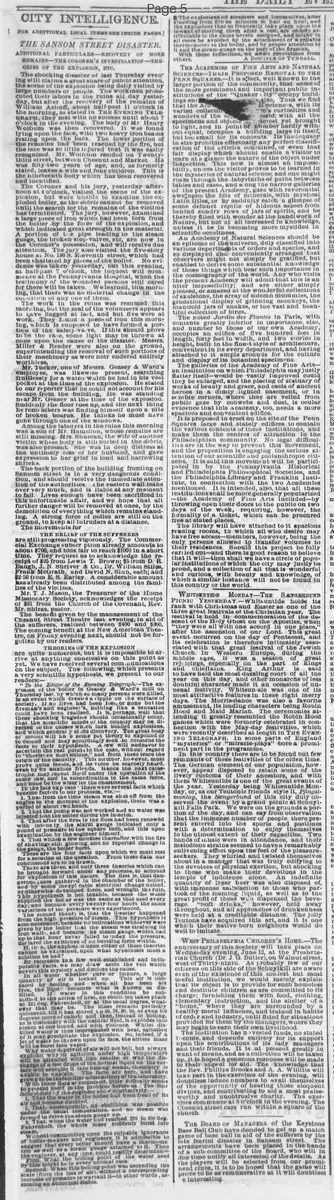
The shocking disaster of last Thursday evening still claims a great share of public attention, the scene of the explosion being daily visited by large numbers of people. The workmen prosecuted their labors in the ruins all day yesterday, but after the recovery of the remains of William Achuff, about half-past 11 o'clock in the morning, as stated in The Evening Telegraph, they met with no success until about 7 o'clock in the evening. The body of Mr. Henry Wolfrom was then recovered. It was found lying upon the face, with two heavy iron beams resting upon the back. The lower portion of the remains had been reached by the fire, but the face was so little injured that it was easily recognized. Mr. Wolfrom resided on Twenty-third street, between Chestnut and Market. He was fifty-two years of age, and, as formerly stated, leaves a wife and four children. This is the nineteenth body which has been recovered and identified.
The Coroner and his jury, yesterday afternoon at 4 o'clock, visited the scene of the explosion, but were unable to examine the exploded boiler, as the debris cannot be removed until the search for the remains of the victims has terminated. The Jury, however, examined a large piece of iron which had been torn from the boiler by the force of the explosion, and which indicated great strength in the material. A portion of the pipe leading to the steam gauge, the broken stop-valves, etc., are now in the Coroner's possession, and will receive due attention. The jury also visited the five-story house at No. 136 S. Eleventh street, which had been shattered by pieces of the boiler. No evidence was taken yesterday, but this evening, at half-past 7 o'clock, the inquest will commence at the Pennsylvania Hospital, when the testimony of the wounded persons still cared for there will be taken. We learned, this morning, that there was no material change in the condition of any one of them.
The work in the ruins was resumed this morning, but the zeal of the volunteers appears to have flagged at last, and but five were at work. They found a piece of iron this morning, which is supposed to have formed a portion of the safety-valve. If this should prove to be the case, some light may be thrown at once upon the cause of the disaster. Messrs. Miller & Reader were also on the ground, superintending the removal of such portions of their machinery as were not rendered entirely worthless.
Mr. Tucker, one of Messrs. Geasey & Ward's employes, was likewise present, searching fruitlessly for a watch which he had in his vest pocket at the time of the explosion. He stated to our reporter that he could not account for his escape from the building. He was standing near Mr. Geasey at the time of the explosion. Suddenly the floor rose up, and the next thing he remembers was finding himself upon a pile of broken boards. He thinks he must have gone through one of the windows.
Among the laborers in the ruins this morning was a son of Mr. Hamilton, whose remains are still missing. Mrs. Shuman, the wife of another victim whose body is still buried in the debris, was also present. She was in deep distress at the untimely loss of her husband, and gave expression to her grief in loud and harrowing shrieks.
The back portion of the building fronting on Sansom street is in a very dangerous condition, and should receive the immediate attention of the authorities. The eastern wall leans over very much, and is liable at any moment to fall. Lives enough have been sacrificed in this unfortunate affair, and we hope that all further danger will be removed at once, by the demolition of everything which remains standing. A strong force of police are still on the ground, to keep all intruders at a distance.
THE RELIEF OF THE SUFFERERS
are still progressing vigorously. The Commercial Exchange subscription already amounts to about $700, and bids fair to reach $1000 in a short time. They request us to acknowledge the receipt of $25 from Lewis T. Brown; $5 from D. R. Baugh, J. N. Shriver & Co., Dr. William Stiles, Frank McGrath, and David N. Sinn, each; and $2.50 from E. S. Earley. A considerable amount has already been distributed among the families of the victims.
Mr. T. J. Mason, the Treasurer of the Home Missionary Society, acknowledges the receipt of $31 from the Church of the Covenant, Rev. Mr. Shiras, pastor.
The benefit given by the management of the Chestnut Street Theatre last evening, in aid of the sufferers, realized between $400 and $500.
The coming benefit at the New American Theatre, on Friday evening next, should not be forgotten by our readers.
THEORIES OF THE EXPLOSION
are quite numerous, but it is impossible to arrive at anything conclusive on this point as yet. We have received several communications on the subject. The following, which presents a very scientific hypothesis, we present to our readers:-
"To the Editor of the Evening Telegraph:-
The explosion of the boiler in Geasey & Ward's mill on Thursday last, by which so many persons were killed, is an event which creates a ripple on the surface of society. If no lives had been lost, or none but the fireman's and engineer's, nothing like a sensation could have been realized. It is, perhaps, well that these shocking tragedies should occasionally occur, that the scientific minds of the country may be directed to the causes which lurk behind explosions, and which generally elude discovery. The great body of savants will have some pet theory to expound or facts to their hypothesis. A few will endeavor to ascertain the real points in the case, without regard to the origin of the casualty. This number, however, must be cherished convictions prove quite feeble and voice scarcely heard even by its anxious friends. Hence the next catastrophe may repeat itself under the operation the and none the wiser for the chastisement became factors in our problem, viz.—
In the late explosion there were several facts which
1. That from the time steam was shut off from the engine to the moment of the explosion, there was a period of about two hours.
2. That the pump was not worked and no water was injected into the boiler during the interim.
3. That after the fires in the flues had been renewed with intensity, the alarm gauge indicated only a pound of pressure to the square inch, and this upon examination the engineer himself
4. That within a few minutes thereafter, with the fire of shavings still glowing, and no reported change in the gauge, the boiler burst.
These are the four facts upon which we must rest for a solution of the question.
From these data our conclusions are to be drawn.
There are three, and only three theories which can be brought forward under any pretense, to account for explosions of this nature. The first is, that dangerous gases gathered in the chamber of the boiler, otherwise developed force and wrought the ruin
This hypothesis is not tenable, because the water supplied the boiler was the same as that used every day, and because every twenty-four hours the same variations of temperature were experienced.
The second theory is, that the disaster happened from the high pressure of steam. This hypothesis is also untenable, because no intimations whatever were given from walls, and because the steam gauge, which had given boiler that steam straining declared the existence of no bursting force within. that hour never
If, then, the explosion upon either of these theories cannot be explained, upon what hypothesis must a solution be had?
By reference to a few well-established and indisputable facts, we may draw aside the veil which covers this mystery and disclose the cause
In all water whether pure or impure, a large quantity of air is locked up. This air is liberated by boiling, and when all has been set free, the liquid becomes what is known as distilled. If water in this condition admitted to the action of heat, no ebullition takes place till at 212 deg. Fahrenheit, or at the usual degree, whatever that may be. The mass remains perfectly quiescent till it has stored even degrees more of caloric and then, instead of boiling, steam at one bound, and with violence. Whilst distilled water is thus impregnated with heat, agitation may precipitate the explosion jet of water be thrown upon its face, the airless mass will be burst into vapor.
Why water deprived of air will not boil, but always explode why agitation under high charge of a few drops of the normal liquid on the sur- will be attended with like results; or why the dis- unable to explain. The facts are here, and have energize hissing steam chemistry
With these data at command, little difficulty seems the familiar admonitions laboratory before facts stated by the engineer show conclusively:
1. That the water in the boiler had been freed of its air and become distilled.
2. That, consequently, no ebullition was possible formed to drive the steam gauge up, under the usual temperature, and no steam was
3. That, when the water had reached 270 to 300 deg. Fahrenheit, the whole mass suddenly burst into steam.
Without commenting upon the culpable ignorance of boiler-makers and engineers, it is admissible to suggest that every boiler should have a thermometer the engineer, at any time, could readily determine.- gauge by him might be in every normal case.
First. What the boiling point of the water used
Second. When this boiling point was ascending the scale (from the loss of air), without a corresponding increase of pressure to warrant it-in other words, assuming an abnormal status.
The explosions on steamers and locomotives, after standing from fifteen minutes to half an hour, and the explosions that so frequently take place upon the instant of starting them after a rest, are chiefly attributable to the cause herein assigned, and might in all cases be avoided by the attachment of a reliable thermometer to the boiler, and by proper attention to it and the steam-gauge on the part of the fireman.
With these reflections, we await revelations from others.
A DISCIPLE OF TYNDALL
What sub-type of article is it?
What keywords are associated?
What entities or persons were involved?
Where did it happen?
Domestic News Details
Primary Location
Sansom Street, Philadelphia
Event Date
Last Thursday Evening
Key Persons
Outcome
nineteen bodies recovered and identified; additional remains missing; wounded stable at pennsylvania hospital; relief funds exceed $700 from commercial exchange, $31 from church of the covenant, $400-500 from chestnut street theatre benefit; upcoming benefit at new american theatre.
Event Details
Boiler explosion at Geasey & Ward's mill on Sansom Street; recovery of bodies including William Achuff and Henry Wolfrom; coroner's jury inspects site and debris; inquest to begin at Pennsylvania Hospital; search for safety-valve piece; building remains dangerous; relief efforts ongoing with subscriptions and benefits; scientific letter proposes explosion due to distilled water in boiler lacking air, suggesting thermometer use.