Thank you for visiting SNEWPapers!
Sign up free
The Columbian
Bloomsburg, Columbia County, Pennsylvania
What is this article about?
Newspaper introduces Benjamin Butler's letter declining appointment as chairman of a congressional committee investigating Southern affairs, citing its origins in Democratic-Republican alliance, ineffectiveness, and potential harm to the Republican Party amid post-Civil War tensions.
Merged-components note: These two components contain the continuous text of Benjamin Butler's letter/manifesto to Republicans; sequential reading orders and adjacent bounding boxes confirm they form a single logical unit.
Clipping
OCR Quality
Full Text
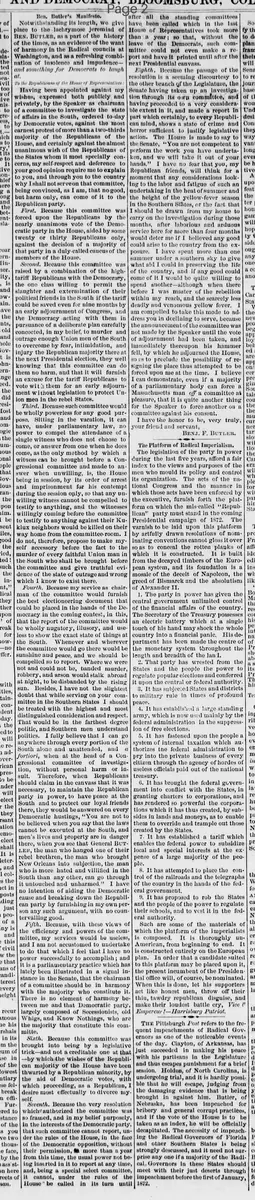
To the Republicans of the House of Representatives:
Having been appointed against my wishes, expressed both publicly and privately, by the Speaker as chairman of a committee to investigate the state of affairs in the South, ordered to-day by Democratic votes, against the most earnest protest of more than a two-thirds majority of the Republicans of the House, and certainly against the almost unanimous wish of the Republicans of the States whom it most specially concerns, my self-respect and deference to your good opinion require me to explain to you, and through you to the country why I shall not serve on that committee, being convinced, as I am, that no good, but harm only, can come of it to the Republican party.
First. Because this committee was forced upon the Republicans by the nearly unanimous vote of the Democratic party in the House, aided by some twenty or thirty Republicans only, against the decision of a majority of that party in a duly-called caucus of the members of the House.
Second, Because this committee was raised by a combination of the high tariff Republicans with the Democracy, the one class willing to permit the slaughter and extermination of their political friends in the South if the tariff could be saved even for nine months by an early adjournment of Congress, and the Democracy acting with them in pursuance of a deliberate plan carefully concocted, in my belief, to murder and outrage enough Union men of the South to overcome by fear, intimidation, and injury the Republican majority there at the next Presidential election, they well knowing that this committee can do them no harm, and that it will furnish an excuse for the tariff Republicans to vote with them for an early adjournment without legislation to protect Union men in the rebel States.
Third. Because such committee would be wholly powerless for any good purpose. Sitting in the vacation, it can have, under parliamentary law, no power to compel the attendance of a single witness who does not choose to come, or answer from one when he does come, as the only method by which a witness can be brought before a Congressional committee and made to answer when unwilling, is, the House being in session, by its order of arrest and imprisonment for his contempt during the session only, so that any unwilling witness cannot be compelled to testify to anything, and the witnesses willingly coming before the committee to testify to anything against their Ku-klux neighbors would be killed on their way home from the committee-room. I do not, therefore, propose to make myself accessory before the fact to the murder of every faithful Union man in the South who shall be brought before the committee and give truthful evidence of the state of outrage and wrong which I know to exist there.
Fourth, Because my service as chairman of the committee would furnish the best electioneering document that could be placed in the hands of the Democracy in the coming contest, in this, that the report of the committee would be wholly nugatory, illusory, and useless to show the exact state of things at the South. Whenever and wherever the committee would go there would be sunshine and peace, and we should be compelled so to report. Where we were not and could not be, banded murder, robbery, and arson would stalk abroad at night, to be disbanded by the rising sun. Besides, I have not the slightest doubt that while serving on your committee in the Southern States I should be treated with the highest and most distinguished consideration and respect. That would be in the farthest degree politic, and Southern men understand politics. I fully believe that I can go anywhere through every portion of the South alone and unattended, and a fortiori, when at the head of a Congressional committee of investigation, without personal harm or insult. Therefore, when Republicans should claim in the canvass that it was necessary, to maintain the Republican party in power, to have peace at the South and to protect our loyal friends there, they would be answered on every Democratic hustings, "You are not to be believed when you say that the laws cannot be executed at the South, and men's lives and property are in danger there, when you see that General Butler, the man who hanged one of their rebel brethren, the man who brought New Orleans into subjection, the man who is more hated and vilified in the South than any other, can go through it untouched and unharmed." I have no intention of aiding the Democratic cause and breaking down the Republican party by furnishing in my own person any such argument, with no countervailing good.
Fifth. Because, with these views of the efficiency and powers of the committee, my services would be useless, and I am not accustomed to undertake to do that which I feel that I have no power successfully to accomplish; and it is a parliamentary practice which has lately been illustrated in a signal instance in the Senate, that the chairman of a committee should be in harmony with the majority who constitute it. There is no element of harmony between me and that Democratic party, largely composed of Secessionists, old Whigs, and Know Nothings, who are the majority that constitute this committee.
Sixth. Because this committee was brought into being by a legislative trick—and not a creditable one at that—by which the wishes of the Republican majority of the House have been thwarted by a Republican minority, by the aid of Democratic votes, with which proceeding, as a Republican, I desire most effectually to divorce myself.
Seventh. Because the very resolution which authorized the committee was so framed, and in my belief purposely, in the interests of the Democratic party, that such committee cannot report, under the rules of the House, in the face of the Democratic opposition, without their permission, more than a year from this time, the usual power not being inserted in it to report at any time, and, being a special select committee, it cannot, under the rules of the House be called in its turn until after all the standing committees have been called which in the last House of Representatives took more than a year: so that, without the leave of the Democrats, such committee could not even make a report and have it printed until after the next Presidential canvass.
Eighth. Because the passage of the resolution is a seeming discourtesy to the other branch of the Legislature, the Senate having taken up an investigation through its own committee, and having proceeded to a very considerable extent in it, and made a report in part which certainly, to every Republican mind, shows a state of crime and horror sufficient to justify legislative action. The House is made to say to the Senate, "You are not competent to perform the work you have undertaken, and we will take it out of your hands." I have no fear that you, my Republican friends, will think for a moment that any considerations looking to the labor and fatigue of such an undertaking in the heat of summer and the height of the yellow-fever season in the Southern States, or the fact that I should be drawn from my home to carry on the investigation during those months, after laborious and arduous service here for more than four months would deter me if I believed any good could arise to the country from the exposure. I have spent more than one summer under a southern sky to give what aid I could in preserving the life of the country, and if any good could come of it I would be quite willing to spend another—although when there before I was master of the rebellion within my reach, and the scarcely less deadly and venomous yellow fever, I am compelled to take this mode to address you in declining to serve, because the announcement of the committee was not made by the Speaker until the vote of adjournment had been taken, and immediately thereupon his hammer fell, by which he adjourned the House, so as to preclude the possibility of resigning the place thus attempted to be forced upon me at the time. I believe I can demonstrate, even if a majority of a parliamentary body can force a Massachusetts man off a committee at pleasure, that it is quite another thing for the Speaker to force another on a committee against his consent.
I have the honor to be, very truly, your friend and servant,
BENJ. F. BUTLER.
What sub-type of article is it?
What themes does it cover?
What keywords are associated?
What entities or persons were involved?
Letter to Editor Details
Author
Benj. F. Butler
Recipient
To The Republicans Of The House Of Representatives
Main Argument
benjamin butler declines his appointment as chairman of a congressional committee investigating southern affairs, arguing it was forced by democrats and tariff republicans, will be ineffective and powerless, endanger witnesses, harm the republican party electorally, and serve democratic interests without achieving protection for union men in the south.
Notable Details