Thank you for visiting SNEWPapers!
Sign up free
Editorial
August 30, 1810
Alexandria Daily Gazette, Commercial & Political
Alexandria, Virginia
What is this article about?
The Connecticut Courant editorial criticizes President Thomas Jefferson's unauthorized appointment of William Short as minister plenipotentiary to Russia in 1808, without Senate consent or congressional provision, violating the Constitution. It highlights illegal payments of nearly $4,000 to Short and hopes it is the last such instance.
Clipping
OCR Quality
92%
Excellent
Full Text
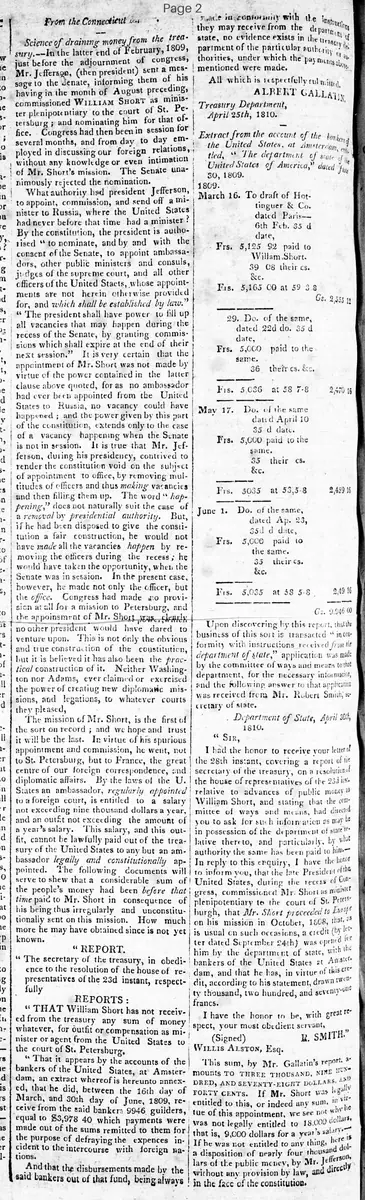
From the Connecticut Courant
Russia.--In the latter end of February, 1809,
just before the adjournment of congress,
Mr. Jefferson, (then president) sent a mes-
sage to the Senate, informing them of his
having in the month of August preceding,
commissioned WILLIAM SHORT as minis-
ter plenipotentiary to the court of St. Pe-
tersburg ; and nominating him for that of-
fice. Congress had then been in session for
several months, and from day to day em-
ployed in discussing our foreign relations,
without any knowledge or even intimation
of Mr. Short's mission. The Senate una-
nimously rejected the nomination.
What authority had president Jefferson,
to appoint, commission, and send off a mi-
nister to Russia, where the United States
had never before that time had a minister ?
By the constitution, the president is autho-
rized " to nominate, and by and with the
consent of the Senate, to appoint ambassa-
dors, other public ministers and consuls,
judges of the supreme court, and all other
officers of the United States, whose appoint-
ments are not herein otherwise provided
for, and which shall be established by law."
" The president shall have power to fill up
all vacancies that may happen during the
recess of the Senate, by granting commis-
sions which shall expire at the end of their
next session." It is very certain that the
appointment of Mr. Short was not made by
virtue of the power contained in the latter
clause above quoted, for as no ambassador
had ever been appointed from the United
States to Russia, no vacancy could have
happened ; and the power given by this part
of the constitution, extends only to the case
of a vacancy happening when the Senate
is not in session. It is true that Mr. Jef-
ferson, during his presidency, contrived to
render the constitution void on the subject
of appointment to office, by removing mul-
titudes of officers and thus making vacancies
and then filling them up. The word " hap-
pening," does not naturally suit the case of
a removal by presidential authority. But,
if he had been disposed to give the consti-
tution a fair construction, he would not
have made all the vacancies happen by re-
moving the officers during the recess; he
would have taken the opportunity, when the
Senate was in session. In the present case,
however, he made not only the officer, but
the office. Congress had made no provi-
sion at all for a mission to Petersburg, and
the appointment of Mr. Short was clearly
no other president would have dared to
venture upon. This is not only the obvious
and true construction of the constitution,
but it is believed it has also been the prac-
tical construction of it. Neither Washing-
ton nor Adams, ever claimed or exercised
the power of creating new diplomatic mis-
sions, and legations, to whatever courts
they pleased,
The mission of Mr. Short. is the first of
the sort on record ; and we hope and trust
it will be the last. In virtue of his spurious
appointment and commission, he went, not
to St. Petersburg, but to France, the great
centre of our foreign correspondence, and
diplomatic affairs. By the laws of the U.
States an ambassador, regularly appointed
to a foreign court, is entitled to a salary
not exceeding nine thousand dollars a year,
and an outfit not exceeding the amount of
a year's salary. This salary, and this out-
fit. cannot be lawfully paid out of the trea-
sury of the United States to any but an am-
bassador legally and constitutionally ap-
pointed. The following documents will
serve to shew that a considerable sum of
the people's money had been before that
time paid to Mr. Short in consequence of
his being thus irregularly and unconstitu-
tionally sent on this mission. How much
more he may have obtained since is not yet
known.
"REPORT.
" The secretary of the treasury, in obedi-
ence to the resolution of the house of re-
presentatives of the 23d instant, respect-
fully
REPORTS :
" THAT William Short has not receiv-
ed from the treasury any sum of money
whatever, for outfit or compensation as mi-
nister or agent from the United States to
the court of St. Petersburg.
" That it appears by the accounts of the
bankers of the United States. at Amster-
dam, an extract whereof is hereunto annex-
ed, that he did, between the 16th day of
March, and 30th day of June, 1809, re-
ceive from the said bankers 9946. guilders,
equal to $3,978 40 which payments were
made out of the sums remitted to them for
the purpose of defraying the expences in-
cident to the intercourse with foreign na-
tions.
And that the disbursements made by the
said bankers out of that fund, being always
rale in conformity with
the
instructions
they may receive from the
department of
state, no evidence exists in
the treasury de:
pariment of the particular
authority
ay.
thorities, under which the
payments above.
mentioned were made.
"All which is respectfully submitted.
ALBERT GALLATIN
Treasury Department,
April 25th—1810 :
Upon discovering by this report, that the
business of this sort is transacted " in con-
formity with instructions received from the
department of state," application was made
by the committee of ways and means to that
department, for the necessary information,
and the following answer to that application
was received from Mr. Robert Smith, se-
cretary of state.
Department of State, April 30th,
1810.
"SIR,
I had the honor to receive your letter of
the 28th instant, covering a report of the
secretary of the treasury, on a resolution of
the house of representatives of the 23d inst.
relative to advances of public money to
William Short, and stating that the com-
mittee of ways and means. had directed
you to ask for such information as may be
in possession of the department of state. Re-
lative thereto, and particularly, by what
authority the same has been paid to him.
In reply to this enquiry, I have the honor
to inform you, that the late President of the
United States, during the recess of Con-
gress, commissioned Mr. Short as minister
plenipotentiary to the court of St. Peters-
burgh, that Mr. Short proceeded to Europe
on his mission in October, 1808, that. as
is usual on such occasions, a credit (by let-
ter dated September 24th)
was opened for
him by the department of state, with the
bankers of the United States at Amster.
dam, and that he has, in virtue of this cre-
dit, according to his statement, drawn twen-
ty thousand, two hundred, and seventy-one
francs.
I have the honor to be, with great re-
spect, your most obedient servant,
(Signed)
R. SMITH."
Willis Alston, Esq.
This sum, by
Mr.
Gallatin's report. a
mounts to three
THOUSAND,
NINE HUN-
DRED, AND SEVENTY-EIGHT DOLLARS, AND
FORTY CENTS. If Mr.
Short
was
: legally
entitled to this, or indeed any sum, in vir-
tue of this appointment,
we
that is, 9,000 dollars for a year's salary.
was not legally entitled
to
18,000 dollars,
lars of the public money, by Mr. Jefferson,
a disposition of nearly four
thousand dol-
If he was not entitled to any
thing,
here is
wvithout any provision by law, and directly
in the face of the constitution.
Russia.--In the latter end of February, 1809,
just before the adjournment of congress,
Mr. Jefferson, (then president) sent a mes-
sage to the Senate, informing them of his
having in the month of August preceding,
commissioned WILLIAM SHORT as minis-
ter plenipotentiary to the court of St. Pe-
tersburg ; and nominating him for that of-
fice. Congress had then been in session for
several months, and from day to day em-
ployed in discussing our foreign relations,
without any knowledge or even intimation
of Mr. Short's mission. The Senate una-
nimously rejected the nomination.
What authority had president Jefferson,
to appoint, commission, and send off a mi-
nister to Russia, where the United States
had never before that time had a minister ?
By the constitution, the president is autho-
rized " to nominate, and by and with the
consent of the Senate, to appoint ambassa-
dors, other public ministers and consuls,
judges of the supreme court, and all other
officers of the United States, whose appoint-
ments are not herein otherwise provided
for, and which shall be established by law."
" The president shall have power to fill up
all vacancies that may happen during the
recess of the Senate, by granting commis-
sions which shall expire at the end of their
next session." It is very certain that the
appointment of Mr. Short was not made by
virtue of the power contained in the latter
clause above quoted, for as no ambassador
had ever been appointed from the United
States to Russia, no vacancy could have
happened ; and the power given by this part
of the constitution, extends only to the case
of a vacancy happening when the Senate
is not in session. It is true that Mr. Jef-
ferson, during his presidency, contrived to
render the constitution void on the subject
of appointment to office, by removing mul-
titudes of officers and thus making vacancies
and then filling them up. The word " hap-
pening," does not naturally suit the case of
a removal by presidential authority. But,
if he had been disposed to give the consti-
tution a fair construction, he would not
have made all the vacancies happen by re-
moving the officers during the recess; he
would have taken the opportunity, when the
Senate was in session. In the present case,
however, he made not only the officer, but
the office. Congress had made no provi-
sion at all for a mission to Petersburg, and
the appointment of Mr. Short was clearly
no other president would have dared to
venture upon. This is not only the obvious
and true construction of the constitution,
but it is believed it has also been the prac-
tical construction of it. Neither Washing-
ton nor Adams, ever claimed or exercised
the power of creating new diplomatic mis-
sions, and legations, to whatever courts
they pleased,
The mission of Mr. Short. is the first of
the sort on record ; and we hope and trust
it will be the last. In virtue of his spurious
appointment and commission, he went, not
to St. Petersburg, but to France, the great
centre of our foreign correspondence, and
diplomatic affairs. By the laws of the U.
States an ambassador, regularly appointed
to a foreign court, is entitled to a salary
not exceeding nine thousand dollars a year,
and an outfit not exceeding the amount of
a year's salary. This salary, and this out-
fit. cannot be lawfully paid out of the trea-
sury of the United States to any but an am-
bassador legally and constitutionally ap-
pointed. The following documents will
serve to shew that a considerable sum of
the people's money had been before that
time paid to Mr. Short in consequence of
his being thus irregularly and unconstitu-
tionally sent on this mission. How much
more he may have obtained since is not yet
known.
"REPORT.
" The secretary of the treasury, in obedi-
ence to the resolution of the house of re-
presentatives of the 23d instant, respect-
fully
REPORTS :
" THAT William Short has not receiv-
ed from the treasury any sum of money
whatever, for outfit or compensation as mi-
nister or agent from the United States to
the court of St. Petersburg.
" That it appears by the accounts of the
bankers of the United States. at Amster-
dam, an extract whereof is hereunto annex-
ed, that he did, between the 16th day of
March, and 30th day of June, 1809, re-
ceive from the said bankers 9946. guilders,
equal to $3,978 40 which payments were
made out of the sums remitted to them for
the purpose of defraying the expences in-
cident to the intercourse with foreign na-
tions.
And that the disbursements made by the
said bankers out of that fund, being always
rale in conformity with
the
instructions
they may receive from the
department of
state, no evidence exists in
the treasury de:
pariment of the particular
authority
ay.
thorities, under which the
payments above.
mentioned were made.
"All which is respectfully submitted.
ALBERT GALLATIN
Treasury Department,
April 25th—1810 :
Upon discovering by this report, that the
business of this sort is transacted " in con-
formity with instructions received from the
department of state," application was made
by the committee of ways and means to that
department, for the necessary information,
and the following answer to that application
was received from Mr. Robert Smith, se-
cretary of state.
Department of State, April 30th,
1810.
"SIR,
I had the honor to receive your letter of
the 28th instant, covering a report of the
secretary of the treasury, on a resolution of
the house of representatives of the 23d inst.
relative to advances of public money to
William Short, and stating that the com-
mittee of ways and means. had directed
you to ask for such information as may be
in possession of the department of state. Re-
lative thereto, and particularly, by what
authority the same has been paid to him.
In reply to this enquiry, I have the honor
to inform you, that the late President of the
United States, during the recess of Con-
gress, commissioned Mr. Short as minister
plenipotentiary to the court of St. Peters-
burgh, that Mr. Short proceeded to Europe
on his mission in October, 1808, that. as
is usual on such occasions, a credit (by let-
ter dated September 24th)
was opened for
him by the department of state, with the
bankers of the United States at Amster.
dam, and that he has, in virtue of this cre-
dit, according to his statement, drawn twen-
ty thousand, two hundred, and seventy-one
francs.
I have the honor to be, with great re-
spect, your most obedient servant,
(Signed)
R. SMITH."
Willis Alston, Esq.
This sum, by
Mr.
Gallatin's report. a
mounts to three
THOUSAND,
NINE HUN-
DRED, AND SEVENTY-EIGHT DOLLARS, AND
FORTY CENTS. If Mr.
Short
was
: legally
entitled to this, or indeed any sum, in vir-
tue of this appointment,
we
that is, 9,000 dollars for a year's salary.
was not legally entitled
to
18,000 dollars,
lars of the public money, by Mr. Jefferson,
a disposition of nearly four
thousand dol-
If he was not entitled to any
thing,
here is
wvithout any provision by law, and directly
in the face of the constitution.
What sub-type of article is it?
Constitutional
Foreign Affairs
Partisan Politics
What keywords are associated?
Jefferson Appointment
Russia Mission
Constitutional Violation
Senate Consent
Diplomatic Salary
Public Funds Misuse
What entities or persons were involved?
Thomas Jefferson
William Short
U.S. Senate
Albert Gallatin
Robert Smith
Editorial Details
Primary Topic
Jefferson's Unauthorized Appointment Of William Short To Russia
Stance / Tone
Strongly Critical Of Jefferson's Constitutional Overreach
Key Figures
Thomas Jefferson
William Short
U.S. Senate
Albert Gallatin
Robert Smith
Key Arguments
Jefferson Commissioned Short Without Senate Consent During Recess
No Constitutional Authority To Create New Diplomatic Office
Violates Article Ii On Appointments
Precedents By Washington And Adams Not Followed
Unauthorized Payments Of $3,978.40 From Public Funds
Senate Unanimously Rejected Nomination