Thank you for visiting SNEWPapers!
Sign up free
Story
June 15, 1862
Sunday Dispatch
New York, New York County, New York
What is this article about?
During the Civil War, Memphis citizens, previously hostile via newspapers, surprisingly welcomed Union troops after seizure, cheered the U.S. flag, took loyalty oaths, and prioritized business, learning that loyalty is best policy amid Confederate defeats.
Clipping
OCR Quality
98%
Excellent
Full Text
Memphis—Is It Loyal?
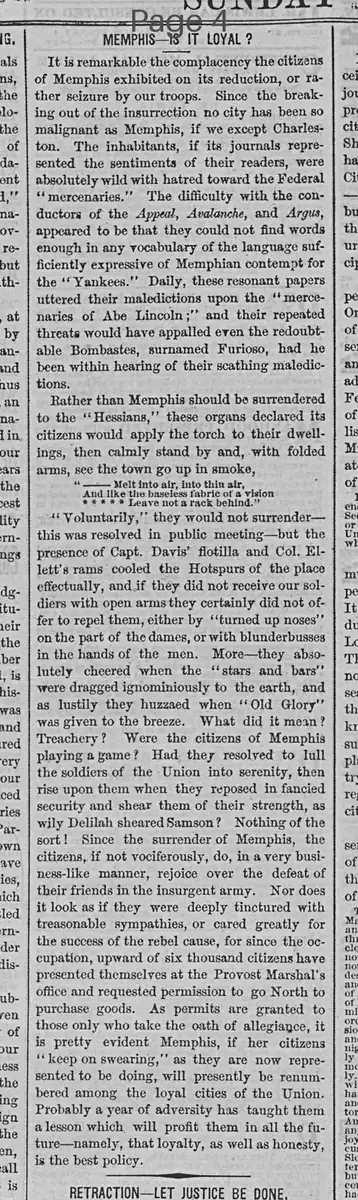
It is remarkable the complacency the citizens of Memphis exhibited on its reduction, or rather seizure by our troops. Since the breaking out of the insurrection no city has been so malignant as Memphis, if we except Charleston. The inhabitants, if its journals represented the sentiments of their readers, were absolutely wild with hatred toward the Federal "mercenaries." The difficulty with the conductors of the Appeal, Avalanche, and Argus appeared to be that they could not find words enough in any vocabulary of the language sufficiently expressive of Memphian contempt for the "Yankees." Daily, these resonant papers uttered their maledictions upon the "mercenaries of Abe Lincoln;" and their repeated threats would have appalled even the redoubtable Bombastes, surnamed Furioso, had he been within hearing of their scathing maledictions.
Rather than Memphis should be surrendered to the "Hessians," these organs declared its citizens would apply the torch to their dwellings, then calmly stand by and, with folded arms, see the town go up in smoke,
Melt into air. into thin air.
And like the baseless fabric of a vision
* * Leave not a rack behind."
"Voluntarily," they would not surrender—this was resolved in public meeting—but the presence of Capt. Davis' flotilla and Col. Ellet's rams cooled the Hotspurs of the place effectually, and if they did not receive our soldiers with open arms they certainly did not offer to repel them, either by "turned up noses" on the part of the dames, or with blunderbusses in the hands of the men. More—they absolutely cheered when the "stars and bars" were dragged ignominiously to the earth. and as lustily they huzzaed when "Old Glory" was given to the breeze. What did it mean?
Treachery? Were the citizens of Memphis playing a game? Had they resolved to lull the soldiers of the Union into serenity. then rise upon them when they reposed in fancied security and shear them of their strength, as wily Delilah sheared Samson? Nothing of the sort! Since the surrender of Memphis, the citizens, if not vociferously, do, in a very business-like manner. rejoice over the defeat of their friends in the insurgent army. Nor does it look as if they were deeply tinctured with treasonable sympathies, or cared greatly for the success of the rebel cause, for since the occupation, upward of six thousand citizens have presented themselves at the Provost Marshal's office and requested permission to go North to purchase goods. As permits are granted to those only who take the oath of allegiance, it is pretty evident Memphis, if her citizens "keep on swearing," as they are now represented to be doing, will presently be renumbered among the loyal cities of the Union.
Probably a year of adversity has taught them a lesson which will profit them in all the future—namely, that loyalty, as well as honesty, is the best policy.
It is remarkable the complacency the citizens of Memphis exhibited on its reduction, or rather seizure by our troops. Since the breaking out of the insurrection no city has been so malignant as Memphis, if we except Charleston. The inhabitants, if its journals represented the sentiments of their readers, were absolutely wild with hatred toward the Federal "mercenaries." The difficulty with the conductors of the Appeal, Avalanche, and Argus appeared to be that they could not find words enough in any vocabulary of the language sufficiently expressive of Memphian contempt for the "Yankees." Daily, these resonant papers uttered their maledictions upon the "mercenaries of Abe Lincoln;" and their repeated threats would have appalled even the redoubtable Bombastes, surnamed Furioso, had he been within hearing of their scathing maledictions.
Rather than Memphis should be surrendered to the "Hessians," these organs declared its citizens would apply the torch to their dwellings, then calmly stand by and, with folded arms, see the town go up in smoke,
Melt into air. into thin air.
And like the baseless fabric of a vision
* * Leave not a rack behind."
"Voluntarily," they would not surrender—this was resolved in public meeting—but the presence of Capt. Davis' flotilla and Col. Ellet's rams cooled the Hotspurs of the place effectually, and if they did not receive our soldiers with open arms they certainly did not offer to repel them, either by "turned up noses" on the part of the dames, or with blunderbusses in the hands of the men. More—they absolutely cheered when the "stars and bars" were dragged ignominiously to the earth. and as lustily they huzzaed when "Old Glory" was given to the breeze. What did it mean?
Treachery? Were the citizens of Memphis playing a game? Had they resolved to lull the soldiers of the Union into serenity. then rise upon them when they reposed in fancied security and shear them of their strength, as wily Delilah sheared Samson? Nothing of the sort! Since the surrender of Memphis, the citizens, if not vociferously, do, in a very business-like manner. rejoice over the defeat of their friends in the insurgent army. Nor does it look as if they were deeply tinctured with treasonable sympathies, or cared greatly for the success of the rebel cause, for since the occupation, upward of six thousand citizens have presented themselves at the Provost Marshal's office and requested permission to go North to purchase goods. As permits are granted to those only who take the oath of allegiance, it is pretty evident Memphis, if her citizens "keep on swearing," as they are now represented to be doing, will presently be renumbered among the loyal cities of the Union.
Probably a year of adversity has taught them a lesson which will profit them in all the future—namely, that loyalty, as well as honesty, is the best policy.
What sub-type of article is it?
Historical Event
Curiosity
What themes does it cover?
Fortune Reversal
Moral Virtue
Social Manners
What keywords are associated?
Memphis Seizure
Union Occupation
Loyalty Shift
Civil War Sentiments
Oath Of Allegiance
What entities or persons were involved?
Citizens Of Memphis
Capt. Davis
Col. Ellet
Where did it happen?
Memphis
Story Details
Key Persons
Citizens Of Memphis
Capt. Davis
Col. Ellet
Location
Memphis
Story Details
The article contrasts the pre-seizure hostility of Memphis newspapers and citizens toward the Union with their post-occupation behavior of cheering the Union flag, rejoicing over Confederate defeats, and taking oaths of allegiance to go North, concluding that adversity has taught them loyalty is the best policy.