Thank you for visiting SNEWPapers!
Sign up free
Phenix Gazette
Alexandria, Virginia
What is this article about?
U.S. Senate debated a bill yesterday authorizing legal representatives of the Marquis de Maison Rouge to sue the United States, reported by the Judiciary Committee. Senators including Van Buren, Randolph, Tazewell, Johnston, Berrien, Holmes, Brown, and Eaton participated in the discussion. Randolph opposed it as a novel principle incompatible with a free constitution.
Clipping
OCR Quality
Full Text
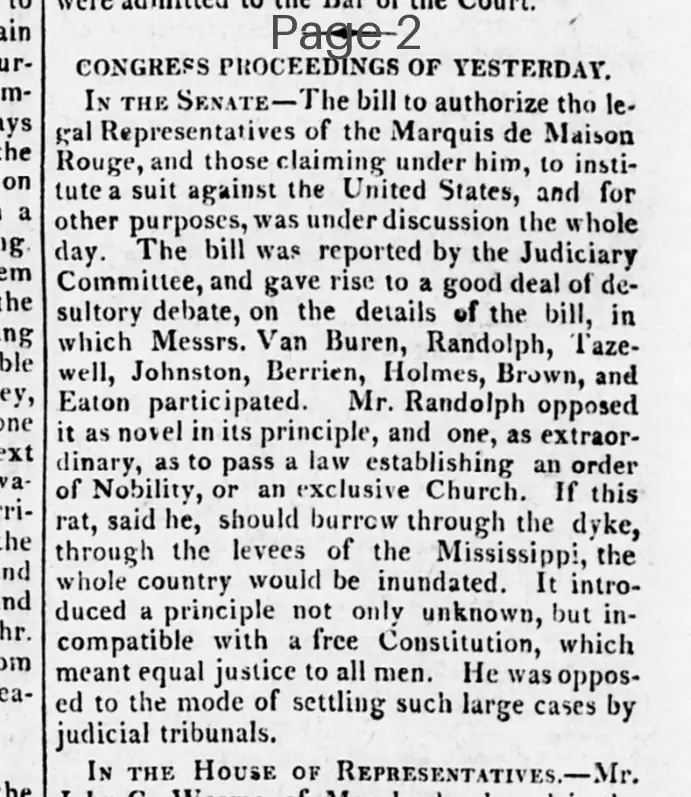
In The Senate—The bill to authorize the legal Representatives of the Marquis de Maison Rouge, and those claiming under him, to institute a suit against the United States, and for other purposes, was under discussion the whole day. The bill was reported by the Judiciary Committee, and gave rise to a good deal of desultory debate, on the details of the bill, in which Messrs. Van Buren, Randolph, Tazewell, Johnston, Berrien, Holmes, Brown, and Eaton participated. Mr. Randolph opposed it as novel in its principle, and one, as extraordinary, as to pass a law establishing an order of Nobility, or an exclusive Church. If this rat, said he, should burrow through the dyke, through the levees of the Mississippi, the whole country would be inundated. It introduced a principle not only unknown, but incompatible with a free Constitution, which meant equal justice to all men. He was opposed to the mode of settling such large cases by judicial tribunals.
What sub-type of article is it?
What keywords are associated?
What entities or persons were involved?
Domestic News Details
Event Date
Yesterday
Key Persons
Event Details
The Senate discussed the bill to authorize the legal representatives of the Marquis de Maison Rouge and those claiming under him to institute a suit against the United States for other purposes. The bill was reported by the Judiciary Committee and gave rise to desultory debate on its details, with participation from Messrs. Van Buren, Randolph, Tazewell, Johnston, Berrien, Holmes, Brown, and Eaton. Mr. Randolph opposed it as novel in principle and extraordinary, comparing it to establishing nobility or an exclusive church, warning it would introduce a principle incompatible with a free constitution providing equal justice to all, and opposed settling large cases by judicial tribunals.