Thank you for visiting SNEWPapers!
Sign up free
Editorial
May 14, 1938
Montana Oil And Mining Journal
Great Falls, Billings, Cascade County, Yellowstone County, Montana
What is this article about?
This 1938 editorial discusses geological reasons for oil production in Montana's Kevin-Sunburst field, arguing that drillers should penetrate deeper into the Madison limestone beyond its top to access fissures containing major oil reserves, citing examples like the Aronow-Government and Ohio Baker wells and USGS findings.
Clipping
OCR Quality
95%
Excellent
Full Text
SATURDAY MAY 14, 1938.
"Subsurface formations on the northwest half of the southeast portion of the San Andreas fault?"
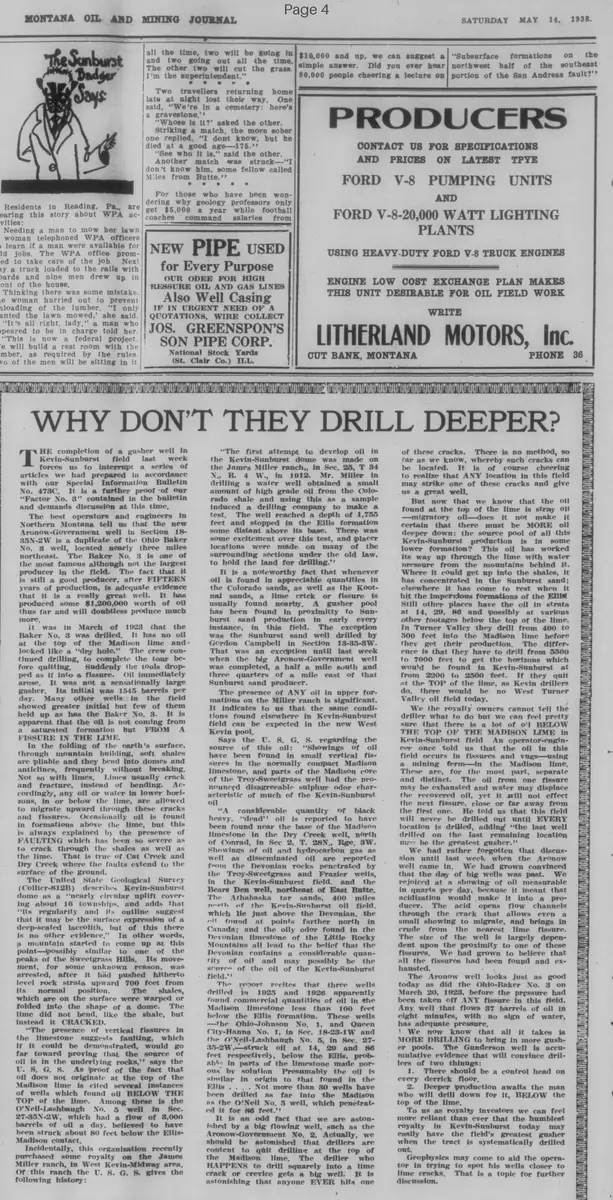
WHY DON'T THEY DRILL DEEPER?
The completion of a gusher well in Kevin-Sunburst forces us to interrupt a series of articles we had prepared in accordance with our Special Information Bulletin No. 473C.
It is a further proof of our "Factor No. 3" contained in the bulletin and demands discussion at this time.
The best operators and engineers in Northern Montana tell us that the new Aronow-Government well in Section 18-35N-2W is a duplicate of the Ohio Baker No. 8 well located nearly three miles northeast. The Baker No. 3 is one of the most famous although not the largest producer in the field. The fact that it is still a good producer, after FIFTEEN years of production, is adequate evidence that it is a really great well. It has produced some $1,200,000 worth of oil thus far and will doubtless produce much more.
It was in March of 1923 that the Baker No. 3 was drilled. It had no oil at the top of the Madison lime and looked like a "dry hole." The crew continued drilling, to complete the tour before quitting.
Suddenly the tools dropped as if into a fissure. Oil immediately arose. It was not a sensationally large gusher. Its initial was 1545 barrels per day. Many other wells in the field showed greater initial but few of them held up as has the Baker No. 3. It is apparent that the oil is not coming from a saturated formation but FROM A FISSURE IN THE LIME.
In the folding of the earth's surface, through mountain building, soft shales are pliable and they bend into domes and anticlines, frequently without breaking.
Not so with limes. Limes usually crack and fracture, instead of bending. Accordingly, any oil or water in lower horizons, in or below the lime, are allowed to migrate upward through these cracks and fissures. Occasionally oil is found in formations above the lime, but this is always explained by the presence of FAULTING which has been so severe as to crack through the shales as well as the lime. That is true of Cat Creek and Dry Creek where the faults extend to the surface of the ground.
The United State Geological Survey (Collier-812B) describes Kevin-Sunburst dome as a "nearly circular uplift covering about 16 townships, and adds that "its regularity and its outline suggest that it may be the surface expression of a deep-seated laccolith, but of this there is no other evidence." In other words, a mountain started to come up at this point-possibly similar to one of the peaks of the Sweetgrass Hills. Its movement, for some unknown reason, was arrested, after it had pushed hitherto level rock strata upward 700 feet from its normal position.
The shales, which are on the surface were warped or folded into the shape of a dome. The lime did not bend, like the shale, but instead it CRACKED.
"The presence of vertical fissures in the limestone suggests faulting, which if it could be demonstrated, would go far toward proving that the source of oil is in the underlying rocks," says the U. S. G. S. As proof of the fact that oil does not originate at the top of the Madison lime is cited several instances of wells which found oil BELOW THE TOP of the lime. Among these is the O'Neil-Lashbaugh No. 5 well in Sec. 27-35N-2W, which had a flow of 3,000 barrels of oil a day, believed to have been struck about 80 feet below the Ellis-Madison contact.
Incidentally, this organization recently purchased some royalty on the James Miller ranch, in West Kevin-Midway area.
Of this ranch the U. S. G. S. gives the following history:
"The first attempt to develop oil in the Kevin-Sunburst dome was made on the James Miller ranch, in Sec. 25, T 34 N, R. 4 W., in 1912. Mr. Miller in drilling a water well obtained a small amount of high grade oil from the Colorado shale and using this as a sample induced a drilling company to make a test. The well reached a depth of 1,755 feet and stopped in the Ellis formation some distance above its base. There was some excitement over this test, and placer locations were made on many of the surrounding sections under the old law, to hold the land for drilling."
It is a noteworthy fact that whenever oil is found in appreciable quantities in the Colorado sands, as well as the Kootenai sands, a lime crack or fissure is usually found nearby. A gusher pool has been found in proximity to Sunburst sand production in early every instance, in this field. The exception was the Sunburst sand well drilled by Gordon Campbell in Section 13-35-3W.
That was an exception until last week when the big Aronow-Government well was completed, a half a mile south and three quarters of a mile east of that Sunburst sand producer.
The presence of ANY oil in upper formations on the Miller ranch is significant. It indicates to us that the same conditions found elsewhere in Kevin-Sunburst field can be expected in the new West Kevin pool.
Says the U. S. G. S. regarding the source of this oil:
"Showings of oil have been found in small vertical fissures in the normally compact Madison limestone, and parts of the Madison core of the Troy-Sweetgrass well had the pronounced disagreeable sulphur odor characteristic of much of the Kevin-Sunburst oil.
"A considerable quantity of black heavy, "dead" oil is reported to have been found near the base of the Madison limestone in the Dry Creek well, north of Conrad, in Sec 2, T. 28N., R. 3W.
Showings of oil and hydrocarbon gas as well as disseminated oil are reported from the Devonian rocks penetrated by the Troy-Sweetgrass and Frazier wells, in the Kevin-Sunburst field, and the Bears Den well, northeast of East Butte.
The Athabaska tar sands, 400 miles north of the Kevin-Sunburst oil field, which lie just above the Devonian, the oil found at points farther north in Canada, and the oily odor found in the Devonian limestone of the Little Rocky Mountains all lead to the belief that the Devonian contains a considerable quantity of oil and may possibly be the source of the oil of the Kevin-Sunburst field."
The report recites that three wells drilled in 1925 and 1926 apparently found commercial quantities of oil in the Madison limestone less than 100 feet below the Ellis formation. These wells—the Ohio-Johnson No. 1, and Queen City-Hanna No. 1, in Sec. 18-23-1W and the O'Neil-Lashbaugh No. 5, in Sec. 27-35-2W,-struck oil at 14, 29 and 86 feet respectively, below the Ellis, probably in parts of the limestone made porous by solution. Presumably the oil is similar in origin to that found in the Ellis . . . . Not more than 30 wells have been drilled as far into the Madison as the O'Neil No. 5 well, which penetrated it for 86 feet."
It is an odd fact that we are astonished by a big flowing well, such as the Aronow-Government No. 2. Actually, we should be astonished that drillers are content to quit drilling at the top of the Madison lime. The driller who HAPPENS to drill squarely into a lime crack or crevice gets a big well. It is astonishing that anyone EVER hits one of these cracks. There is no method, so far as we know, whereby such cracks can be located. It is of course cheering to realize that ANY location in this field may strike one of these cracks and give us a great well.
But now that we know that the oil found at the top of the lime is stray oil -migratory oil does it not make it certain that there must be MORE oil deeper down: the source pool of all this Kevin-Sunburst production is in some lower formation? This oil has worked its way up through the lime with water pressure from the mountains behind it.
Where it could get up into the shales, it has concentrated in the Sunburst sand; elsewhere it has come to rest when it hit the impervious formations of the Ellis! Still other places have the oil in strata at 14, 29, 86 and possibly at various other footages below the top of the lime.
In Turner Valley they drill from 400 to 500 feet into the Madison lime before they get their production. The difference is that they have to drill from 5500 to 7000 feet to get the horizons which would be found in Kevin-Sunburst at from 2200 to 2500 feet.
If they quit at the TOP of the lime, as Kevin drillers do, there would be no West Turner Valley oil field today.
We the royalty owners cannot tell the driller what to do but we can feel pretty sure that there is a lot of oil BELOW THE TOP OF THE MADISON LIME in Kevin-Sunburst field. An operator-engineer once told us that the oil in this field occurs in fissures and vugs-using a mining term--in the Madison lime.
These are, for the most part, separate and distinct. The oil from one fissure may be exhausted and water may displace the recovered oil, yet it will not effect the next fissure, close or far away from the first one. He told us that this field will never be drilled out until EVERY location is drilled, adding "the last well drilled on the last remaining location may be the greatest gusher."
We had rather forgotten that discussion until last week when the Aronow well came in. We had grown convinced that the day of big wells was past. We rejoiced at a showing of oil measurable in quarts per day, because it meant that acidization would make it into a producer. The acid opens flow channels through the crack that allows even a small showing to migrate, and brings in crude from the nearest lime fissure.
The size of the well is largely dependent upon the proximity to one of these fissures. We had grown to believe that all the fissures had been found and exhausted.
The Aronow well looks just as good today as did the Ohio-Baker No. 3 on March 20, 1923, before the pressure had been taken off ANY fissure in this field.
Any well that flows 37 barrels of oil in eight minutes, with no sign of water, has adequate pressure.
We now know that all it takes is MORE DRILLING to bring in more gusher pools. The Gunderson well is accumulative evidence that will convince drillers of two things:
1. There should be a control head on every derrick floor.
2. Deeper production awaits the man who will drill down for it, BELOW the top of the lime.
To us as royalty investors we can feel more reliant than ever that the humblest royalty in Kevin-Sunburst today may easily have the field's greatest gusher when the tract is systematically drilled out.
Geophysics may come to aid the operator in trying to spot his wells closer to lime cracks.
That is a topic for further discussion.
"Subsurface formations on the northwest half of the southeast portion of the San Andreas fault?"
WHY DON'T THEY DRILL DEEPER?
The completion of a gusher well in Kevin-Sunburst forces us to interrupt a series of articles we had prepared in accordance with our Special Information Bulletin No. 473C.
It is a further proof of our "Factor No. 3" contained in the bulletin and demands discussion at this time.
The best operators and engineers in Northern Montana tell us that the new Aronow-Government well in Section 18-35N-2W is a duplicate of the Ohio Baker No. 8 well located nearly three miles northeast. The Baker No. 3 is one of the most famous although not the largest producer in the field. The fact that it is still a good producer, after FIFTEEN years of production, is adequate evidence that it is a really great well. It has produced some $1,200,000 worth of oil thus far and will doubtless produce much more.
It was in March of 1923 that the Baker No. 3 was drilled. It had no oil at the top of the Madison lime and looked like a "dry hole." The crew continued drilling, to complete the tour before quitting.
Suddenly the tools dropped as if into a fissure. Oil immediately arose. It was not a sensationally large gusher. Its initial was 1545 barrels per day. Many other wells in the field showed greater initial but few of them held up as has the Baker No. 3. It is apparent that the oil is not coming from a saturated formation but FROM A FISSURE IN THE LIME.
In the folding of the earth's surface, through mountain building, soft shales are pliable and they bend into domes and anticlines, frequently without breaking.
Not so with limes. Limes usually crack and fracture, instead of bending. Accordingly, any oil or water in lower horizons, in or below the lime, are allowed to migrate upward through these cracks and fissures. Occasionally oil is found in formations above the lime, but this is always explained by the presence of FAULTING which has been so severe as to crack through the shales as well as the lime. That is true of Cat Creek and Dry Creek where the faults extend to the surface of the ground.
The United State Geological Survey (Collier-812B) describes Kevin-Sunburst dome as a "nearly circular uplift covering about 16 townships, and adds that "its regularity and its outline suggest that it may be the surface expression of a deep-seated laccolith, but of this there is no other evidence." In other words, a mountain started to come up at this point-possibly similar to one of the peaks of the Sweetgrass Hills. Its movement, for some unknown reason, was arrested, after it had pushed hitherto level rock strata upward 700 feet from its normal position.
The shales, which are on the surface were warped or folded into the shape of a dome. The lime did not bend, like the shale, but instead it CRACKED.
"The presence of vertical fissures in the limestone suggests faulting, which if it could be demonstrated, would go far toward proving that the source of oil is in the underlying rocks," says the U. S. G. S. As proof of the fact that oil does not originate at the top of the Madison lime is cited several instances of wells which found oil BELOW THE TOP of the lime. Among these is the O'Neil-Lashbaugh No. 5 well in Sec. 27-35N-2W, which had a flow of 3,000 barrels of oil a day, believed to have been struck about 80 feet below the Ellis-Madison contact.
Incidentally, this organization recently purchased some royalty on the James Miller ranch, in West Kevin-Midway area.
Of this ranch the U. S. G. S. gives the following history:
"The first attempt to develop oil in the Kevin-Sunburst dome was made on the James Miller ranch, in Sec. 25, T 34 N, R. 4 W., in 1912. Mr. Miller in drilling a water well obtained a small amount of high grade oil from the Colorado shale and using this as a sample induced a drilling company to make a test. The well reached a depth of 1,755 feet and stopped in the Ellis formation some distance above its base. There was some excitement over this test, and placer locations were made on many of the surrounding sections under the old law, to hold the land for drilling."
It is a noteworthy fact that whenever oil is found in appreciable quantities in the Colorado sands, as well as the Kootenai sands, a lime crack or fissure is usually found nearby. A gusher pool has been found in proximity to Sunburst sand production in early every instance, in this field. The exception was the Sunburst sand well drilled by Gordon Campbell in Section 13-35-3W.
That was an exception until last week when the big Aronow-Government well was completed, a half a mile south and three quarters of a mile east of that Sunburst sand producer.
The presence of ANY oil in upper formations on the Miller ranch is significant. It indicates to us that the same conditions found elsewhere in Kevin-Sunburst field can be expected in the new West Kevin pool.
Says the U. S. G. S. regarding the source of this oil:
"Showings of oil have been found in small vertical fissures in the normally compact Madison limestone, and parts of the Madison core of the Troy-Sweetgrass well had the pronounced disagreeable sulphur odor characteristic of much of the Kevin-Sunburst oil.
"A considerable quantity of black heavy, "dead" oil is reported to have been found near the base of the Madison limestone in the Dry Creek well, north of Conrad, in Sec 2, T. 28N., R. 3W.
Showings of oil and hydrocarbon gas as well as disseminated oil are reported from the Devonian rocks penetrated by the Troy-Sweetgrass and Frazier wells, in the Kevin-Sunburst field, and the Bears Den well, northeast of East Butte.
The Athabaska tar sands, 400 miles north of the Kevin-Sunburst oil field, which lie just above the Devonian, the oil found at points farther north in Canada, and the oily odor found in the Devonian limestone of the Little Rocky Mountains all lead to the belief that the Devonian contains a considerable quantity of oil and may possibly be the source of the oil of the Kevin-Sunburst field."
The report recites that three wells drilled in 1925 and 1926 apparently found commercial quantities of oil in the Madison limestone less than 100 feet below the Ellis formation. These wells—the Ohio-Johnson No. 1, and Queen City-Hanna No. 1, in Sec. 18-23-1W and the O'Neil-Lashbaugh No. 5, in Sec. 27-35-2W,-struck oil at 14, 29 and 86 feet respectively, below the Ellis, probably in parts of the limestone made porous by solution. Presumably the oil is similar in origin to that found in the Ellis . . . . Not more than 30 wells have been drilled as far into the Madison as the O'Neil No. 5 well, which penetrated it for 86 feet."
It is an odd fact that we are astonished by a big flowing well, such as the Aronow-Government No. 2. Actually, we should be astonished that drillers are content to quit drilling at the top of the Madison lime. The driller who HAPPENS to drill squarely into a lime crack or crevice gets a big well. It is astonishing that anyone EVER hits one of these cracks. There is no method, so far as we know, whereby such cracks can be located. It is of course cheering to realize that ANY location in this field may strike one of these cracks and give us a great well.
But now that we know that the oil found at the top of the lime is stray oil -migratory oil does it not make it certain that there must be MORE oil deeper down: the source pool of all this Kevin-Sunburst production is in some lower formation? This oil has worked its way up through the lime with water pressure from the mountains behind it.
Where it could get up into the shales, it has concentrated in the Sunburst sand; elsewhere it has come to rest when it hit the impervious formations of the Ellis! Still other places have the oil in strata at 14, 29, 86 and possibly at various other footages below the top of the lime.
In Turner Valley they drill from 400 to 500 feet into the Madison lime before they get their production. The difference is that they have to drill from 5500 to 7000 feet to get the horizons which would be found in Kevin-Sunburst at from 2200 to 2500 feet.
If they quit at the TOP of the lime, as Kevin drillers do, there would be no West Turner Valley oil field today.
We the royalty owners cannot tell the driller what to do but we can feel pretty sure that there is a lot of oil BELOW THE TOP OF THE MADISON LIME in Kevin-Sunburst field. An operator-engineer once told us that the oil in this field occurs in fissures and vugs-using a mining term--in the Madison lime.
These are, for the most part, separate and distinct. The oil from one fissure may be exhausted and water may displace the recovered oil, yet it will not effect the next fissure, close or far away from the first one. He told us that this field will never be drilled out until EVERY location is drilled, adding "the last well drilled on the last remaining location may be the greatest gusher."
We had rather forgotten that discussion until last week when the Aronow well came in. We had grown convinced that the day of big wells was past. We rejoiced at a showing of oil measurable in quarts per day, because it meant that acidization would make it into a producer. The acid opens flow channels through the crack that allows even a small showing to migrate, and brings in crude from the nearest lime fissure.
The size of the well is largely dependent upon the proximity to one of these fissures. We had grown to believe that all the fissures had been found and exhausted.
The Aronow well looks just as good today as did the Ohio-Baker No. 3 on March 20, 1923, before the pressure had been taken off ANY fissure in this field.
Any well that flows 37 barrels of oil in eight minutes, with no sign of water, has adequate pressure.
We now know that all it takes is MORE DRILLING to bring in more gusher pools. The Gunderson well is accumulative evidence that will convince drillers of two things:
1. There should be a control head on every derrick floor.
2. Deeper production awaits the man who will drill down for it, BELOW the top of the lime.
To us as royalty investors we can feel more reliant than ever that the humblest royalty in Kevin-Sunburst today may easily have the field's greatest gusher when the tract is systematically drilled out.
Geophysics may come to aid the operator in trying to spot his wells closer to lime cracks.
That is a topic for further discussion.
What sub-type of article is it?
Science Or Medicine
Economic Policy
What keywords are associated?
Kevin Sunburst Oil
Madison Lime Fissures
Deeper Drilling
Oil Gushers
Geological Survey
Montana Oil Field
Royalty Investment
What entities or persons were involved?
Aronow Government Well
Ohio Baker No. 3
U.S. Geological Survey
Kevin Sunburst Field
James Miller Ranch
O'neil Lashbaugh No. 5
Troy Sweetgrass Well
Editorial Details
Primary Topic
Advocacy For Deeper Oil Drilling In Kevin Sunburst Field
Stance / Tone
Urging Deeper Drilling Into Madison Lime Fissures For Greater Oil Production
Key Figures
Aronow Government Well
Ohio Baker No. 3
U.S. Geological Survey
Kevin Sunburst Field
James Miller Ranch
O'neil Lashbaugh No. 5
Troy Sweetgrass Well
Key Arguments
Oil Migrates Upward Through Fissures In The Madison Limestone Rather Than Originating At Its Top
Historical Wells Like Baker No. 3 Succeeded By Hitting Fissures Below The Top Of The Lime
Usgs Reports Indicate Oil Sources In Underlying Devonian Rocks And Fissures
Drillers Should Penetrate Deeper Into The Madison Lime, As In Turner Valley, To Access Major Reserves
Fissures Are Separate, So Systematic Drilling Of Every Location Is Needed To Exhaust The Field
Recent Aronow Well Proves Untapped Gushers Remain Via Deeper Drilling