Thank you for visiting SNEWPapers!
Sign up free
Story
February 6, 1888
The Sun
New York, New York County, New York
What is this article about?
In New York, actress Mrs. Langtry's lawyer seeks to permanently block the removal of her fence pillars by the Public Works Department, alleging selective enforcement compared to similar church structures, to protect her privacy.
Clipping
OCR Quality
98%
Excellent
Full Text
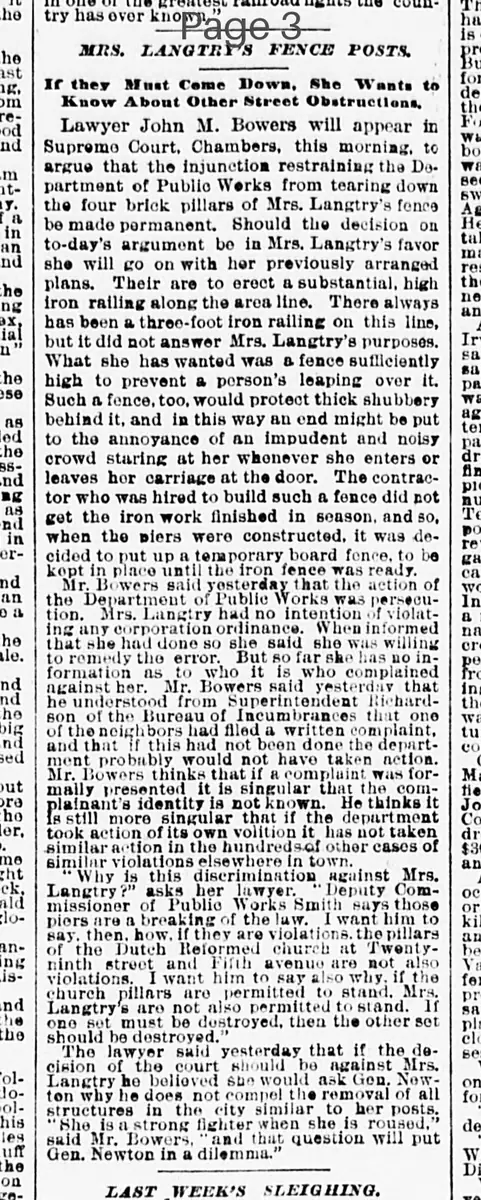
MRS. LANGTRY'S FENCE POSTS.
If they Must Come Down, She Wants to Know About Other Street Obstructions.
Lawyer John M. Bowers will appear in Supreme Court, Chambers, this morning, to argue that the injunction restraining the Department of Public Works from tearing down the four brick pillars of Mrs. Langtry's fence be made permanent. Should the decision on to-day's argument be in Mrs. Langtry's favor she will go on with her previously arranged plans. Their are to erect a substantial, high iron railing along the area line. There always has been a three-foot iron railing on this line, but it did not answer Mrs. Langtry's purposes. What she has wanted was a fence sufficiently high to prevent a person's leaping over it. Such a fence, too, would protect thick shrubbery behind it, and in this way an end might be put to the annoyance of an impudent and noisy crowd staring at her whenever she enters or leaves her carriage at the door. The contractor who was hired to build such a fence did not get the iron work finished in season, and so, when the piers were constructed, it was decided to put up a temporary board fence, to be kept in place until the iron fence was ready.
Mr. Bowers said yesterday that the action of the Department of Public Works was persecution. Mrs. Langtry had no intention of violating any corporation ordinance. When informed that she had done so she said she was willing to remedy the error. But so far she has no information as to who it is who complained against her. Mr. Bowers said yesterday that he understood from Superintendent Richardson of the Bureau of Incumbrances that one of the neighbors had filed a written complaint, and that if this had not been done the department probably would not have taken action. Mr. Bowers thinks that if a complaint was formally presented it is singular that the complainant's identity is not known. He thinks it is still more singular that if the department took action of its own volition it has not taken similar action in the hundreds of other cases of similar violations elsewhere in town.
"Why is this discrimination against Mrs. Langtry?" asks her lawyer. "Deputy Commissioner of Public Works Smith says those piers are a breaking of the law. I want him to say, then, how, if they are violations, the pillars of the Dutch Reformed church at Twenty-ninth street and Fifth avenue are not also violations. I want him to say also why, if the church pillars are permitted to stand, Mrs. Langtry's are not also permitted to stand. If one set must be destroyed, then the other set should be destroyed."
The lawyer said yesterday that if the decision of the court should be against Mrs. Langtry he believed she would ask Gen. Newton why he does not compel the removal of all structures in the city similar to her posts. "She is a strong fighter when she is roused," said Mr. Bowers, "and that question will put Gen. Newton in a dilemma."
If they Must Come Down, She Wants to Know About Other Street Obstructions.
Lawyer John M. Bowers will appear in Supreme Court, Chambers, this morning, to argue that the injunction restraining the Department of Public Works from tearing down the four brick pillars of Mrs. Langtry's fence be made permanent. Should the decision on to-day's argument be in Mrs. Langtry's favor she will go on with her previously arranged plans. Their are to erect a substantial, high iron railing along the area line. There always has been a three-foot iron railing on this line, but it did not answer Mrs. Langtry's purposes. What she has wanted was a fence sufficiently high to prevent a person's leaping over it. Such a fence, too, would protect thick shrubbery behind it, and in this way an end might be put to the annoyance of an impudent and noisy crowd staring at her whenever she enters or leaves her carriage at the door. The contractor who was hired to build such a fence did not get the iron work finished in season, and so, when the piers were constructed, it was decided to put up a temporary board fence, to be kept in place until the iron fence was ready.
Mr. Bowers said yesterday that the action of the Department of Public Works was persecution. Mrs. Langtry had no intention of violating any corporation ordinance. When informed that she had done so she said she was willing to remedy the error. But so far she has no information as to who it is who complained against her. Mr. Bowers said yesterday that he understood from Superintendent Richardson of the Bureau of Incumbrances that one of the neighbors had filed a written complaint, and that if this had not been done the department probably would not have taken action. Mr. Bowers thinks that if a complaint was formally presented it is singular that the complainant's identity is not known. He thinks it is still more singular that if the department took action of its own volition it has not taken similar action in the hundreds of other cases of similar violations elsewhere in town.
"Why is this discrimination against Mrs. Langtry?" asks her lawyer. "Deputy Commissioner of Public Works Smith says those piers are a breaking of the law. I want him to say, then, how, if they are violations, the pillars of the Dutch Reformed church at Twenty-ninth street and Fifth avenue are not also violations. I want him to say also why, if the church pillars are permitted to stand, Mrs. Langtry's are not also permitted to stand. If one set must be destroyed, then the other set should be destroyed."
The lawyer said yesterday that if the decision of the court should be against Mrs. Langtry he believed she would ask Gen. Newton why he does not compel the removal of all structures in the city similar to her posts. "She is a strong fighter when she is roused," said Mr. Bowers, "and that question will put Gen. Newton in a dilemma."
What sub-type of article is it?
Historical Event
What themes does it cover?
Justice
Social Manners
What keywords are associated?
Fence Dispute
Mrs Langtry
Public Works Department
Legal Injunction
New York Court
Discrimination Claim
What entities or persons were involved?
Mrs. Langtry
John M. Bowers
Superintendent Richardson
Deputy Commissioner Of Public Works Smith
Gen. Newton
Where did it happen?
New York City
Story Details
Key Persons
Mrs. Langtry
John M. Bowers
Superintendent Richardson
Deputy Commissioner Of Public Works Smith
Gen. Newton
Location
New York City
Story Details
Mrs. Langtry's lawyer argues in court to make permanent an injunction against the Department of Public Works removing her fence pillars, claiming discrimination as similar church pillars remain. She plans to replace with high iron railing to protect privacy and shrubbery.