Thank you for visiting SNEWPapers!
Sign up free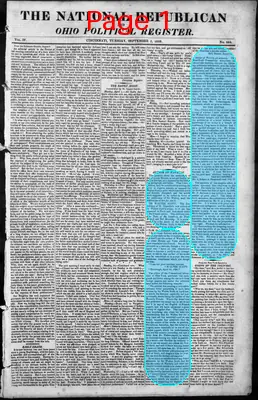
The National Republican And Ohio Political Register
Cincinnati, Hamilton County, Ohio
What is this article about?
European and American newspapers debate the authenticity of a 1826 letter from Sir Walter Scott denying authorship of the Waverley Novels, published in a French edition. Translator Defauconpret confirms receiving it years earlier but disclaims its publication, deepening the mystery.
Merged-components note: Continuation of the article on the 'AUTHOR OF WAVERLY' across sequential reading orders.
Clipping
OCR Quality
Full Text
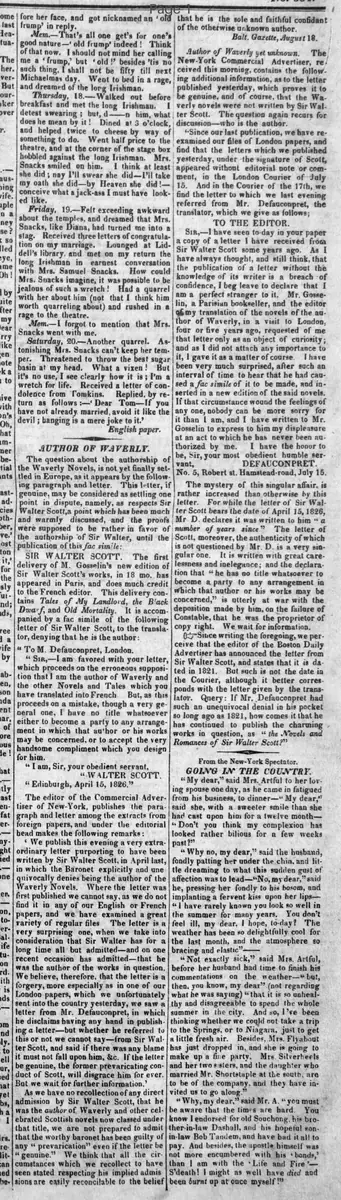
The question about the authorship of the Waverly Novels, is not yet finally settled in Europe, as it appears by the following paragraph and letter. This letter, if genuine, may be considered as settling one point in dispute, namely, as respects Sir Walter Scott, a point which has been much and warmly discussed, and the proofs were supposed to be rather in favor of the authorship of Sir Walter, until the publication of this fac simile:
SIR WALTER SCOTT. The first delivery of M. Gosselin's new edition of Sir Walter Scott's works, in 18 mo. has appeared in Paris, and does much credit to the French editor. This delivery contains Tales of My Landlord, the Black Dwarf, and Old Mortality. It is accompanied by a fac simile of the following letter of Sir Walter Scott, to the translator, denying that he is the author:
"To M. Defauconpret, London.
"Sir,--I am favored with your letter, which proceeds on the erroneous supposition that I am the author of Waverly and the other Novels and Tales which you have translated into French. But, as this proceeds on a mistake, though a very general one, I have no title whatsoever either to become a party to any arrangement in which that author or his works may be concerned, or to accept the very handsome compliment which you design for him.
"I am, Sir, your obedient servant,
"WALTER SCOTT.
"Edinburgh, April 15, 1826."
The editor of the Commercial Advertiser of New-York, publishes the paragraph and letter among the extracts from foreign papers, and under the editorial head makes the following remarks:
We publish this evening a very extraordinary letter purporting to have been written by Sir Walter Scott, in April last, in which the Baronet explicitly and unequivocally denies being the author of the Waverly Novels. Where the letter was first published we cannot say, as we do not find it in any of our English or French papers, and we have examined a great variety of regular files. The letter is a very surprising one, when we take into consideration that Sir Walter has for a long time all but admitted--and on one recent occasion has admitted--that he was the author of the works in question. We believe, therefore, that the letter is a forgery, more especially as in one of our London papers, which we unfortunately sent into the country yesterday, we saw a letter from Mr. Defauconpret, in which he disclaims having any hand in publishing a letter--but whether he referred to this or not we cannot say--from Sir Walter Scott, and said if there was any blame it must not fall upon him, &c. If the letter be genuine, the former prevaricating conduct of Scott, will disgrace him forever. But we wait for further information.'
As we have no recollection of any direct admission by Sir Walter Scott, that he was the author of Waverly and other celebrated Scottish novels now classed under that title, we are not prepared to admit that the worthy baronet has been guilty of any "prevarication" even if the letter be "genuine." We think that all the circumstances which we recollect to have seen stated respecting his implied admissions are easily reconcilable to the belief
that he is the sole and faithful confidant of the otherwise unknown author.
Balt. Gazette, August 18.
Author of Waverly yet unknown.
The New-York Commercial Advertiser, received this morning, contains the following additional information, as to the letter published yesterday, which proves it to be genuine, and of course, that the Waverly novels were not written by Sir Walter Scott. The question again recurs for discussion--who is the author.
"Since our last publication, we have re-examined our files of London papers, and find that the letter which we published yesterday, under the signature of Scott, appeared without editorial note or comment, in the London Courier of July 15. And in the Courier of the 17th, we find the letter to which we last evening referred from Mr. Defauconpret, the translator, which we give as follows;
TO THE EDITOR.
SIR,--I have seen to-day in your paper a copy of a letter I have received from Sir Walter Scott some years ago. As I have always thought, and still think, that the publication of a letter without the knowledge of its writer is a breach of confidence, I beg leave to declare that I am a perfect stranger to it. Mr. Gosselin, a Parisian bookseller, and the editor of my translation of the novels of the author of Waverly, in a visit to London, four or five years ago, requested of me that letter only as an object of curiosity; and as I did not attach any importance to it, I gave it as a matter of course. I have been very much surprised, after such an interval of time to hear that he had caused a fac simile of it to be made, and inserted in a new edition of the said novels. If that circumstance wound the feelings of any one, nobody can be more sorry for it than I am, and I have written to Mr. Gosselin to express to him my displeasure at an act to which he has never been authorized by me. I have the honor to be, Sir, your most obedient humble servant,
DEFAUCONPRET.
No. 5, Robert st. Hampstead-road, July 15."
The mystery of this singular affair, is rather increased than otherwise by this letter. For while the letter of Sir Walter Scott bears the date of April 15, 1826, Mr D. declares it was written to him "a number of years since" The letter of Scott, moreover, the authenticity of which is not questioned by Mr. D. is a very singular one. It is written with great carelessness and inelegance; and the declaration that "he has no title whatsoever to become a party to any arrangement in which that author or his works may be concerned," is utterly at war with the deposition made by him, on the failure of Constable, that he was the proprietor of copyright. We wait for information.
--Since writing the foregoing, we perceive that the editor of the Boston Daily Advertiser has announced the letter from Sir Walter Scott, and states that it is dated in 1821. But such is not the date in the Courier, although it better corresponds with the letter given by the translator. Query: If Mr. Defauconpret had such an unequivocal denial in his pocket so long ago as 1821, how comes it that he has continued to publish the charming works in question, as "the Novels and Romances of Sir Walter Scott?"
What sub-type of article is it?
What keywords are associated?
What entities or persons were involved?
Where did it happen?
Foreign News Details
Primary Location
Europe
Event Date
April 15, 1826
Key Persons
Outcome
letter denies scott's authorship; authenticity confirmed but date disputed (1826 vs. 1821); mystery of true author persists.
Event Details
A facsimile of Sir Walter Scott's 1826 letter to translator M. Defauconpret denies authorship of Waverley Novels, included in Paris edition by M. Gosselin. New York and Baltimore papers debate its genuineness; Defauconpret's response confirms receipt years earlier but disclaims publication. Contradictions noted with Scott's past statements on copyrights.