Thank you for visiting SNEWPapers!
Sign up free
Edwardsville Spectator
Edwardsville, Madison County, Illinois
What is this article about?
U.S. Senate report by Mr. King on March 15, responding to petitions for repealing laws restricting British vessels in trade between U.S. and British West Indies colonies. Advocates maintaining countervailing measures to protect American navigation and honor, citing historical context and failed treaty efforts.
Clipping
OCR Quality
Full Text
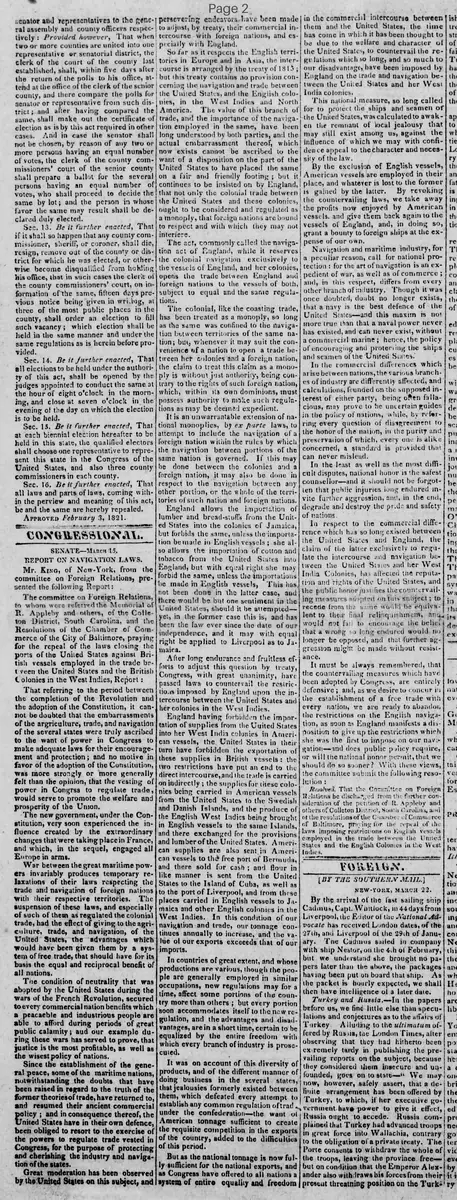
SENATE—MARCH 15.
REPORT ON NAVIGATION LAWS.
Mr. King, of New-York, from the committee on Foreign Relations, presented the following Report:
The committee on Foreign Relations, to whom were referred the Memorial of R. Appleby and others, of the Colleton District, South Carolina, and the Resolutions of the Chamber of Commerce of the City of Baltimore, praying for the repeal of the laws closing the ports of the United States against British vessels employed in the trade between the United States and the British Colonies in the West Indies, Report:
That referring to the period between the completion of the Revolution and the adoption of the Constitution, it cannot be doubted that the embarrassments of the agriculture, trade, and navigation of the several states were truly ascribed to the want of power in Congress to make adequate laws for their encouragement and protection; and no motive in favor of the adoption of the Constitution, was more strongly or more generally felt than the opinion, that the vesting of power in Congress to regulate trade, would serve to promote the welfare and prosperity of the Union.
The new government, under the Constitution, very soon experienced the influence created by the extraordinary changes that were taking place in France, and which, in the sequel, engaged all Europe in arms.
War between the great maritime powers invariably produces temporary relaxations of their laws respecting the trade and navigation of foreign nations with their respective territories. The suspension of these laws, and especially of such of them as regulated the colonial trade, had the effect of giving to the agriculture, trade, and navigation, of the United States, the advantages which would have been given them by a system of free trade, that should have for its basis the equal and reciprocal benefit of all nations.
The condition of neutrality that was adopted by the United States during the wars of the French Revolution, secured to every commercial nation benefits which a peaceable and industrious people are able to afford during periods of great public calamity; and our example during these wars has served to prove, that justice is the most profitable, as well as the wisest policy of nations.
Since the establishment of the general peace, some of the maritime nations, notwithstanding the doubts that have been raised in regard to the truth of the former theories of trade, have returned to, and resumed their ancient commercial policy; and in consequence thereof, the United States have in their own defence, been obliged to resort to the exercise of the powers to regulate trade vested in Congress, for the purpose of protecting and cherishing the industry and navigation of the states.
Great moderation has been observed by the United States on this subject, and persevering endeavors have been made to adjust, by treaty, their commercial intercourse with foreign nations, and especially with England.
So far as it respects the English territories in Europe and in Asia, the intercourse is arranged by the treaty of 1815; but this treaty contains no provision concerning the navigation and trade between the United States, and the English colonies, in the West Indies and North America. The value of this branch of trade, and the importance of the navigation employed in the same, have been long understood by both parties, and the actual embarrassment thereof, which now exists cannot be ascribed to the want of a disposition on the part of the United States to have placed the same on a fair and friendly footing; but it continues to be insisted on by England that not only the colonial trade between the United States and these colonies, ought to be considered and regulated as a monopoly, that foreign nations are bound to respect and with which they may not interfere.
The act, commonly called the navigation act of England, while it reserves the colonial navigation exclusively to the vessels of England, and her colonies, opens the trade between England and foreign nations to the vessels of both, subject to equal and the same regulations.
The colonial, like the coasting trade, has been treated as a monopoly, so long as the same was confined to the navigation between territories of the same nation: but, whenever it may suit the convenience of a nation to open a trade between her colonies and a foreign nation, the claim to treat this trade as a monopoly is without just authority, being contrary to the rights of such foreign nation, which, within its own dominions, must possess authority to make such regulations as may be deemed expedient.
It is an unwarrantable extension of national monopolies, by ex parte laws, to attempt to include the navigation of a foreign nation within the rules by which the navigation between portions of the same nation is governed. If this may be done between the colonies and a foreign nation, it may also be done in respect to the navigation between any other portion, or the whole of the territories of such nation and foreign nations.
England allows the importation of lumber and bread-stuffs from the United States into the colonies of Jamaica, but forbids the same, unless the importation be made in English vessels; she also allows the importation of cotton and tobacco from the United States into England, but with equal right she may forbid the same, unless the importations be made in English vessels. This has not been done in the latter case, and there would be but one sentiment in the United States, should it be attempted—yet, in the former case this is, and has been the law ever since the date of our independence, and it may with equal right be applied to Liverpool as to Jamaica.
After long endurance and fruitless efforts to adjust this question by treaty, Congress, with great unanimity, have passed laws to countervail the restrictions imposed by England upon the intercourse between the United States and her colonies in the West Indies.
England having forbidden the importation of supplies from the United States into her West India colonies in American vessels, the United States in their turn have forbidden the exportation of these supplies in British vessels: the two restrictions have put an end to the direct intercourse, and the trade is carried on indirectly; the supplies for these colonies being carried in American vessels from the United States to the Swedish and Danish Islands, and the produce of the English West Indies being brought in English vessels to the same Islands, and there exchanged for the provisions and lumber of the United States. American supplies are also sent in American vessels to the free port of Bermuda, and there sold for cash; and flour in like manner is sent from the United States to the Island of Cuba, as well as to the port of Liverpool, and from these places carried in English vessels to Jamaica and other English colonies in the West Indies. In this condition of our navigation and trade, our tonnage continues annually to increase, and the value of our exports exceeds that of our imports.
In countries of great extent, and whose productions are various, though the people are generally employed in similar occupations, new regulations may for a time, affect some portions of the country more than others; but every portion soon accommodates itself to the new regulation, and the advantages and disadvantages, are in a short time, certain to be equalized by the entire freedom with which every branch of industry is prosecuted.
It was on account of this diversity of products, and of the different manner of doing business in the several states, that jealousies formerly existed between them, which defeated every attempt to establish any common regulation of trade, under the confederation—the want of American tonnage sufficient to create the requisite competition in the exports of the country, added to the difficulties of this period.
But as the national tonnage is now fully sufficient for the national exports, and as Congress have offered to all nations a system of entire equality and freedom in the commercial intercourse between them and the United States, the time has come in which it has been thought to be due to the welfare and character of the United States, to countervail the regulations which so long, and so much to our disadvantage, have been imposed by England on the trade and navigation between the United States and her West India colonies.
This national measure, so long called for to protect the ships and seamen of the United States, was calculated to awaken the remnant of local jealousy that may still exist among us, against the influence of which we may with confidence appeal to the character and necessity of the law.
By the exclusion of English vessels, American vessels are employed in their place, and whatever is lost to the former is gained by the latter. By revoking the countervailing laws, we take away the profits now enjoyed by American vessels, and give them back again to the vessels of England, and, in doing so, grant a bounty to foreign ships at the expense of our own.
Navigation and maritime industry, for a peculiar reason, call for national protection: for the art of navigation is an expedient of war, as well as of commerce; and, in this respect, differs from every other branch of industry. Though it was once doubted, doubt no longer exists, that a navy is the best defence of the United States—and this maxim is not more true than that a naval power never has existed, and can never exist, without a commercial marine; hence, the policy of encouraging and protecting the ships and seamen of the United States.
In the commercial differences which arise between nations, the various branches of industry are differently affected, and calculations, founded on the supposed interest of either party, being often fallacious, may prove to be uncertain guides in the policy of nations, while, by referring every question of disagreement to the honor of the nation, in the purity, and preservation of which, every one is alike concerned, a standard is provided that can never mislead.
In the least as well as the most difficult disputes, national honor is the safest counsellor—and it should not be forgotten that public injuries long endured invite further aggression, and, in the end, degrade and destroy the pride and safety of nations.
In respect to the commercial difference which has so long existed between the United States and England, the claim of the latter exclusively to regulate the intercourse and navigation between the United States and her West India Colonies, has affected the reputation and rights of the United States, and the public honor justifies the countervailing measures adopted on this subject; to recede from the same would be equivalent to their final relinquishment, and would not fail to encourage the belief that a wrong so long endured would no longer be opposed, and that further aggression might be made without resistance.
It must be always remembered, that the countervailing measures which have been adopted by Congress, are entirely defensive; and, as we desire to concur in the establishment of a free trade with every nation, we are ready to abandon the restrictions on the English navigation, as soon as England manifests a disposition to give up the restrictions which she was the first to impose on our navigation—and does public policy require, or will the national honor permit, that we should do so sooner? With these views, the committee submit the following resolution:
Resolved, That the Committee on Foreign Relations be discharged from the further consideration of the petition of R. Appleby and others of Colleton District, South Carolina, and of the resolutions of the Chamber of Commerce of Baltimore, praying for the repeal of the laws imposing restrictions on English vessels employed in the trade between the United States and the English Colonies in the West Indies.
What sub-type of article is it?
What themes does it cover?
What keywords are associated?
What entities or persons were involved?
Where did it happen?
Story Details
Key Persons
Location
United States And British West Indies Colonies
Event Date
March 15
Story Details
The Senate Committee on Foreign Relations reports against repealing laws restricting British vessels in U.S.-West Indies trade, arguing for countervailing measures to protect American navigation, citing historical trade policies, failed treaties, and national honor.