Thank you for visiting SNEWPapers!
Sign up free
Editorial
September 28, 1873
The Morning Star And Catholic Messenger
New Orleans, Orleans County, Louisiana
What is this article about?
An editorial from the Philadelphia Catholic Herald argues that good manners are a moral and religious duty, not mere accomplishments, essential for reducing social friction and promoting respect. It critiques rudeness, defends etiquette, and laments declining veneration in American democratic society, urging their inclusion in religious training.
Clipping
OCR Quality
95%
Excellent
Full Text
Good Manners a Duty.
(From the Philadelphia Catholic Herald)
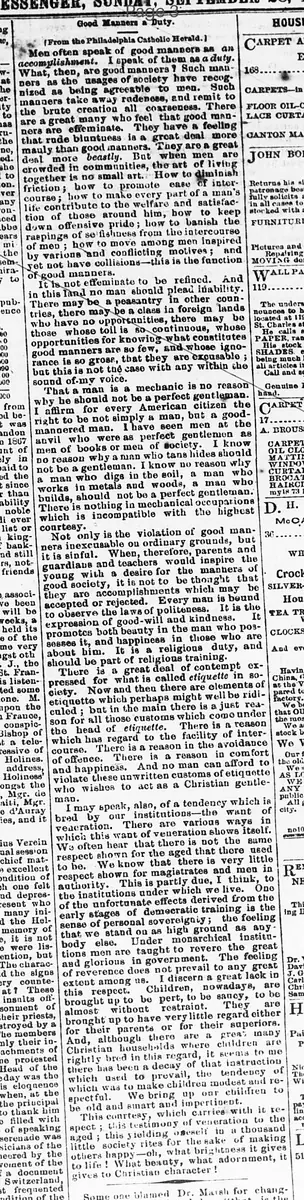
Men often speak of good manners as an accomplishment. I speak of them as a duty. What, then, are good manners? Such manners as the usages of society have recognized as being agreeable to men. Such manners take away rudeness, and remit to the brute creation all coarseness. There are a great many who feel that good manners are effeminate. They have a feeling that rude bluntness is a great deal more manly than good manners. They are a great deal more beastly. But when men are crowded in communities, the art of living together is no small art. How to diminish friction; how to promote ease of intercourse; how to make every part of a man's life contribute to the welfare and satisfaction of those around him, how to keep down offensive pride; how to banish the creepings of selfishness from the intercourse of men; how to move among men inspired by various and conflicting motives; and yet not have collisions-this is the function of good manners.
In this land no man should plead inability. It is not effeminate to be refined. And there may be a peasantry in other countries, there may be a class in foreign lands who have no opportunities, there may be those whose toil is so continuous, whose opportunities for knowing what constitutes good manners are so few, and whose ignorance is so gross, that they are excusable; but this is not the case with any within the sound of my voice. I affirm for every American citizen the why he should not be a perfect gentleman. That a man is a mechanic is no reason why he should not be a gentleman. I have seen men at the anvil who were as perfect gentlemen as men of books or men of society. I know no reason why a man who digs in the soil, a man who works in metals and woods, a man who builds, should not be a perfect gentleman. There is nothing in mechanical occupations which is incompatible with the highest courtesy.
Not only is the violation of good manners inexcusable on ordinary grounds, but it is sinful. When, therefore, parents and guardians and teachers would inspire the young with a desire for the manners of good society, it is not to be thought that they are accomplishments which may be accepted or rejected. Every man is bound to observe the laws of politeness. It is the expression of good-will and kindness. It promotes both beauty in the man who possesses it, and happiness in those who are about him. It is a religious duty, and should be part of religious training.
There is a great deal of contempt expressed for what is called etiquette in society. Now and then there are elements of etiquette which perhaps might well be ridiculed; but in the main there is a just reason for all those customs which come under the head of etiquette. There is a reason which has regard to the facility of intercourse. There is a reason in the avoidance of offence. There is a reason in comfort and happiness. And no man can afford to violate these unwritten customs of etiquette who wishes to act as a Christian gentleman.
I may speak, also, of a tendency which is bred by our institutions-the want of veneration. There are various ways in which this want of veneration shows itself. We often hear that there is not the same respect shown for the aged that there used to be. We know that there is very little respect shown for magistrates and men in authority. This is partly due, I think, to the institutions under which we live. One of the unfortunate effects derived from the early stages of democratic training is the sense of personal sovereignty; the feeling that we stand on as high ground as anybody else. Under monarchical institutions men are taught to revere the great and glorious in government. The feeling of reverence does not prevail to any great extent among us. I discern a great lack in this respect. Children, nowadays, are brought up to be pert, to be saucy, to be old and smart and impertinent. We bring up our children to be old and smart which carries with it disrespect. They are brought up to have very little regard either for their parents or for their superiors. And, although there are a great many Christian households where children are rightly bred in this regard, it seems to me there has been a decay of that instruction which used to prevail, the tendency of which was to make children modest and respectful. This courtesy, which carries with it respect; this testimony of veneration to the aged; this yielding oneself in a thousand little society rites for the sake of making others happy-oh, what brightness it gives to life! What beauty, what adornment, it gives to Christian character!
(From the Philadelphia Catholic Herald)
Men often speak of good manners as an accomplishment. I speak of them as a duty. What, then, are good manners? Such manners as the usages of society have recognized as being agreeable to men. Such manners take away rudeness, and remit to the brute creation all coarseness. There are a great many who feel that good manners are effeminate. They have a feeling that rude bluntness is a great deal more manly than good manners. They are a great deal more beastly. But when men are crowded in communities, the art of living together is no small art. How to diminish friction; how to promote ease of intercourse; how to make every part of a man's life contribute to the welfare and satisfaction of those around him, how to keep down offensive pride; how to banish the creepings of selfishness from the intercourse of men; how to move among men inspired by various and conflicting motives; and yet not have collisions-this is the function of good manners.
In this land no man should plead inability. It is not effeminate to be refined. And there may be a peasantry in other countries, there may be a class in foreign lands who have no opportunities, there may be those whose toil is so continuous, whose opportunities for knowing what constitutes good manners are so few, and whose ignorance is so gross, that they are excusable; but this is not the case with any within the sound of my voice. I affirm for every American citizen the why he should not be a perfect gentleman. That a man is a mechanic is no reason why he should not be a gentleman. I have seen men at the anvil who were as perfect gentlemen as men of books or men of society. I know no reason why a man who digs in the soil, a man who works in metals and woods, a man who builds, should not be a perfect gentleman. There is nothing in mechanical occupations which is incompatible with the highest courtesy.
Not only is the violation of good manners inexcusable on ordinary grounds, but it is sinful. When, therefore, parents and guardians and teachers would inspire the young with a desire for the manners of good society, it is not to be thought that they are accomplishments which may be accepted or rejected. Every man is bound to observe the laws of politeness. It is the expression of good-will and kindness. It promotes both beauty in the man who possesses it, and happiness in those who are about him. It is a religious duty, and should be part of religious training.
There is a great deal of contempt expressed for what is called etiquette in society. Now and then there are elements of etiquette which perhaps might well be ridiculed; but in the main there is a just reason for all those customs which come under the head of etiquette. There is a reason which has regard to the facility of intercourse. There is a reason in the avoidance of offence. There is a reason in comfort and happiness. And no man can afford to violate these unwritten customs of etiquette who wishes to act as a Christian gentleman.
I may speak, also, of a tendency which is bred by our institutions-the want of veneration. There are various ways in which this want of veneration shows itself. We often hear that there is not the same respect shown for the aged that there used to be. We know that there is very little respect shown for magistrates and men in authority. This is partly due, I think, to the institutions under which we live. One of the unfortunate effects derived from the early stages of democratic training is the sense of personal sovereignty; the feeling that we stand on as high ground as anybody else. Under monarchical institutions men are taught to revere the great and glorious in government. The feeling of reverence does not prevail to any great extent among us. I discern a great lack in this respect. Children, nowadays, are brought up to be pert, to be saucy, to be old and smart and impertinent. We bring up our children to be old and smart which carries with it disrespect. They are brought up to have very little regard either for their parents or for their superiors. And, although there are a great many Christian households where children are rightly bred in this regard, it seems to me there has been a decay of that instruction which used to prevail, the tendency of which was to make children modest and respectful. This courtesy, which carries with it respect; this testimony of veneration to the aged; this yielding oneself in a thousand little society rites for the sake of making others happy-oh, what brightness it gives to life! What beauty, what adornment, it gives to Christian character!
What sub-type of article is it?
Social Reform
Moral Or Religious
What keywords are associated?
Good Manners
Social Duty
Religious Training
Etiquette
Veneration
Democratic Society
Respect For Authority
Editorial Details
Primary Topic
Good Manners As A Moral And Religious Duty
Stance / Tone
Advocacy For Refined Manners And Respect In Society
Key Arguments
Good Manners Are A Duty, Not An Accomplishment, Essential For Harmonious Community Living
Rudeness Is Beastly And Effeminate Perceptions Are Misguided
No Excuse For Lacking Manners In America, Compatible With All Occupations Including Manual Labor
Violation Of Good Manners Is Sinful And A Religious Duty
Etiquette Serves Practical Purposes In Social Intercourse And Happiness
Democratic Institutions Foster Lack Of Veneration And Respect For Authority And The Aged
Children Should Be Raised With Modesty And Respect To Enhance Christian Character