Thank you for visiting SNEWPapers!
Sign up free
Foreign News
January 17, 1949
The Daily Alaska Empire
Juneau, Juneau County, Alaska
What is this article about?
A living fossil, a tiny transparent centipede-like shrimp from the ancient Phreatoidea group, discovered in wells of Benares, India. Dr. B. N. Chopra notes its ancestors date to over 100 million years ago, supporting Gondwana land theory.
Clipping
OCR Quality
98%
Excellent
Full Text
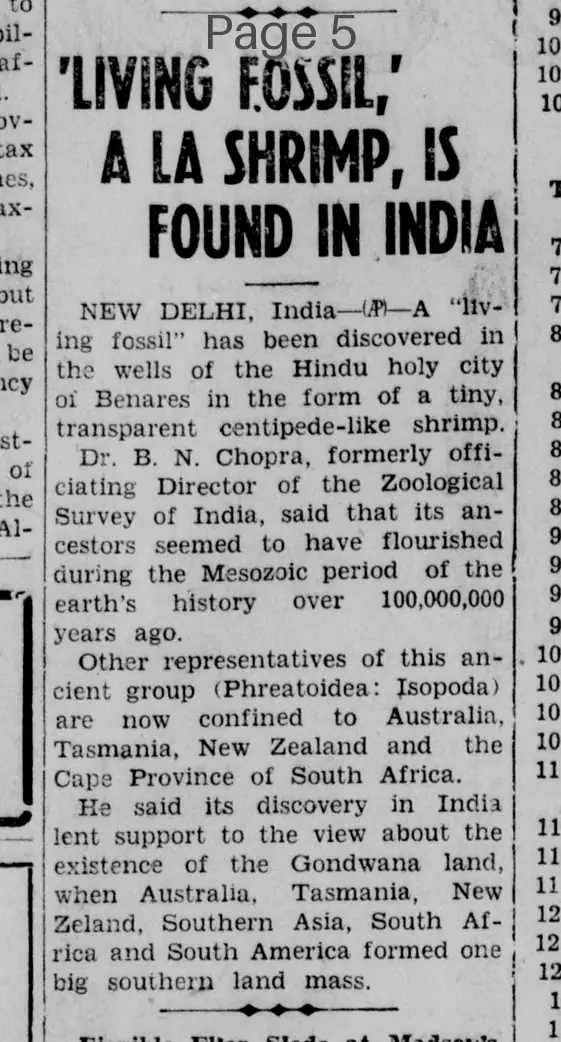
'LIVING FOSSIL, A LA SHRIMP, IS FOUND IN INDIA
NEW DELHI, India-(A)--A "living fossil" has been discovered in the wells of the Hindu holy city of Benares in the form of a tiny, transparent centipede-like shrimp.
Dr. B. N. Chopra, formerly officiating Director of the Zoological Survey of India, said that its ancestors seemed to have flourished during the Mesozoic period of the earth's history over 100,000,000 years ago.
Other representatives of this ancient group (Phreatoidea: Isopoda) are now confined to Australia, Tasmania, New Zealand and the Cape Province of South Africa.
He said its discovery in India lent support to the view about the existence of the Gondwana land, when Australia, Tasmania, New Zealand, Southern Asia, South Africa and South America formed one big southern land mass.
NEW DELHI, India-(A)--A "living fossil" has been discovered in the wells of the Hindu holy city of Benares in the form of a tiny, transparent centipede-like shrimp.
Dr. B. N. Chopra, formerly officiating Director of the Zoological Survey of India, said that its ancestors seemed to have flourished during the Mesozoic period of the earth's history over 100,000,000 years ago.
Other representatives of this ancient group (Phreatoidea: Isopoda) are now confined to Australia, Tasmania, New Zealand and the Cape Province of South Africa.
He said its discovery in India lent support to the view about the existence of the Gondwana land, when Australia, Tasmania, New Zealand, Southern Asia, South Africa and South America formed one big southern land mass.
What sub-type of article is it?
Scientific Discovery
Zoological Find
What keywords are associated?
Living Fossil
Shrimp
India
Benares
Phreatoidea
Gondwana
Mesozoic
What entities or persons were involved?
Dr. B. N. Chopra
Where did it happen?
Benares, India
Foreign News Details
Primary Location
Benares, India
Key Persons
Dr. B. N. Chopra
Outcome
discovery lends support to the existence of gondwana land.
Event Details
A tiny, transparent centipede-like shrimp, a living fossil, found in wells of Benares. Ancestors flourished in Mesozoic period over 100,000,000 years ago. Other representatives confined to Australia, Tasmania, New Zealand, and Cape Province of South Africa.