Thank you for visiting SNEWPapers!
Sign up free
Editorial
July 23, 1833
The New Hampshire Gazette
Portsmouth, Rockingham County, New Hampshire
What is this article about?
Satirical critique of the Portsmouth municipal committee's persistent efforts to obtain a written response from President Jackson regarding his unfulfilled visit to the city, questioning the involvement of William Claggett in the correspondence.
Clipping
OCR Quality
95%
Excellent
Full Text
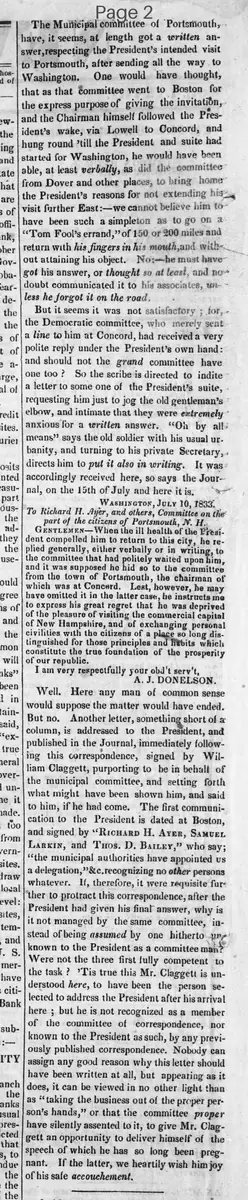
The Municipal committee of Portsmouth, have, it seems, at length got a written answer, respecting the President's intended visit to Portsmouth, after sending all the way to Washington. One would have thought, that as that committee went to Boston on the express purpose of giving the invitation, and the Chairman himself followed the President's wake, via Lowell to Concord, and hung round 'till the President and suite had started for Washington, he would have been able, at least verbally, as did the committee from Dover and other places, to bring home the President's reasons for not extending his visit further East: we cannot believe him to have been such a simpleton as to go on a "Tom Fool's errand," of 150 or 200 miles and return with his fingers in his mouth, and without attaining his object. No: he must have got his answer, or thought so at least, and no doubt communicated it to his associates, unless he forgot it on the road.
But it seems it was not satisfactory; for, the Democratic committee, who merely sent a line to him at Concord, had received a very polite reply under the President's own hand: and should not the grand committee have one too? So the scribe is directed to indite a letter to some one of the President's suite, requesting him just to jog the old gentleman's elbow, and intimate that they were extremely anxious for a written answer. "Oh by all means" says the old soldier with his usual urbanity, and turning to his private Secretary, directs him to put it also in writing. It was—accordingly received here, so says the Journal, on the 15th of July and here it is.
Washington, July 10, 1833.
To Richard H. Ayer, and others, Committee on the part of the citizens of Portsmouth, N. H.
GENTLEMEN—When the ill health of the President compelled him to return to this city, he replied generally, either verbally or in writing, to the committee that had politely waited upon him, and it was supposed he had so to the committee from the town of Portsmouth, the chairman of which was at Concord. Lest, however, he may have omitted it in the latter case, he instructs me to express his great regret that he was deprived of the pleasure of visiting the commercial capital of New Hampshire, and of exchanging personal civilities with the citizens of a place so long distinguished for those principles and habits which constitute the true foundation of the prosperity of our republic.
I am very respectfully your ob'dt serv't,
A. J. DONELSON.
Well. Here any man of common sense would suppose the matter would have ended. But no. Another letter, something short of a column, is addressed to the President, and published in the Journal, immediately following this correspondence, signed by William Claggett, purporting to be in behalf of the municipal committee, and setting forth what might have been shown him, and said to him, if he had come. The first communication to the President is dated at Boston, and signed by "RICHARD H. AYER, SAMUEL LARKIN, and THOS. D. BAILEY," who say; "the municipal authorities have appointed us a delegation,"&c. recognizing no other persons whatever. If, therefore, it were requisite further to protract this correspondence, after the President had given his final answer, why is it not managed by the same committee, instead of being assumed by one hitherto quite unknown to the President as a committee man?
Were not the three first fully competent to the task? 'Tis true this Mr. Claggett is understood here, to have been the person selected to address the President after his arrival here; but he is not recognized as a member of the committee of correspondence, nor known to the President as such, by any previously published correspondence. Nobody can assign any good reason why this letter should have been written at all, but appearing as it does, it can be viewed in no other light than as "taking the business out of the proper person's hands," or that the committee proper have silently assented to it, to give Mr. Claggett an opportunity to deliver himself of the speech of which he has so long been pregnant. If the latter, we heartily wish him joy of his safe accouchement.
But it seems it was not satisfactory; for, the Democratic committee, who merely sent a line to him at Concord, had received a very polite reply under the President's own hand: and should not the grand committee have one too? So the scribe is directed to indite a letter to some one of the President's suite, requesting him just to jog the old gentleman's elbow, and intimate that they were extremely anxious for a written answer. "Oh by all means" says the old soldier with his usual urbanity, and turning to his private Secretary, directs him to put it also in writing. It was—accordingly received here, so says the Journal, on the 15th of July and here it is.
Washington, July 10, 1833.
To Richard H. Ayer, and others, Committee on the part of the citizens of Portsmouth, N. H.
GENTLEMEN—When the ill health of the President compelled him to return to this city, he replied generally, either verbally or in writing, to the committee that had politely waited upon him, and it was supposed he had so to the committee from the town of Portsmouth, the chairman of which was at Concord. Lest, however, he may have omitted it in the latter case, he instructs me to express his great regret that he was deprived of the pleasure of visiting the commercial capital of New Hampshire, and of exchanging personal civilities with the citizens of a place so long distinguished for those principles and habits which constitute the true foundation of the prosperity of our republic.
I am very respectfully your ob'dt serv't,
A. J. DONELSON.
Well. Here any man of common sense would suppose the matter would have ended. But no. Another letter, something short of a column, is addressed to the President, and published in the Journal, immediately following this correspondence, signed by William Claggett, purporting to be in behalf of the municipal committee, and setting forth what might have been shown him, and said to him, if he had come. The first communication to the President is dated at Boston, and signed by "RICHARD H. AYER, SAMUEL LARKIN, and THOS. D. BAILEY," who say; "the municipal authorities have appointed us a delegation,"&c. recognizing no other persons whatever. If, therefore, it were requisite further to protract this correspondence, after the President had given his final answer, why is it not managed by the same committee, instead of being assumed by one hitherto quite unknown to the President as a committee man?
Were not the three first fully competent to the task? 'Tis true this Mr. Claggett is understood here, to have been the person selected to address the President after his arrival here; but he is not recognized as a member of the committee of correspondence, nor known to the President as such, by any previously published correspondence. Nobody can assign any good reason why this letter should have been written at all, but appearing as it does, it can be viewed in no other light than as "taking the business out of the proper person's hands," or that the committee proper have silently assented to it, to give Mr. Claggett an opportunity to deliver himself of the speech of which he has so long been pregnant. If the latter, we heartily wish him joy of his safe accouchement.
What sub-type of article is it?
Partisan Politics
Satire
What keywords are associated?
Portsmouth Committee
President Jackson Visit
Written Response
William Claggett
Partisan Correspondence
Satirical Critique
What entities or persons were involved?
President Jackson
Richard H. Ayer
Samuel Larkin
Thos. D. Bailey
William Claggett
A. J. Donelson
Portsmouth Municipal Committee
Democratic Committee
Editorial Details
Primary Topic
Criticism Of Portsmouth Committee's Handling Of President Jackson's Visit Invitation
Stance / Tone
Satirical Mockery Of Committee's Persistence And Internal Dynamics
Key Figures
President Jackson
Richard H. Ayer
Samuel Larkin
Thos. D. Bailey
William Claggett
A. J. Donelson
Portsmouth Municipal Committee
Democratic Committee
Key Arguments
Committee Unnecessarily Prolonged Correspondence After Verbal Response
Claggett's Letter Usurps Authority Of Original Committee Members
No Good Reason For Additional Letter After President's Regret Expressed
Suggests Internal Committee Assent To Give Claggett Speaking Opportunity