Thank you for visiting SNEWPapers!
Sign up free
Editorial
March 28, 1828
Delaware Journal
Wilmington, New Castle County, Delaware
What is this article about?
Editorial defends Adams administration against Jacksonian attacks, excuses initial Jackson support due to misinformation, exposes opposition lies, and highlights Jacksonians' role in opposing domestic industry protection via a congressional committee report.
Clipping
OCR Quality
98%
Excellent
Full Text
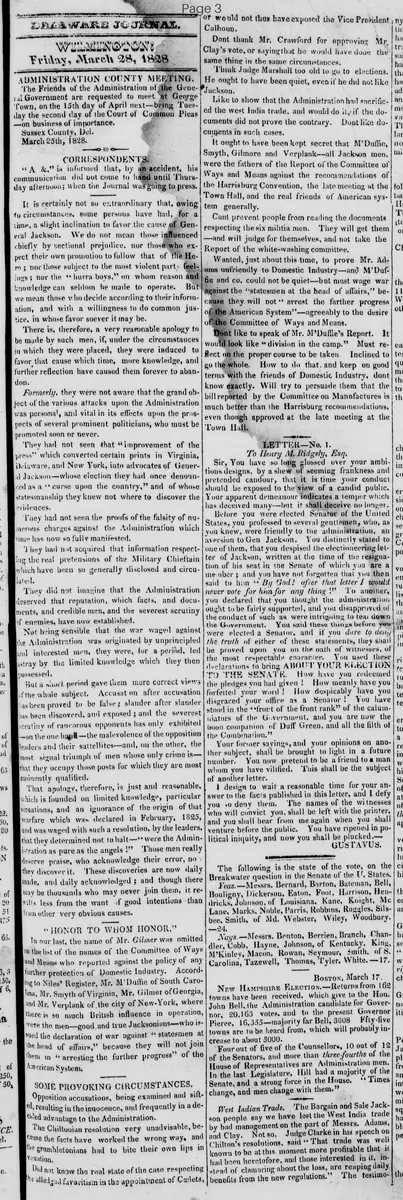
CORRESPONDENTS.
"A &." is informed that, by an accident, his communication did not come to hand until Thursday afternoon; when the Journal was going to press.
It is certainly not so extraordinary that, owing to circumstances, some persons have had, for a time, a slight inclination to favor the cause of General Jackson. We do not mean those influenced chiefly by sectional prejudice, nor those who expect their own promotion to follow that of the Hero; nor those subject to the most violent party feelings; nor the "hurra boys," on whom reason and knowledge can seldom be made to operate. But we mean those who decide according to their information, and with a willingness to do common justice, in whose favor soever it may be.
There is, therefore, a very reasonable apology to be made by such men, if, under the circumstances in which they were placed, they were induced to favor that cause which time, more knowledge, and further reflection have caused them forever to abandon.
Formerly, they were not aware that the grand object of the various attacks upon the Administration was personal, and vital in its effects upon the prospects of several prominent politicians, who must be promoted soon or never.
They had not seen that "improvement of the press" which converted certain prints in Virginia, Delaware, and New York, into advocates of General Jackson—whose election they had once denounced as a "curse upon the country," and of whose statesmanship they knew not where to discover the evidences.
They had not seen the proofs of the falsity of numerous charges against the Administration which time has now so fully manifested.
They had not acquired that information respecting the real pretensions of the Military Chieftain which have been so generally disclosed and circulated.
They did not imagine that the Administration deserved that reputation, which facts, and documents, and credible men, and the severest scrutiny of enemies, have now established.
Not being sensible that the war waged against the Administration was originated by unprincipled and interested men, they were, for a period, led astray by the limited knowledge which they then possessed.
But a short period gave them more correct views of the whole subject. Accusation after accusation has been proved to be false; slander after slander has been discovered, and exposed; and the severest scrutiny of rancorous opponents has only exhibited—on the one hand—the malevolence of the opposition leaders and their satellites—and, on the other, the most signal triumph of men whose only crime is—that they occupy those posts for which they are most eminently qualified.
That apology, therefore, is just and reasonable, which is founded on limited knowledge, particular situations, and an ignorance of the origin of that warfare which was declared in February, 1825, and was waged with such a resolution, by the leaders, that they determined not to halt—"were the Administration as pure as the angels!" Those men really deserve praise, who acknowledge their error, no: they discover it. These discoveries are now daily made, and daily acknowledged; and though there may be thousands who may never join them, it results less from the want of good intentions than from other very obvious causes.
"HONOR TO WHOM HONOR."
In our last, the name of Mr. Gilmer was omitted in the list of the names of the Committee of Ways and Means who reported against the policy of any further protection of Domestic Industry. According to Niles' Register, Mr. M'Duffie of South Carolina, Mr. Smyth of Virginia, Mr. Gilmer of Georgia, and Mr. Verplank of the city of New-York, where there is so much British influence in operation, were the men—good and true Jacksonians—who issued the declaration of war against "statesmen at the head of affairs," because they will not join them in "arresting the further progress" of the American System:
SOME PROVOKING CIRCUMSTANCES.
Opposition accusations, being examined and sifted, resulting in the innocence, and frequently in a decided advantage to the Administration.
The Chiltonian resolution very unadvisable, because the facts have worked the wrong way, and the grumbletonians had to bite their own lips in vexation.
Did not know the real state of the case respecting the alleged favoritism in the appointment of Cadets, or would not thus have exposed the Vice President Calhoun.
Dont thank Mr. Crawford for approving Mr. Clay's vote, or saying that he would have done the same thing in the same circumstances.
Think Judge Marshall too old to go to elections. He ought to have been quiet, even if he did not like Jackson.
Like to show that the Administration had sacrificed the west India trade, and would do it, if the documents did not prove the contrary. Dont like documents in such cases.
It ought to have been kept secret that M'Duffie, Smyth, Gilmer and Verplank—all Jackson men. were the fathers of the Report of the Committee of Ways and Means against the recommendations of the Harrisburg Convention, the late meeting at the Town Hall, and the real friends of American system generally.
Cant prevent people from reading the documents respecting the six militia men. They will get them—and will judge for themselves, and not take the Report of the white-washing committee.
Wanted, just about this time, to prove Mr. Adams unfriendly to Domestic Industry—and M'Duffie and co. could not be quiet—but must wage war against the "statesmen at the head of affairs," because they will not "arrest the farther progress of the American System"—agreeably to the desire of the Committee of Ways and Means.
Dont like to speak of Mr. M'Duffie's Report. It would look like "division in the camp." Must reflect on the proper course to be taken. Inclined to go the whole. How to do that, and keep on good terms with the friends of Domestic Industry, dont know exactly. Will try to persuade them that the bill reported by the Committee on Manufactures is much better than the Harrisburg recommendations, even though approved at the late meeting at the Town Hall.
"A &." is informed that, by an accident, his communication did not come to hand until Thursday afternoon; when the Journal was going to press.
It is certainly not so extraordinary that, owing to circumstances, some persons have had, for a time, a slight inclination to favor the cause of General Jackson. We do not mean those influenced chiefly by sectional prejudice, nor those who expect their own promotion to follow that of the Hero; nor those subject to the most violent party feelings; nor the "hurra boys," on whom reason and knowledge can seldom be made to operate. But we mean those who decide according to their information, and with a willingness to do common justice, in whose favor soever it may be.
There is, therefore, a very reasonable apology to be made by such men, if, under the circumstances in which they were placed, they were induced to favor that cause which time, more knowledge, and further reflection have caused them forever to abandon.
Formerly, they were not aware that the grand object of the various attacks upon the Administration was personal, and vital in its effects upon the prospects of several prominent politicians, who must be promoted soon or never.
They had not seen that "improvement of the press" which converted certain prints in Virginia, Delaware, and New York, into advocates of General Jackson—whose election they had once denounced as a "curse upon the country," and of whose statesmanship they knew not where to discover the evidences.
They had not seen the proofs of the falsity of numerous charges against the Administration which time has now so fully manifested.
They had not acquired that information respecting the real pretensions of the Military Chieftain which have been so generally disclosed and circulated.
They did not imagine that the Administration deserved that reputation, which facts, and documents, and credible men, and the severest scrutiny of enemies, have now established.
Not being sensible that the war waged against the Administration was originated by unprincipled and interested men, they were, for a period, led astray by the limited knowledge which they then possessed.
But a short period gave them more correct views of the whole subject. Accusation after accusation has been proved to be false; slander after slander has been discovered, and exposed; and the severest scrutiny of rancorous opponents has only exhibited—on the one hand—the malevolence of the opposition leaders and their satellites—and, on the other, the most signal triumph of men whose only crime is—that they occupy those posts for which they are most eminently qualified.
That apology, therefore, is just and reasonable, which is founded on limited knowledge, particular situations, and an ignorance of the origin of that warfare which was declared in February, 1825, and was waged with such a resolution, by the leaders, that they determined not to halt—"were the Administration as pure as the angels!" Those men really deserve praise, who acknowledge their error, no: they discover it. These discoveries are now daily made, and daily acknowledged; and though there may be thousands who may never join them, it results less from the want of good intentions than from other very obvious causes.
"HONOR TO WHOM HONOR."
In our last, the name of Mr. Gilmer was omitted in the list of the names of the Committee of Ways and Means who reported against the policy of any further protection of Domestic Industry. According to Niles' Register, Mr. M'Duffie of South Carolina, Mr. Smyth of Virginia, Mr. Gilmer of Georgia, and Mr. Verplank of the city of New-York, where there is so much British influence in operation, were the men—good and true Jacksonians—who issued the declaration of war against "statesmen at the head of affairs," because they will not join them in "arresting the further progress" of the American System:
SOME PROVOKING CIRCUMSTANCES.
Opposition accusations, being examined and sifted, resulting in the innocence, and frequently in a decided advantage to the Administration.
The Chiltonian resolution very unadvisable, because the facts have worked the wrong way, and the grumbletonians had to bite their own lips in vexation.
Did not know the real state of the case respecting the alleged favoritism in the appointment of Cadets, or would not thus have exposed the Vice President Calhoun.
Dont thank Mr. Crawford for approving Mr. Clay's vote, or saying that he would have done the same thing in the same circumstances.
Think Judge Marshall too old to go to elections. He ought to have been quiet, even if he did not like Jackson.
Like to show that the Administration had sacrificed the west India trade, and would do it, if the documents did not prove the contrary. Dont like documents in such cases.
It ought to have been kept secret that M'Duffie, Smyth, Gilmer and Verplank—all Jackson men. were the fathers of the Report of the Committee of Ways and Means against the recommendations of the Harrisburg Convention, the late meeting at the Town Hall, and the real friends of American system generally.
Cant prevent people from reading the documents respecting the six militia men. They will get them—and will judge for themselves, and not take the Report of the white-washing committee.
Wanted, just about this time, to prove Mr. Adams unfriendly to Domestic Industry—and M'Duffie and co. could not be quiet—but must wage war against the "statesmen at the head of affairs," because they will not "arrest the farther progress of the American System"—agreeably to the desire of the Committee of Ways and Means.
Dont like to speak of Mr. M'Duffie's Report. It would look like "division in the camp." Must reflect on the proper course to be taken. Inclined to go the whole. How to do that, and keep on good terms with the friends of Domestic Industry, dont know exactly. Will try to persuade them that the bill reported by the Committee on Manufactures is much better than the Harrisburg recommendations, even though approved at the late meeting at the Town Hall.
What sub-type of article is it?
Partisan Politics
Economic Policy
What keywords are associated?
Jackson Support
Adams Administration
American System
Domestic Industry
Partisan Opposition
Protectionism
Committee Report
Calhoun Exposure
What entities or persons were involved?
General Jackson
Administration
Mr. Gilmer
Mr. M'duffie
Mr. Smyth
Mr. Verplank
Vice President Calhoun
Mr. Crawford
Mr. Clay
Judge Marshall
Editorial Details
Primary Topic
Defense Of Adams Administration And Critique Of Jacksonian Opposition
Stance / Tone
Strongly Pro Adams Administration, Anti Jacksonian
Key Figures
General Jackson
Administration
Mr. Gilmer
Mr. M'duffie
Mr. Smyth
Mr. Verplank
Vice President Calhoun
Mr. Crawford
Mr. Clay
Judge Marshall
Key Arguments
Initial Support For Jackson Due To Limited Knowledge Is Understandable But Now Abandoned
Attacks On Administration Are Personal And Motivated By Politicians' Ambitions
Press Improvements Converted Some Papers To Jackson Advocates Despite Prior Denunciations
Charges Against Administration Proven False
Real Pretensions Of Jackson Disclosed
Administration's Reputation Established By Facts And Scrutiny
Opposition War Originated By Unprincipled Men In February 1825
Committee Of Ways And Means Against Domestic Industry Protection Led By Jacksonians
Opposition Accusations Backfire, Proving Administration Innocence
Frustrations Of Opposition In Various Policy Areas Like Cadets, Trade, Militia