Thank you for visiting SNEWPapers!
Sign up free
Literary
August 27, 1834
Morning Star
Limerick, York County, Maine
What is this article about?
A narrative retelling from the Book of Daniel describes King Nebuchadnezzar strolling through the lush hanging gardens of Babylon, admiring his grand city, and succumbing to pride. A heavenly voice then declares his kingdom lost, dooming him to live like an ox for seven years until he recognizes God's sovereignty.
Clipping
OCR Quality
95%
Excellent
Full Text
Children's Department.
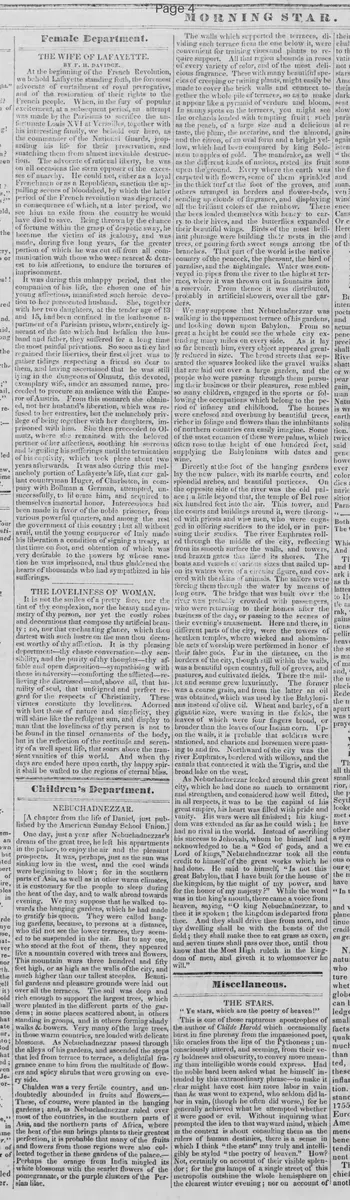
NEBUCHADNEZZAR.
[A chapter from the life of Daniel, just published by the American Sunday School Union.]
One day, just a year after Nebuchadnezzar's dream of the great tree, he left his apartments in the palace, to enjoy the air and the pleasant prospects. It was, perhaps, just as the sun was sinking low in the west, and the cool winds were beginning to blow; for in the southern parts of Asia, as well as in other warm climates, it is customary for the people to sleep during the heat of the day, and to walk abroad towards evening. We may suppose that he walked towards the hanging gardens, which he had made to gratify his queen. They were called hanging gardens, because, to persons at a distance, who did not see the lower terraces, they seemed to be suspended in the air. But to any one, who stood at the foot of them, they appeared like a mountain covered with trees and flowers. This mountain was three hundred and fifty feet high, or as high as the walls of the city, and much higher than our tallest steeples. Beautiful gardens and pleasure grounds were laid out over all the terraces. The soil was deep and rich enough to support the largest trees, which were planted in the different parts of the gardens; in some places scattered about, in others standing in groups, and in others forming shady walks & bowers. Very many of the large trees, in those warm countries, are loaded with delicate blossoms. As Nebuchadnezzar passed through the alleys of his gardens, and ascended the steps that led from terrace to terrace, a delightful fragrance came to him from the multitude of flowers and spicy shrubs that were growing on every side.
Chaldea was a very fertile country, and undoubtedly abounded in fruits and flowers.—These, of course, were planted in the hanging gardens; and, as Nebuchadnezzar ruled over most of the countries, in the southern parts of Asia, and the northern parts of Africa, where the heat of the sun brings plants to their greatest perfection, it is probable that many of the fruits and flowers from those regions were also collected together in these gardens of the palace.—Perhaps the orange from India mingled its white blossoms with the scarlet flowers of the pomegranate, or the purple clusters of the Persian lilac.
The walls which supported the terraces, dividing each terrace from the one below it, were convenient for training vines and plants to require support. All that region abounds in roses of every variety of color, and of the most delicious fragrance. These with many beautiful species of creeping or twining plants, might easily be made to cover the brick walls and connect together the whole pile of terraces, so as to make it appear like a pyramid of verdure and bloom. In sunny spots on the terraces, you might see the orchards loaded with tempting fruit; such as the peach, of a large size and a delicious taste, the plum, the nectarine, and the almond, and the citron, of an oval form and a bright yellow, which had been compared by king Solomon to apples of gold. The mandrake, as well as the different kinds of melons, rested its fruit upon the ground. Everywhere the earth was carpeted with flowers, some of them sprinkled in the thick turf at the foot of the groves, and others arranged in borders and flower-beds, sending up clouds of fragrance, and displaying all the brilliant colors of the rainbow. There the bees loaded themselves with honey to carry to their hives, and the butterflies expanded their beautiful wings. Birds of the most brilliant plumage were building their nests in the trees, or pouring forth sweet songs among the branches. That part of the world is the native country of the peacock, the pheasant, the bird of paradise, and the nightingale. Water was conveyed in pipes from the river to the highest terrace, where it was thrown out in fountains into a reservoir. From thence it was distributed, probably in artificial showers, over all the gardens.
We may suppose that Nebuchadnezzar was walking in the uppermost terrace of his gardens, and looking down upon Babylon. From so great a height he could see the whole city extending many miles on every side. As it lay so far beneath him, every object appeared greatly reduced in size. The broad streets that separated the squares looked like the gravel walks that are laid out over a large garden, and the people who were passing through them pursuing their business or their pleasures, resembled so many children, engaged in the sports or following the occupations which belong to the period of infancy and childhood. The houses were enclosed and overhung by beautiful trees, richer in foliage and flowers than the inhabitants of northern countries can easily imagine. Some of the most common of these were palms, which often rose to the height of one hundred feet, supplying the Babylonians with dates and wine.
Directly at the foot of the hanging gardens lay the new palace, with its marble courts, and splendid arches, and beautiful porticoes. On the opposite side of the river was the old palace; a little beyond that, the temple of Bel rose six hundred feet into the air. This tower, and the courts and buildings around it, were thronged with priests and wise men, who were engaged in offering sacrifices to the idol, or in pursuing their studies. The river Euphrates rolled through the middle of the city, reflecting from its smooth surface the walls, and towers, and brazen gates that lined its shores. The boats and vessels of various sizes that sailed upon its waters were of a circular figure, and covered with the skins of animals. The sailors were forcing them through the water by means of long oars. The bridge that was built over the river was probably crowded with passengers, who were returning to their homes after the business of the day, or passing to the scenes of their evening's amusement. Here and there, in different parts of the city, were the towers of heathen temples, where wicked and abominable acts of worship were performed in honor of their false gods. Far in the distance, on the borders of the city, though still within the walls, was a beautiful open country, full of groves, and pastures, and cultivated fields. There the millet and sesame grew luxuriantly. The former was a coarse grain, and from the latter an oil was obtained, which was used by the Babylonians instead of olive oil. Wheat and barley, of a gigantic size, were waving in the fields, the leaves of which were four fingers broad, or broader than the leaves of our Indian corn. Upon the walls, it is probable that soldiers were stationed, and chariots and horsemen were passing to and fro. Northward of the city was the river Euphrates, bordered with willows, and the canals that connected it with the Tigris, and the broad lake on the west.
As Nebuchadnezzar looked around this great city, which he had done so much to ornament and strengthen, and considered how well fitted, in all respects, it was to be the capital of his great empire, his heart was filled with pride and vanity. His wars were all finished; his kingdom was extended as far as he could wish; he had no rival in the world. Instead of ascribing his success to Jehovah, whom he himself had acknowledged to be a "God of gods, and a Lord of kings," Nebuchadnezzar took all the credit to himself of the great works which he had done. He said to himself, "Is not this great Babylon, that I have built for the house of the kingdom, by the might of my power, and for the honor of my majesty?" While the word was in the king's mouth, there came a voice from heaven, saying, "O king Nebuchadnezzar, to thee it is spoken; the kingdom is departed from thee. And they shall drive thee from men, and thy dwelling shall be with the beasts of the field; they shall make thee to eat grass as oxen, and seven times shall pass over thee, until thou know that the Most High ruleth in the kingdom of men, and giveth it to whomsoever he will."
NEBUCHADNEZZAR.
[A chapter from the life of Daniel, just published by the American Sunday School Union.]
One day, just a year after Nebuchadnezzar's dream of the great tree, he left his apartments in the palace, to enjoy the air and the pleasant prospects. It was, perhaps, just as the sun was sinking low in the west, and the cool winds were beginning to blow; for in the southern parts of Asia, as well as in other warm climates, it is customary for the people to sleep during the heat of the day, and to walk abroad towards evening. We may suppose that he walked towards the hanging gardens, which he had made to gratify his queen. They were called hanging gardens, because, to persons at a distance, who did not see the lower terraces, they seemed to be suspended in the air. But to any one, who stood at the foot of them, they appeared like a mountain covered with trees and flowers. This mountain was three hundred and fifty feet high, or as high as the walls of the city, and much higher than our tallest steeples. Beautiful gardens and pleasure grounds were laid out over all the terraces. The soil was deep and rich enough to support the largest trees, which were planted in the different parts of the gardens; in some places scattered about, in others standing in groups, and in others forming shady walks & bowers. Very many of the large trees, in those warm countries, are loaded with delicate blossoms. As Nebuchadnezzar passed through the alleys of his gardens, and ascended the steps that led from terrace to terrace, a delightful fragrance came to him from the multitude of flowers and spicy shrubs that were growing on every side.
Chaldea was a very fertile country, and undoubtedly abounded in fruits and flowers.—These, of course, were planted in the hanging gardens; and, as Nebuchadnezzar ruled over most of the countries, in the southern parts of Asia, and the northern parts of Africa, where the heat of the sun brings plants to their greatest perfection, it is probable that many of the fruits and flowers from those regions were also collected together in these gardens of the palace.—Perhaps the orange from India mingled its white blossoms with the scarlet flowers of the pomegranate, or the purple clusters of the Persian lilac.
The walls which supported the terraces, dividing each terrace from the one below it, were convenient for training vines and plants to require support. All that region abounds in roses of every variety of color, and of the most delicious fragrance. These with many beautiful species of creeping or twining plants, might easily be made to cover the brick walls and connect together the whole pile of terraces, so as to make it appear like a pyramid of verdure and bloom. In sunny spots on the terraces, you might see the orchards loaded with tempting fruit; such as the peach, of a large size and a delicious taste, the plum, the nectarine, and the almond, and the citron, of an oval form and a bright yellow, which had been compared by king Solomon to apples of gold. The mandrake, as well as the different kinds of melons, rested its fruit upon the ground. Everywhere the earth was carpeted with flowers, some of them sprinkled in the thick turf at the foot of the groves, and others arranged in borders and flower-beds, sending up clouds of fragrance, and displaying all the brilliant colors of the rainbow. There the bees loaded themselves with honey to carry to their hives, and the butterflies expanded their beautiful wings. Birds of the most brilliant plumage were building their nests in the trees, or pouring forth sweet songs among the branches. That part of the world is the native country of the peacock, the pheasant, the bird of paradise, and the nightingale. Water was conveyed in pipes from the river to the highest terrace, where it was thrown out in fountains into a reservoir. From thence it was distributed, probably in artificial showers, over all the gardens.
We may suppose that Nebuchadnezzar was walking in the uppermost terrace of his gardens, and looking down upon Babylon. From so great a height he could see the whole city extending many miles on every side. As it lay so far beneath him, every object appeared greatly reduced in size. The broad streets that separated the squares looked like the gravel walks that are laid out over a large garden, and the people who were passing through them pursuing their business or their pleasures, resembled so many children, engaged in the sports or following the occupations which belong to the period of infancy and childhood. The houses were enclosed and overhung by beautiful trees, richer in foliage and flowers than the inhabitants of northern countries can easily imagine. Some of the most common of these were palms, which often rose to the height of one hundred feet, supplying the Babylonians with dates and wine.
Directly at the foot of the hanging gardens lay the new palace, with its marble courts, and splendid arches, and beautiful porticoes. On the opposite side of the river was the old palace; a little beyond that, the temple of Bel rose six hundred feet into the air. This tower, and the courts and buildings around it, were thronged with priests and wise men, who were engaged in offering sacrifices to the idol, or in pursuing their studies. The river Euphrates rolled through the middle of the city, reflecting from its smooth surface the walls, and towers, and brazen gates that lined its shores. The boats and vessels of various sizes that sailed upon its waters were of a circular figure, and covered with the skins of animals. The sailors were forcing them through the water by means of long oars. The bridge that was built over the river was probably crowded with passengers, who were returning to their homes after the business of the day, or passing to the scenes of their evening's amusement. Here and there, in different parts of the city, were the towers of heathen temples, where wicked and abominable acts of worship were performed in honor of their false gods. Far in the distance, on the borders of the city, though still within the walls, was a beautiful open country, full of groves, and pastures, and cultivated fields. There the millet and sesame grew luxuriantly. The former was a coarse grain, and from the latter an oil was obtained, which was used by the Babylonians instead of olive oil. Wheat and barley, of a gigantic size, were waving in the fields, the leaves of which were four fingers broad, or broader than the leaves of our Indian corn. Upon the walls, it is probable that soldiers were stationed, and chariots and horsemen were passing to and fro. Northward of the city was the river Euphrates, bordered with willows, and the canals that connected it with the Tigris, and the broad lake on the west.
As Nebuchadnezzar looked around this great city, which he had done so much to ornament and strengthen, and considered how well fitted, in all respects, it was to be the capital of his great empire, his heart was filled with pride and vanity. His wars were all finished; his kingdom was extended as far as he could wish; he had no rival in the world. Instead of ascribing his success to Jehovah, whom he himself had acknowledged to be a "God of gods, and a Lord of kings," Nebuchadnezzar took all the credit to himself of the great works which he had done. He said to himself, "Is not this great Babylon, that I have built for the house of the kingdom, by the might of my power, and for the honor of my majesty?" While the word was in the king's mouth, there came a voice from heaven, saying, "O king Nebuchadnezzar, to thee it is spoken; the kingdom is departed from thee. And they shall drive thee from men, and thy dwelling shall be with the beasts of the field; they shall make thee to eat grass as oxen, and seven times shall pass over thee, until thou know that the Most High ruleth in the kingdom of men, and giveth it to whomsoever he will."
What sub-type of article is it?
Prose Fiction
What themes does it cover?
Religious
Moral Virtue
Political
What keywords are associated?
Nebuchadnezzar
Babylon
Hanging Gardens
Pride
Divine Punishment
Euphrates
Chaldea
What entities or persons were involved?
A Chapter From The Life Of Daniel, Just Published By The American Sunday School Union.
Literary Details
Title
Nebuchadnezzar.
Author
A Chapter From The Life Of Daniel, Just Published By The American Sunday School Union.
Form / Style
Narrative Retelling Of A Biblical Event In Descriptive Prose.
Key Lines
Is Not This Great Babylon, That I Have Built For The House Of The Kingdom, By The Might Of My Power, And For The Honor Of My Majesty?
O King Nebuchadnezzar, To Thee It Is Spoken; The Kingdom Is Departed From Thee. And They Shall Drive Thee From Men, And Thy Dwelling Shall Be With The Beasts Of The Field; They Shall Make Thee To Eat Grass As Oxen, And Seven Times Shall Pass Over Thee, Until Thou Know That The Most High Ruleth In The Kingdom Of Men, And Giveth It To Whomsoever He Will.