Thank you for visiting SNEWPapers!
Sign up free
Alexandria Daily Gazette, Commercial & Political
Alexandria, Virginia
What is this article about?
U.S. House of Representatives session on November 21, 1811, featured petitions from merchants on British imports, election contest report for Virginia's John P. Hungerford, widow's claim for war office fire damage, and debate on resolution for duties on imported manufactures of flax, hemp, cotton, wool, lead, including amendments and votes.
Clipping
OCR Quality
Full Text
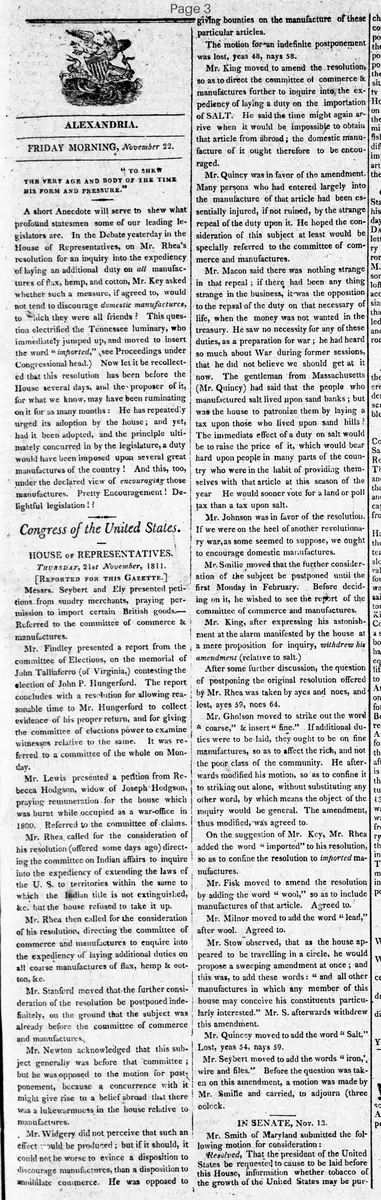
HOUSE OF REPRESENTATIVES.
Thursday, 21st November, 1811.
[REPORTED FOR THIS GAZETTE.]
Messrs. Seybert and Ely presented petitions from sundry merchants, praying permission to import certain British goods. Referred to the committee of commerce & manufactures.
Mr. Findley presented a report from the committee of Elections, on the memorial of John Talliaferro (of Virginia,) contesting the election of John P. Hungerford. The report concludes with a resolution for allowing reasonable time to Mr. Hungerford to collect evidence of his proper return, and for giving the committee of elections power to examine witnesses relative to the same. It was referred to a committee of the whole on Monday.
Mr. Lewis presented a petition from Rebecca Hodgson, widow of Joseph Hodgson, praying remuneration for the house which was burnt while occupied as a war-office in 1800. Referred to the committee of claims.
Mr. Rhea called for the consideration of his resolution (offered some days ago) directing the committee on Indian affairs to inquire into the expediency of extending the laws of the U. S. to territories within the same to which the Indian title is not extinguished, &c. but the house refused to take it up.
Mr. Rhea then called for the consideration of his resolution, directing the committee of commerce and manufactures to enquire into the expediency of laying additional duties on all coarse manufactures of flax, hemp & cotton, &c.
Mr. Stanford moved that the further consideration of the resolution be postponed indefinitely, on the ground that the subject was already before the committee of commerce and manufactures.
Mr. Newton acknowledged that this subject generally was before that committee; but he was opposed to the motion for postponement, because a concurrence with it might give rise to a belief abroad that there was a lukewarmness in the house relative to manufactures.
Mr. Widgery did not perceive that such an effect would be produced; but if it should, it could not be worse to evince a disposition to discourage manufactures, than a disposition to annihilate commerce. He was opposed to giving bounties on the manufacture of these particular articles.
The motion for an indefinite postponement was lost, yeas 48, nays 58.
Mr. King moved to amend the resolution, so as to direct the committee of commerce & manufactures further to inquire into the expediency of laying a duty on the importation of SALT. He said the time might again arrive when it would be impossible to obtain that article from abroad; the domestic manufacture of it ought therefore to be encouraged.
Mr. Quincy was in favor of the amendment. Many persons who had entered largely into the manufacture of that article had been essentially injured, if not ruined, by the strange repeal of the duty upon it. He hoped the consideration of this subject at least would be specially referred to the committee of commerce and manufactures.
Mr. Macon said there was nothing strange in that repeal; if there had been any thing strange in the business, it was the opposition to the repeal of the duty on that necessary of life, when the money was not wanted in the treasury. He saw no necessity for any of these duties, as a preparation for war; he had heard so much about War during former sessions, that he did not believe we should get at it now. The gentleman from Massachusetts (Mr. Quincy) had said that the people who manufactured salt lived upon sand banks; but was the house to patronize them by laying a tax upon those who lived upon sand hills? The immediate effect of a duty on salt would be to raise the price of it, which would bear hard upon people in many parts of the country who were in the habit of providing themselves with that article at this season of the year. He would sooner vote for a land or poll tax than a tax upon salt.
Mr. Johnson was in favor of the resolution. If we were on the eve of another revolutionary war, as some seemed to suppose, we ought to encourage domestic manufactures.
Mr. Smilie moved that the further consideration of the subject be postponed until the first Monday in February. Before deciding on it, he wished to see the report of the committee of commerce and manufactures.
Mr. King, after expressing his astonishment at the alarm manifested by the house at a mere proposition for inquiry, withdrew his amendment (relative to salt.)
After some further discussion; the question of postponing the original resolution offered by Mr. Rhea was taken by ayes and noes, and lost, ayes 59, noes 64.
Mr. Gholson moved to strike out the word "coarse," & insert "fine." If additional duties were to be laid, they ought to be on fine manufactures, so as to affect the rich, and not the poor class of the community. He afterwards modified his motion, so as to confine it to striking out alone, without substituting any other word, by which means the object of the inquiry would be general. The amendment, thus modified, was agreed to.
On the suggestion of Mr. Key, Mr. Rhea added the word "imported" to his resolution, so as to confine the resolution to imported manufactures.
Mr. Fisk moved to amend the resolution by adding the word "wool," so as to include manufactures of that article. Agreed to.
Mr. Milnor moved to add the word "lead," after wool. Agreed to.
Mr. Stow observed, that as the house appeared to be travelling in a circle, he would propose a sweeping amendment at once; and this was, to add these words: "and all other manufactures in which any member of this house may conceive his constituents particularly interested." Mr. S. afterwards withdrew this amendment.
Mr. Quincy moved to add the word "Salt." Lost, yeas 54, nays 59.
Mr. Seybert moved to add the words "iron, wire and files." Before the question was taken on this amendment, a motion was made by Mr. Smilie and carried, to adjourn (three o'clock.
What sub-type of article is it?
What keywords are associated?
What entities or persons were involved?
Domestic News Details
Event Date
November 21, 1811
Key Persons
Outcome
petitions referred to committees; election report referred to committee of the whole; resolution on indian affairs not taken up; motions to postpone duties resolution lost (48-58, 59-64); amendments to remove 'coarse', add 'imported', 'wool', 'lead' agreed to; additions of 'salt', 'iron, wire and files' not voted on due to adjournment.
Event Details
House session included presentation of merchant petitions for British imports, election contest report from Virginia, widow's petition for fire-damaged property used as war office, failed call for Indian affairs resolution, and extended debate on Rhea's resolution for inquiring into additional duties on imported coarse manufactures of flax, hemp, cotton, with amendments, oppositions citing commerce impacts and war preparations, and eventual modifications before adjournment.