Thank you for visiting SNEWPapers!
Sign up free
Fincastle Mirror
Fincastle, Botetourt County, Virginia
What is this article about?
In chapters IX-XI of 'Sophia, or the Girl of the Pine Woods,' Sophia Thompson escapes an abduction attempt by the obsessive Van Dorman, receives aid from the reformed Tivingham, clears her name from false rumors, and reunites with Col. Jackson, who proves her innocence and marries her, affirming virtue's triumph.
Merged-components note: Merged multi-chapter serialized fiction story 'Sophia, or the Girl of the Pine Woods' across pages 2 and 3 based on sequential reading order and narrative continuation.
Clippings
1 of 2
OCR Quality
Full Text
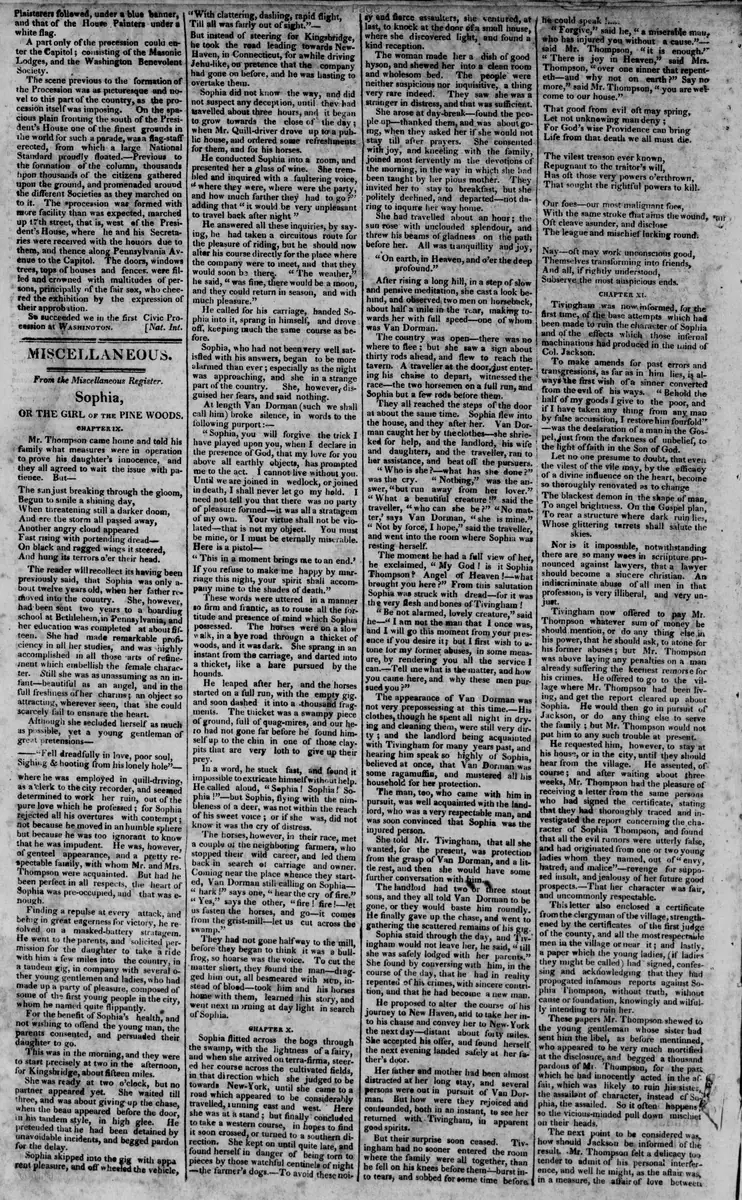
From the Miscellaneous Register.
Sophia,
OR THE GIRL OF THE PINE WOODS.
CHAPTER IX.
Mr. Thompson came home and told his family what measures were in operation to prove his daughter's innocence, and they all agreed to wait the issue with patience. But--!
The sun just breaking through the gloom,
Begun to smile a shining day,
When threatening still a darker doom,
And ere the storm all passed away,
Another angry cloud appeared
Fast rising with portending dread--
On black and ragged wings it steered,
And hung its terrors o'er their head.
The reader will recollect its having been previously said, that Sophia was only about twelve years old, when her father removed into the country. She, however, had been sent two years to a boarding school at Bethlehem, in Pennsylvania, and her education was completed at about fifteen. She had made remarkable proficiency in all her studies, and was highly accomplished in all those arts of refinement which embellish the female character. Still she was as unassuming as an infant--beautiful as an angel, and in the full freshness of her charms; an object so attracting, wherever seen, that she could scarcely fail to ensnare the heart.
Although she secluded herself as much as possible, yet a young gentleman of great pretensions--
Fell dreadfully in love, poor soul,
Sighing & hooting from his lonely hole"--
where he was employed in quill-driving: as a clerk to the city recorder, and seemed determined to work her ruin, out of the pure love which he professed; for Sophia rejected all his overtures with contempt; not because he moved in a humble sphere but because he was too ignorant to know that he was impudent. He was, however, of genteel appearance, and a pretty respectable family, with whom Mr. and Mrs. Thompson were acquainted. But had he been perfect in all respects, the heart of Sophia was pre-occupied, and that was enough.
Finding a repulse at every attack, and being in great eagerness for victory, he resolved on a masked-battery stratagem. He went to the parents, and solicited permission for the daughter to take a ride with him a few miles into the country, in a tandem gig, in company with several other young gentlemen and ladies, who had made up a party of pleasure, composed of some of the first young people in the city, whom he named quite flippantly.
For the benefit of Sophia's health, and not wishing to offend the young man, the parents consented, and persuaded their daughter to go.
This was in the morning, and they were to start precisely at two in the afternoon, for Kingsbridge, about fifteen miles.
She was ready at two o'clock, but no partner appeared yet. She waited till three, and was about giving up the chase, when the beau appeared before the door, in his tandem style, in high glee. He pretended that he had been detained by unavoidable incidents, and begged pardon for the delay.
Sophia skipped into the gig with apparent pleasure, and off wheeled the vehicle,
"With clattering, dashing, rapid flight,
Till all was fairly out of sight."--
But instead of steering for Kingsbridge he took the road leading towards New-Haven, in Connecticut, for awhile driving Jehu-like, on pretence that the company had gone on before, and he was hastening to overtake them.
Sophia did not know the way, and did not suspect any deception, until they had travelled about three hours, and it began to grow towards the close of the day; when Mr. Quill-driver drove up to a public house, and ordered some refreshments for them, and for his horses.
He conducted Sophia into a room, and presented her a glass of wine. She trembled and inquired with a faltering voice, "where they were, where were the party, and how much farther they had to go?" adding that "it would be very unpleasant to travel back after night."
He answered all these inquiries, by saying, he had taken a circuitous route for the pleasure of riding, but he should now alter his course directly for the place where the company were to meet, and that they would soon be there. "The weather," he said, "was fine, there would be a moon, and they could return in season, and with much pleasure."
He called for his carriage, handed Sophia into it, sprang in himself, and drove off, keeping much the same course as before.
Sophia, who had not been very well satisfied with his answers, began to be more alarmed than ever; especially as the night was approaching, and she in a strange part of the country. She, however, disguised her fears, and said nothing.
At length Van Dorman (such we shall call him) broke silence, in words to the following purport:--
"Sophia, you will forgive the trick I have played upon you, when I declare in the presence of God, that my love for you above all earthly objects, has prompted me to the act. I cannot live without you. Until we are joined in wedlock, or joined in death, I shall never let go my hold. I need not tell you that there was no party of pleasure formed--it was all a stratagem of my own. Your virtue shall not be violated--that is not my object. You must be mine, or I must be eternally miserable. Here is a pistol--
"This in a moment brings me to an end."
If you refuse to make me happy by marriage this night, your spirit shall accompany mine to the shades of death."
These words were uttered in a manner so firm and frantic, as to rouse all the fortitude and presence of mind which Sophia possessed. The horses were on a slow walk, in a bye road through a thicket of woods, and it was dark. She sprang in an instant from the carriage, and darted into a thicket, like a hare pursued by the hounds.
He leaped after her, and the horses started on a full run, with the empty gig, and soon dashed it into a thousand fragments. The thicket was a swampy piece of ground, full of quag-mires, and our hero had not gone far before he found himself up to the chin in one of those clay-pits that are very loth to give up their prey.
In a word, he stuck fast, and found it impossible to extricate himself without help. He called aloud, "Sophia! Sophia! Sophia!" but Sophia, flying with the nimbleness of a deer, was not within the reach of his sweet voice; or if she was, did not know it was the cry of distress.
The horses, however, in their race, met a couple of the neighboring farmers, who stopped their wild career, and led them back in search of carriage and owner. Coming near the place whence they started, Van Dorman still calling on Sophia--
"hark!" says one, "hear the cry of fire."
"Yes," says the other, "fire! fire!--let us fasten the horses, and go--it comes from the grist-mill--let us cut across the swamp."
They had not gone halfway to the mill before they began to think it was a bull-frog, so hoarse was the voice. To cut the matter short, they found the man--dragged him out, all besmeared with mud, instead of blood--took him and his horses home with them, learned his story, and went next morning at day light in search of Sophia.
CHAPTER X.
Sophia flitted across the bogs through the swamp, with the lightness of a fairy, and when she arrived on terra-firma, steered her course across the cultivated fields, in that direction which she judged to be towards New-York, until she came to a road which appeared to be considerably travelled, running east and west. Here she was at a stand; but finally concluded to take a western course, in hopes to find it soon crossed, or turned to a southern direction. She kept on until quite late, and found herself in danger of being torn to pieces by those watchful sentinels of night the farmer's dogs.--To avoid these noisy and fierce assaulters, she ventured, at last, to knock at the door of a small house where she discovered light, and found a kind reception.
The woman made her a dish of good hyson, and shewed her into a clean room and wholesome bed. The people were neither suspicious nor inquisitive, a thing very rare indeed. They saw she was a stranger in distress, and that was sufficient.
She arose at day-break--found the people up--thanked them, and was about going, when they asked her if she would not stay till after prayers. She consented with joy, and kneeling with the family, joined most fervently in the devotions of the morning, in the way in which she had been taught by her pious mother. They invited her to stay to breakfast, but she politely declined, and departed--not daring to inquire her way home.
She had travelled about an hour: the sun rose with unclouded splendour, and threw his beams of gladness on the path before her. All was tranquillity and joy,
"On earth, in Heaven, and o'er the deep profound."
After rising a long hill, in a step of slow and pensive meditation, she cast a look behind, and observed two men on horseback, about half a mile in the rear, making towards her with full speed---one of whom was Van Dorman.
The country was open--there was no where to flee; but she saw a sign about thirty rods ahead, and flew to reach the tavern. A traveller at the door, just entering his chaise to depart, witnessed the race--the two horsemen on a full run, and Sophia but a few rods before them.
They all reached the steps of the door at about the same time. Sophia flew into the house, and they after her. Van Dorman caught her by the clothes--she shrieked for help, and the landlord, his wife and daughters, and the traveller, ran to her assistance, and beat off the pursuers.
"Who is she?--what has she done?" was the cry. "Nothing," was the answer, "but run away from her lover."
"What a beautiful creature!" said the traveller, "who can she be?" "No matter," says Van Dorman, "she is mine."
"Not by force, I hope," said the traveller, and went into the room where Sophia was resting herself.
The moment he had a full view of her, he exclaimed, "My God! is it Sophia Thompson? Angel of Heaven!--what brought you here?" From this salutation Sophia was struck with dread--for it was the very flesh and bones of Tivingham!
"Be not alarmed, lovely creature," said he--"I am not the man that I once was, and I will go this moment from your presence if you desire it; but I first wish to atone for my former abuses, in some measure, by rendering you all the service I can.--Tell me what is the matter, and how you came here, and why these men pursued you?"
The appearance of Van Dorman was not very prepossessing at this time.--His clothes, though he spent all night in drying and cleaning them, were still very dirty; and the landlord being acquainted with Tivingham for many years past, and hearing him speak so highly of Sophia, believed at once, that Van Dorman was some ragamuffin, and mustered all his household for her protection.
The man, too, who came with him in pursuit, was well acquainted with the landlord, who was a very respectable man, and was soon convinced that Sophia was the injured person.
She told Mr. Tivingham, that all she wanted, for the present, was protection from the grasp of Van Dorman, and a little rest, and then she would have some further conversation with him.
The landlord had two or three stout sons, and they all told Van Dorman to be gone, or they would baste him roundly. He finally gave up the chase, and went to gathering the scattered remains of his gig.
Sophia staid through the day, and Tivingham would not leave her, he said, "till she was safely lodged with her parents."
She found by conversing with him, in the course of the day, that he had in reality repented of his crimes, with sincere contrition, and that he had become a new man.
He proposed to alter the course of his journey to New Haven, and to take her into his chaise and convey her to New-York the next day--distant about forty miles.
She accepted his offer, and found herself the next evening landed safely at her father's door.
Her father and mother had been almost distracted at her long stay, and several persons were out in pursuit of Van Dorman. But how were they rejoiced and confounded, both in an instant, to see her returned with--Tivingham, in apparent good spirits.
But their surprise soon ceased. Tivingham had no sooner entered the room where the family were all together, than he fell on his knees before them--burst into tears, and sobbed for some time before he could speak.
"Forgive," said he, "a miserable man who has injured you without a cause."
"It is enough," said Mr. Thompson.
"There is joy in Heaven," said Mrs. Thompson, "over one sinner that repenteth--and why not on earth?" Say no more," said Mr. Thompson, "you are welcome to our house."
That good from evil oft may spring,
Let not unknowing man deny;
For God's wise Providence can bring
Life from that death we all must die.
The vilest treason ever known,
Repugnant to the traitor's will,
Has oft those very powers o'erthrown,
That sought the rightful powers to kill.
Our foes--our most malignant foes,
With the same stroke that arms the wound,
Oft cleave asunder, and disclose
The league and mischief lurking round.
Nay--oft may work unconscious good,
Themselves transforming into friends,
And all, if rightly understood,
Subserve the most auspicious ends.
CHAPTER XI.
Tivingham was now informed, for the first time, of the base attempts which had been made to ruin the character of Sophia and of the effects which those infernal machinations had produced in the mind of Col. Jackson.
To make amends for past errors and transgressions, as far as in him lies, is always the first wish of a sinner converted from the evil of his ways. "Behold the half of my goods I give to the poor, and if I have taken any thing from any man by false accusation, I restore him fourfold"--was the declaration of a man in the Gospel, just from the darkness of unbelief, to the light of faith in the Son of God.
Let no one presume to doubt, that even the vilest of the vile may, by the efficacy of a divine influence on the heart, become so thoroughly renovated as to change
The blackest demon in the shape of man,
To angel brightness. On the Gospel plan,
To rear a structure where dark ruin lies,
Whose glittering turrets shall salute the skies.
Nor is it impossible, notwithstanding there are so many woes in scripture pronounced against lawyers, that a lawyer should become a sincere christian. An indiscriminate abuse of all men in that profession, is very illiberal, and very unjust.
Tivingham now offered to pay Mr. Thompson whatever sum of money he should mention, or do any thing else in his power, that he should ask, to atone for his former abuses; but Mr. Thompson was above laying any penalties on a man already suffering the keenest remorse for his crimes. He offered to go to the village where Mr. Thompson had been living, and get the report cleared up about Sophia. He would then go in pursuit of Jackson, or do any thing else to serve the family; but Mr. Thompson would not put him to any such trouble at present.
He requested him, however, to stay at his house, or in the city, until they should hear from the village. He assented, of course; and after waiting about three weeks, Mr. Thompson had the pleasure of receiving a letter from the same persons who had signed the certificate, stating that they had thoroughly traced and investigated the report concerning the character of Sophia Thompson, and found that all the evil rumors were utterly false, and had originated from one or two young ladies whom they named, out of envy, hatred, and malice"--revenge for supposed insult, and jealousy of her future good prospects.--That her character was fair, and uncommonly respectable.
This letter also enclosed a certificate from the clergyman of the village, strengthened by the certificates of the first judge of the county, and all the most respectable men in the village or near it; and lastly, a paper which the young ladies, (if ladies they might be called) had signed, confessing and acknowledging that they had propagated infamous reports against Sophia Thompson, without truth, without cause or foundation, knowingly and wilfully intending to ruin her.
These papers Mr. Thompson shewed to the young gentleman whose sister had sent him the libel, as before mentioned, who appeared to be very much mortified at the disclosure, and begged a thousand pardons of Mr. Thompson, for the part which he had innocently acted in the affair, which was likely to ruin his sister, the assailant of character, instead of Sophia, the assailed. So it often happens that the vicious-minded pull down mischief on their heads.
The next point to be considered was, how should Jackson be informed of the result. Mr. Thompson felt a delicacy too tender to admit of his personal interference, and well he might, as the affair was, in a measure, the affair of love between
Col. Jackson and his daughter Livingston was anxious to start forth with after him, for it had been lately ascertained that Jackson was at Augusta, in Georgia: but the family thought it best to let the Colonel take his own time to return, and things their natural course. Livingston therefore went to Connecticut.
Matters remained in this situation for about six months, in which time Sophia made several conquests, although she kept as retired as possible.
As for poor Van Dorman, he never troubled her afterwards; having enough to do with pacifying his friends, and Mr. Thompson through them, or the ridiculous part he had acted. His passion, too, was somewhat cooled by his plunge into the quagmire of the swamp.
It is 'through such tribulation' that the saint shall 'enter into the kingdom of heaven' and it is also through much tribulation that the lover, very frequently, is brought to the consummation of his or her wishes, in the married state-that earthly 'paradise lost.'
The next shock that Sophia received was from a notice in the papers, that Col. Jackson had accepted a challenge to a duel, from an officer of the navy, and that a meeting would soon take place.
This intelligence threw Sophia and all the family into the depth of distress.
They knew that Jackson was conscientiously opposed to the practice of duelling: but they knew also that he possessed a dauntless and lofty spirit, which could not brook an insult. He had held a Colonel's commission in the British Army, when quite young; but had resigned it in disgust, on account of the principles which he had imbibed in childhood, in favor of American liberty--under whose banners he was born.
The papers were searched with great avidity for about twenty days, when news arrived that the parties had met, and that the difference was terminated in a manner highly honorable to the character of Col. Jackson.
But poor Sophia was destined to face another whirlwind, more terrible than all the rest. About two months afterwards, when Sophia had just returned from a pleasant walk in high spirits, she took up a paper and read in it that Col. Francis Jackson was married on such a day, by such a priest, at Augusta, to Miss Eleanor Woodhouse.
Had a thousand claps of thunder all struck around her at once, she could not have been more amazed! Here was an end to all her hopes. Her father and mother strove to console her, but in vain.
She became seriously ill, and in a few days would have passed to the world of spirits, had not a physician been found whose skill was infallible.
Doctor Nee, of William street, who had constantly attended her for several days, at last brought a remedy, which effected a material alteration favorable to her recovery, in a few minutes.
He first went and told Sophia that she must prepare for a sudden shock--to muster all her fortitude and resolution. He left her and in a few minutes returned, with no other than Col. Jackson!
'Dear injured girl,' said he, 'give yourself no more trouble. I am satisfied of your innocence. I am not married, and never will be to any person but yourself.'
Suffice to say, that Sophia shortly exchanged her couch of sickness for the bridal bed, and the family were all made happy and independent for life.
The moral to be drawn from this story, which is founded principally on fact, (excepting the names of the parties,) is obvious--that--
Virtue will triumph at last,
When vice and folly stand aghast.
*The next southern papers brought a contradiction of the report that Col. Jackson was married. It was all a mistake, and wholly without foundation.
Translated for the Boston Palladium.
What sub-type of article is it?
What themes does it cover?
What keywords are associated?
What entities or persons were involved?
Literary Details
Title
Sophia, Or The Girl Of The Pine Woods.
Author
From The Miscellaneous Register. Translated For The Boston Palladium.
Key Lines