Thank you for visiting SNEWPapers!
Sign up free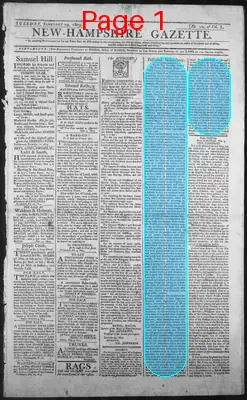
The New Hampshire Gazette
Portsmouth, Rockingham County, New Hampshire
What is this article about?
A letter to the New-Hampshire Gazette traces the origins of U.S. political party names from the Revolution (Tories vs. Whigs) through the Constitution's adoption (Federalists vs. Anti-Federalists), critiquing Federalists as aiming for aristocratic government under Adams.
Merged-components note: Continuation of the same letter to the editor on party political names.
Clipping
OCR Quality
Full Text
For the New-Hampshire Gazette.
On Party Political Names.
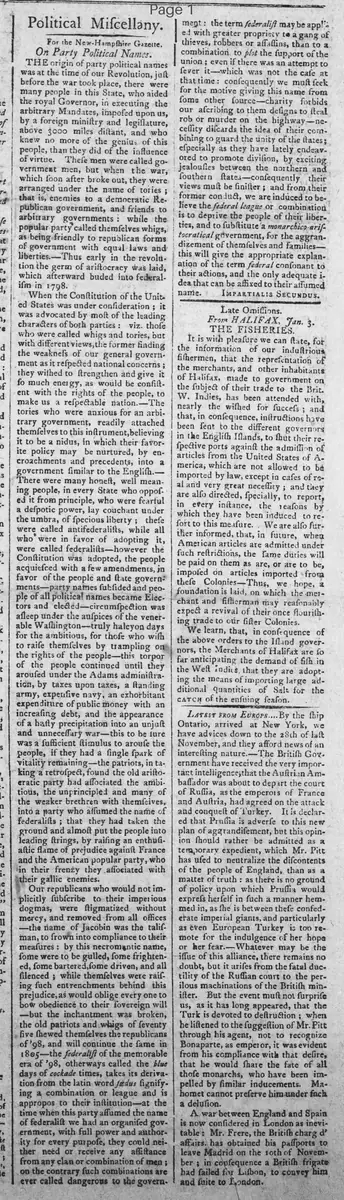
THE origin of party political names was at the time of our Revolution, just before the war took place, there were many people in this State, who aided the royal Governor, in executing the arbitrary Mandates, imposed upon us, by a foreign ministry and legislature, above 3000 miles distant, and who knew no more of the genius of this people, than they did of the influence of virtue. These men were called government men, but when the war, which soon after broke out, they were arranged under the name of tories; that is, enemies to a democratic Republican government, and friends to arbitrary governments: while the popular party called themselves whigs, as being friendly to republican forms of government with equal laws and liberties.--Thus early in the revolution the germ of aristocracy was laid, which afterward budded into federalism in 1798.
When the Constitution of the United States was under consideration; it was advocated by most of the leading characters of both parties: viz. those who were called whigs and tories, but with different views, the former finding the weakness of our general government as it respected national concerns: they wished to strengthen and give it so much energy, as would be consistent with the rights of the people, to make us a respectable nation.-The tories who were anxious for an arbitrary government, readily attached themselves to this instrument,believing it to be a nidus, in which their favorite policy may be nurtured, by encroachments and precedents, into a government similar to the English.- There were many honest, well meaning people, in every State who opposed it from principle, who were fearful a despotic power, lay couchant under the umbra, of specious liberty; these were called antifederalists, while all who were in favor of adopting it, were called federalists--however the Constitution was adopted, the people acquiesced with a few amendments, in favor of the people and state governments--party names subsided and people of all political names became Electors and elected--circumspection was asleep under the auspices of the venerable Washington--truly halcyon days for the ambitious, for those who wish to raise themselves by trampling on the rights of the people-this torpor of the people continued until they aroused under the Adams administration, by taxes upon taxes, a standing army, expensive navy, an exorbitant expenditure of public money with an increasing debt, and the appearance of a hasty precipitation into an unjust and unnecessary war--this to be sure was a sufficient stimulus to arouse the people, if they had a single spark of vitality remaining—the patriots, in taking a retrospect, found the old aristocratic party had associated the ambitious, the unprincipled and many of the weaker brethren with themselves, into a party who assumed the name of federalists: that they had taken the ground and almost put the people into leading strings, by raising an enthusiastic flame of prejudice against France and the American popular party, who in their frenzy they associated with their Gallic enemies.
Our republicans who would not implicitly subscribe to their imperious dogmas, were stigmatized without mercy, and removed from all offices -the name of Jacobin was the talisman, to frown into compliance to their measures: by this necromantic name, some were to be gulled, some frightened, some bartered, some driven, and all silenced: while themselves were raising such entrenchments behind this prejudice, as would oblige every one to bow obedience to their sovereign will -but the enchantment was broken, the old patriots and whigs of seventy five shewed themselves the republicans of'98, and will continue the same in 1805-the federalist of the memorable era of '98, otherways called the blue days of cockade times, takes its derivation from the latin word sedus signifying a combination or league and is appropos to their institution-at the time when this party assumed the name of federalist we had an organized government, with full power and authority for every purpose, they could neither need or receive any assistance from any clan or combination of men; on the contrary such combinations are ever called dangerous to the government. The term federalis may be applied with greater propriety to a gang of thieves, robbers or assassins, than to a combination to plot the support of the union; even if there was an attempt to sever it--which was not the case at that time: consequently we must seek for the motive giving this name from some other source--charity forbids our ascribing to them designs to steal rob or murder on the highway-necessity discards the idea of their combining to guard the unity of the states; especially as they have lately endeavored to promote division, by exciting jealousies between the northern and southern states-consequently their views must be sinister; and from their former conduct, we are induced to believe the federal league or combination is to deprive the people of their liberties, and to substitute a monarchico-aristocratical government, for the aggrandizement of themselves and families-- this will give the appropriate explanation of the term federal consonant to their actions, and the only adequate idea that can be affixed to their assumed name.
IMPARTIALIS SECUNDUS.
What sub-type of article is it?
What themes does it cover?
What keywords are associated?
What entities or persons were involved?
Letter to Editor Details
Author
Impartialis Secundus
Recipient
New Hampshire Gazette
Main Argument
the letter traces party names from tories and whigs in the revolution to federalists and anti-federalists during the constitution's adoption, arguing that federalists seek to establish an aristocratic government by eroding liberties, as evidenced by actions under adams.
Notable Details