Thank you for visiting SNEWPapers!
Sign up free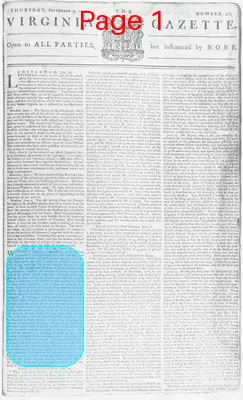
Editorial
September 9, 1773
The Virginia Gazette
Williamsburg, Virginia
What is this article about?
A correspondent warns of a profound crisis threatening British liberties due to government encroachments on the East India Company's charter, criticizing parliamentary apathy and praising opposition from Scottish members like Mr. D—r.
Clipping
OCR Quality
98%
Excellent
Full Text
LONDON, June 16.
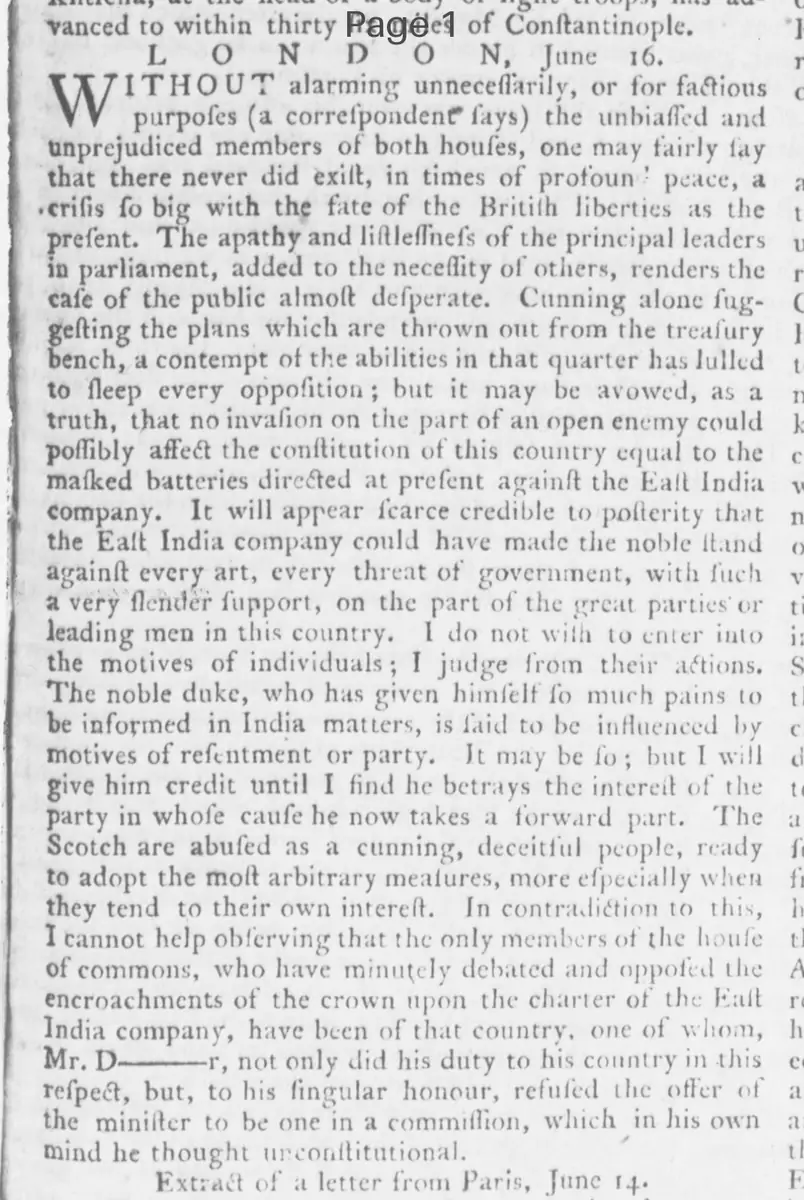
WITHOUT alarming unnecessarily, or for factious purposes (a correspondent says) the unbiased and unprejudiced members of both houses, one may fairly say that there never did exist, in times of profound peace, a crisis so big with the fate of the British liberties as the present. The apathy and listlessness of the principal leaders in parliament, added to the necessity of others, renders the case of the public almost desperate. Cunning alone suggesting the plans which are thrown out from the treasury bench, a contempt of the abilities in that quarter has lulled to sleep every opposition; but it may be avowed, as a truth, that no invasion on the part of an open enemy could possibly affect the constitution of this country equal to the masked batteries directed at present against the East India company. It will appear scarce credible to posterity that the East India company could have made the noble stand against every art, every threat of government, with such a very slender support, on the part of the great parties or leading men in this country. I do not wish to enter into the motives of individuals; I judge from their actions. The noble duke, who has given himself so much pains to be informed in India matters, is said to be influenced by motives of resentment or party. It may be so; but I will give him credit until I find he betrays the interest of the party in whose cause he now takes a forward part. The Scotch are abused as a cunning, deceitful people, ready to adopt the most arbitrary measures, more especially when they tend to their own interest. In contradiction to this, I cannot help observing that the only members of the house of commons, who have minutely debated and opposed the encroachments of the crown upon the charter of the East India company, have been of that country, one of whom, Mr. D—r, not only did his duty to his country in this respect, but, to his singular honour, refused the offer of the minister to be one in a commission, which in his own mind he thought unconstitutional.
WITHOUT alarming unnecessarily, or for factious purposes (a correspondent says) the unbiased and unprejudiced members of both houses, one may fairly say that there never did exist, in times of profound peace, a crisis so big with the fate of the British liberties as the present. The apathy and listlessness of the principal leaders in parliament, added to the necessity of others, renders the case of the public almost desperate. Cunning alone suggesting the plans which are thrown out from the treasury bench, a contempt of the abilities in that quarter has lulled to sleep every opposition; but it may be avowed, as a truth, that no invasion on the part of an open enemy could possibly affect the constitution of this country equal to the masked batteries directed at present against the East India company. It will appear scarce credible to posterity that the East India company could have made the noble stand against every art, every threat of government, with such a very slender support, on the part of the great parties or leading men in this country. I do not wish to enter into the motives of individuals; I judge from their actions. The noble duke, who has given himself so much pains to be informed in India matters, is said to be influenced by motives of resentment or party. It may be so; but I will give him credit until I find he betrays the interest of the party in whose cause he now takes a forward part. The Scotch are abused as a cunning, deceitful people, ready to adopt the most arbitrary measures, more especially when they tend to their own interest. In contradiction to this, I cannot help observing that the only members of the house of commons, who have minutely debated and opposed the encroachments of the crown upon the charter of the East India company, have been of that country, one of whom, Mr. D—r, not only did his duty to his country in this respect, but, to his singular honour, refused the offer of the minister to be one in a commission, which in his own mind he thought unconstitutional.
What sub-type of article is it?
Constitutional
Imperialism
Partisan Politics
What keywords are associated?
British Liberties
East India Company
Parliamentary Apathy
Constitutional Crisis
Scottish Opposition
Government Encroachments
What entities or persons were involved?
East India Company
Parliament
Treasury Bench
Noble Duke
Scotch Members
Mr. D—R
Editorial Details
Primary Topic
Government Encroachments On East India Company Charter
Stance / Tone
Alarmist Defense Of British Liberties And East India Company
Key Figures
East India Company
Parliament
Treasury Bench
Noble Duke
Scotch Members
Mr. D—R
Key Arguments
Current Crisis In Peacetime Threatens British Liberties More Than Any Invasion
Parliamentary Leaders' Apathy Leaves Public Desperate
Government Cunning Has Silenced Opposition
East India Company Nobly Resists Government Threats With Little Support
Only Scottish Commons Members Opposed Crown Encroachments On Company Charter
Mr. D—R Honorably Refused Unconstitutional Commission