Thank you for visiting SNEWPapers!
Sign up free
Rhode Island American, Statesman And Providence Gazette
Providence, Providence County, Rhode Island
What is this article about?
On the 18th, the U.S. Congress debated and passed a bill clarifying pension eligibility for Revolutionary War veterans, adjusting property thresholds and service terms. Amendments were proposed and voted on, with the final vote 123-84 in favor.
Clipping
OCR Quality
Full Text
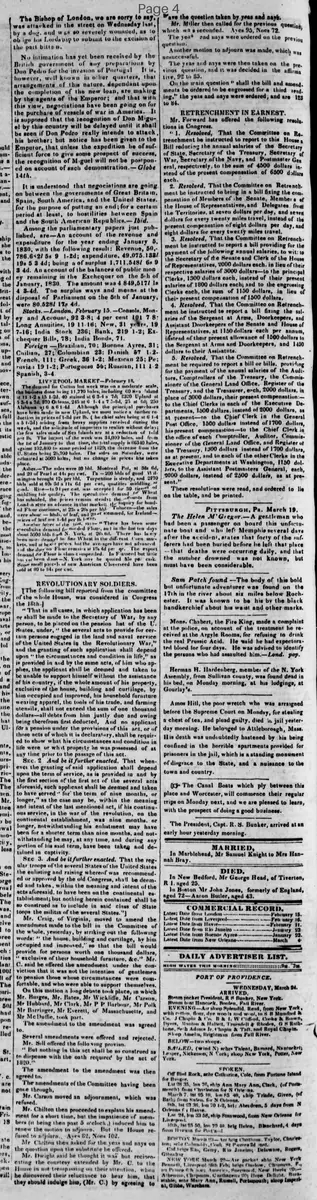
The following bill reported from the committee of the whole House, was considered in Congress the 18th—
"That in all cases, in which application has been or shall be made to the Secretary of War, by any person, to be placed on the pension list of the U. States, under, "the several acts to provide for certain persons engaged in the land and naval service of the United States in the Revolutionary War." and the granting of such application shall depend upon "the circumstances and condition in life," as is provided in and by the same acts, of him who applies, the applicant shall be deemed and taken to be unable to support himself without the assistance of his country, if the whole amount of his property exclusive of the house, building and curtilage, by him occupied and improved, his household furniture wearing apparel, the tools of his trade, and farming utensils, shall not exceed the sum of one thousand dollars—all debts from him justly due and owing being therefrom first deducted. And no applicant for a pension under the provisions of this act, or of those acts of which it is declaratory, shall be required to show what his circumstances and condition in life were or what property he was possessed of at any time prior to the passage of this act.
Sec. 2. And be it further enacted. That whenever the granting of said application shall depend upon the term of service, as is provided in and by the first section of the first act of the several acts aforesaid, such applicant shall be deemed and taken to have served, for the term of nine months, or longer, as the case may be, within the meaning and intent of the last mentioned act, if his continuous service, in the war of the revolution, on the continental establishment, was nine months, or longer, notwithstanding his enlistment may have been for a shorter term than nine months, and notwithstanding he may, at any time, and during any portion of his said term, have been taken and detained in captivity.
Sec. 3. And be it further enacted. That the regular troops of the several States of the United States the enlisting and raising whereof was recommended or approved by the old Congress, shall be deemed and taken, within the meaning and intent of the acts aforesaid, to have been on the continental establishment; but nothing herein contained shall be so construed as to include in said class of State troops the militia of the several States."
Mr. Craig, of Virginia, moved to amend the amendment made to the bill in the Committee of the whole, yesterday, by striking out the following words: "the house, building and curtilage, by him occupied and improved." so that the bill would provide for persons worth one thousand dollars, "exclusive of their household furniture, &c." Mr. C. said he offered the amendment under the conviction that it was not the intention of gentlemen to pension those whose circumstances were comfortable, and who were able to support themselves.
On this motion a long debate took place, in which Mr. Burges, Mr. Bates, Mr. Wickliffe, Mr. Carson, Mr. Hubbard, Mr. Clark, Mr. P. P. Barbour, Mr. Polk Mr. Barringer, Mr. Everett, of Massachusetts, and Mr. McDuffie, took part.
The amendment to the amendment was agreed to.
Several amendments were offered and rejected.
Mr. Sill offered the following proviso.
"But nothing in this act shall be so construed as to dispense with the oath required by the act of 1820."
The amendment to the amendment was then agreed to.
The amendments of the Committee having been gone through,
Mr. Carson moved an adjournment, which was refused.
Mr. Chilton then proceeded to explain his amendment for a short time, but the impatience of members (it being then past 5 o'clock,) induced him to renew the motion to adjourn. But the House refused to adjourn. Ayes 82, Noes 102.
Mr. Chilton then asked for the yeas and nays on the question upon the substitute he offered.
Mr. Dwight said he thought it was but reciprocating the courtesy extended by Mr. C. to the House in not trespassing on their attention, when he discovered their reluctance to hear him, that they should indulge him, (Mr. C.) by agreeing to have the question taken by yeas and nays.
Mr. Miller then called for the previous question; which was seconded. Ayes 95, Noes 72.
The yeas and nays were ordered on the previous question.
Another motion to adjourn was made, which was unsuccessful.
The yeas and nays were then taken on the previous question, and it was decided in the affirmative, 92 to 85.
On the main question "shall the bill and amendments be ordered to be engrossed for a third reading," the yeas and nays were ordered, and are 123 to 84.
What sub-type of article is it?
What keywords are associated?
What entities or persons were involved?
Domestic News Details
Event Date
The 18th
Key Persons
Outcome
the bill and amendments were ordered to be engrossed for a third reading by a vote of 123 to 84.
Event Details
Congress considered a bill clarifying pension eligibility for Revolutionary War veterans based on property limits, service terms, and state troops. Amendments were debated and voted on, including striking provisions for occupied property and adding a proviso about oaths. Multiple motions to adjourn were rejected, leading to the bill's advancement.