Thank you for visiting SNEWPapers!
Sign up free
The National Intelligencer And Washington Advertiser
Washington, District Of Columbia
What is this article about?
Concluding biographical notice of Thomas Erskine, detailing his rapid rise to silk gown in 1783, expertise in crim. con. trials, notable speeches in cases like Sykes v. Parlow and Stockdale's libel trial, parliamentary career, defense of trial by jury in Dean of St. Asaph case, defenses in state trials, and personal character.
Merged-components note: This is a continuation of the biographical notice of Thomas Erskine across pages 1 and 2. The second component was mislabeled as 'obituary' but is part of the same literary biographical piece, not a death notice.
Clippings
1 of 2
OCR Quality
Full Text
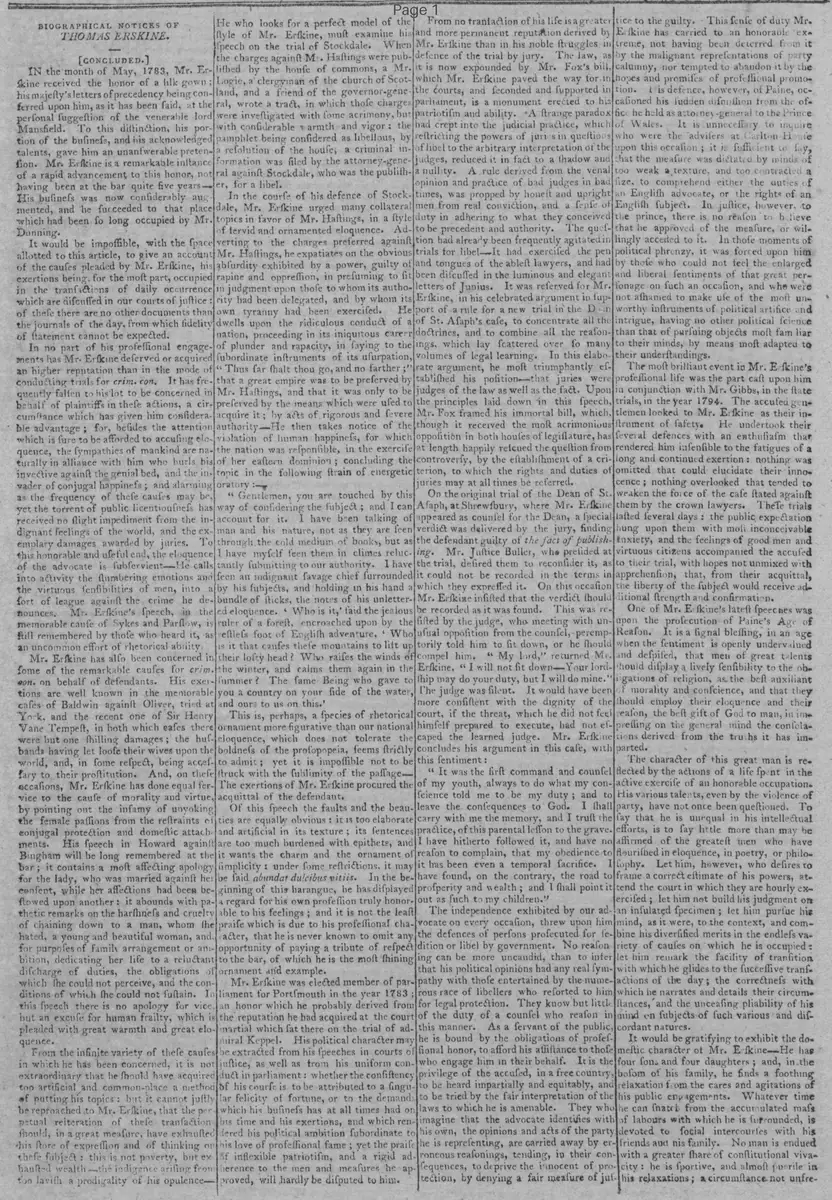
THOMAS ERSKINE.
[CONCLUDED.]
IN the month of May, 1783, Mr. Erskine received the honor of a silk gown; his majesty's letters of precedency being conferred upon him, as it has been said, at the personal suggestion of the venerable lord Mansfield. To this distinction, his portion of the business, and his acknowledged talents, gave him an unanswerable pretension. Mr. Erskine is a remarkable instance of a rapid advancement to this honor, not having been at the bar quite five years. His business was now considerably augmented, and he succeeded to that place which had been so long occupied by Mr. Dunning.
It would be impossible, with the space allotted to this article, to give an account of the causes pleaded by Mr. Erskine, his exertions being, for the most part, occupied in the transactions of daily occurrence which are discussed in our courts of justice: of these there are no other documents than the journals of the day, from which fidelity of statement cannot be expected.
In no part of his professional engagements has Mr. Erskine deserved or acquired an higher reputation than in the mode of conducting trials for crim. con. It has frequently fallen to his lot to be concerned in behalf of plaintiffs in these actions, a circumstance which has given him considerable advantage; for, besides the attention which is sure to be afforded to accusing eloquence, the sympathies of mankind are naturally in alliance with him who hurls his invective against the genial bed, and the invader of conjugal happiness; and alarming as the frequency of these causes may be, yet the torrent of public licentiousness has received no slight impediment from the indignant feelings of the world, and the exemplary damages awarded by juries. To this honorable and useful end, the eloquence of the advocate is subservient. He calls into activity the slumbering emotions and the virtuous sensibilities of men, into a sort of league against the crime he denounces. Mr. Erskine's speech, in the memorable cause of Sykes and Parlow, is still remembered by those who heard it, as an uncommon effort of rhetorical ability.
Mr. Erskine has also been concerned in some of the remarkable causes for crim. con. on behalf of defendants. His exertions are well known in the memorable cases of Baldwin against Oliver, tried at York, and the recent one of Sir Henry Vane Tempest, in both which cases there were but one Shilling damages; the husbands having let loose their wives upon the world, and, in some respect, being accessory to their prostitution. And, on these occasions, Mr. Erskine has done equal service to the cause of morality and virtue, by pointing out the infamy of unyoking the female passions from the restraints of conjugal protection and domestic attachments. His speech in Howard against Bingham will be long remembered at the bar; it contains a most affecting apology for the lady, who was married against her consent, while her affections had been bestowed upon another: it abounds with pathetic remarks on the harshness and cruelty of chaining down to a man, whom she hated, a young and beautiful woman, and, for purposes of family arrangement or ambition, dedicating her life to a reluctant discharge of duties, the obligations of which she could not perceive, and the conditions of which she could not sustain. In this speech there is no apology for vice, but an excuse for human frailty, which is pleaded with great warmth and great eloquence.
From the infinite variety of these causes in which he has been concerned, it is not extraordinary that he should have acquired too artificial and common-place a method of passing his topics: but it cannot justly be reproached to Mr. Erskine, that the perpetual reiteration of these transactions should, in a great measure, have exhausted his store of expression and of thinking on these subjects: this is not poverty, but exhausted wealth. The indigence arising from too lavish a prodigality of his opulence.
He who looks for a perfect model of the style of Mr. Erskine, must examine his speech on the trial of Stockdale. When the charges against Mr. Hastings were published by the house of commons, a Mr. Logie, a clergyman of the church of Scotland, and a friend of the governor-general, wrote a tract, in which those charges were investigated with some acrimony, but with considerable warmth and vigor: the pamphlet being considered as libellous, by a resolution of the house, a criminal information was filed by the attorney-general against Stockdale, who was the publisher, for a libel.
In the course of his defence of Stockdale, Mr. Erskine urged many collateral topics in favor of Mr. Hastings, in a style of fervid and ornamented eloquence. Adverting to the charges preferred against Mr. Hastings, he expatiates on the obvious absurdity exhibited by a power, guilty of rapine and oppression, in presuming to sit in judgment upon those to whom its authority had been delegated, and by whom its own tyranny had been exercised. He dwells upon the ridiculous conduct of a nation, proceeding in its iniquitous career of plunder and rapacity, in saying to the subordinate instruments of its usurpation, "Thus far shalt thou go, and no farther;" that a great empire was to be preserved by Mr. Hastings, and that it was only to be preserved by the means which were used to acquire it; by acts of rigorous and severe authority. He then takes notice of the violation of human happiness, for which the nation was responsible, in the exercise of her eastern dominion; concluding the topic in the following train of energetic oratory:
"Gentlemen, you are touched by this way of considering the subject; and I can account for it. I have been talking of man and his nature, not as they are seen through the cold medium of books, but as I have myself seen them in climes reluctantly submitting to our authority. I have seen an indignant savage chief surrounded by his subjects, and holding in his hand a bundle of sticks, the notes of his unlettered eloquence. Who is it,' said the jealous ruler of a forest, encroached upon by the restless foot of English adventure. Who is it that causes these mountains to lift up their lofty head? Who raises the winds of the winter, and calms them again in the Summer? The same Being who gave to you a country on your side of the water, and ours to us on this."
This is, perhaps, a species of rhetorical ornament more figurative than our national eloquence, which does not tolerate the boldness of the prosopopoeia, seems strictly to admit; yet it is impossible not to be struck with the sublimity of the passage. The exertions of Mr. Erskine procured the acquittal of the defendant.
Of this speech the faults and the beauties are equally obvious: it is too elaborate and artificial in its texture: its sentences are too much burdened with epithets, and it wants the charm and the ornament of simplicity: under some restrictions, it may be said abundant dulcibus vitiis. In the beginning of this harangue, he has displayed a regard for his own profession truly honorable to his feelings: and it is not the least praise which is due to his professional character, that he is never known to omit any opportunity of paying a tribute of respect to the bar, of which he is the most shining ornament and example.
Mr. Erskine was elected member of parliament for Portsmouth in the year 1783; an honor which he probably derived from the reputation he had acquired at the court martial which sat there on the trial of admiral Keppel. His political character may be extracted from his speeches in courts of justice, as well as from his uniform conduct in parliament: whether the consistency of his course is to be attributed to a singular felicity of fortune, or to the demands which his business has at all times had on his time and his exertions, and which rendered his political ambition subordinate to his love of professional fame; yet the praise of inflexible patriotism, and a rigid adherence to the men and measures he approved, will hardly be disputed to him.
From no transaction of his life is a greater and more permanent reputation derived by Mr. Erskine than in his noble struggles in defence of the trial by jury. The law, as it is now expounded by Mr. Fox's bill, which Mr. Erskine paved the way for in the courts, and seconded and supported in parliament, is a monument erected to his patriotism and ability. A strange paradox had crept into the judicial practice, which restricting the powers of juries in questions of libel to the arbitrary interpretation of the judges, reduced it in fact to a shadow and a nullity. A rule derived from the venal opinion and practice of bad judges in bad times, was propped by honest and upright men from real conviction, and a sense of duty in adhering to what they conceived to be precedent and authority. The question had already been frequently agitated in trials for libel. It had exercised the pen and tongues of the ablest lawyers, and had been discussed in the luminous and elegant letters of Junius. It was reserved for Mr. Erskine, in his celebrated argument in support of a rule for a new trial in the Dean of St. Asaph's case, to concentrate all the doctrines, and to combine all the reasonings, which lay scattered over so many volumes of legal learning. In this elaborate argument, he most triumphantly established his position. That juries were judges of the law as well as the fact. Upon the principles laid down in this speech, Mr. Fox framed his immortal bill, which, though it received the most acrimonious opposition in both houses of legislature, has at length happily rescued the question from controversy, by the establishment of a criterion, to which the rights and duties of juries may at all times be referred.
On the original trial of the Dean of St. Asaph, at Shrewsbury, where Mr. Erskine appeared as counsel for the Dean, a special verdict was delivered by the jury, finding the defendant guilty of the fact of publishing. Mr. Justice Buller, who presided at the trial, desired them to reconsider it, as it could not be recorded in the terms in which they expressed it. On this occasion Mr. Erskine insisted that the verdict should be recorded as it was found. This was resisted by the judge, who meeting with unusual opposition from the counsel, peremptorily told him to sit down, or he should compel him. "My lord," returned Mr. Erskine, "I will not sit down. Your lordship may do your duty, but I will do mine."
The judge was silent. It would have been more consistent with the dignity of the court, if the threat, which he did not feel himself prepared to execute, had not escaped the learned judge. Mr. Erskine concludes his argument in this case, with this sentiment:
"It was the first command and counsel of my youth, always to do what my conscience told me to be my duty; and to leave the consequences to God. I shall carry with me the memory, and I trust the practice, of this parental lesson to the grave. I have hitherto followed it, and have no reason to complain, that my obedience to it has been even a temporal sacrifice. I have found, on the contrary, the road to prosperity and wealth; and I shall point it out as such to my children."
The independence exhibited by our advocate on every occasion, threw upon him the defences of persons prosecuted for sedition or libel by government. No reasoning can be more uncandid, than to infer that his political opinions had any real sympathy with those entertained by the numerous race of libellers who resorted to him for legal protection. They know but little of the duty of a counsel who reason in this manner. As a servant of the public, he is bound by the obligations of professional honor, to afford his assistance to those who engage him in their behalf. It is the privilege of the accused, in a free country, to be heard impartially and equitably, and to be tried by the fair interpretation of the laws to which he is amenable. They who imagine that the advocate identifies with his own, the opinions and acts of the party he is representing, are carried away by erroneous reasonings, tending, in their consequences, to deprive the innocent of protection, by denying a fair measure of justice to the guilty.
This sense of duty Mr. Erskine has carried to an honorable extreme, not having been deterred from it by the malignant representations of party calumny, nor tempted to abandon it by the hopes and promises of professional promotion. His defence, however, of Paine, occasioned his sudden dismission from the office he held as attorney-general to the Prince of Wales. It is unnecessary to inquire who were the advisers at Carlton House upon this occasion; it is sufficient to say, that the measure was dictated by minds of too weak a texture, and too contracted a size, to comprehend either the duties of an English advocate, or the rights of an English subject. In justice, however, to the prince, there is no reason to believe that he approved of the measure, or willingly acceded to it. In those moments of political phrensy, it was forced upon him by those who could not feel the enlarged and liberal sentiments of that great personage on such an occasion, and who were not ashamed to make use of the most unworthy instruments of political artifice and intrigue, having no other political science than that of pursuing objects most familiar to their minds, by means most adapted to their understandings.
The most brilliant event in Mr. Erskine's professional life was the part cast upon him in conjunction with Mr. Gibbs, in the state trials, in the year 1794. The accused gentlemen looked to Mr. Erskine as their instrument of safety. He undertook their several defences with an enthusiasm that rendered him insensible to the fatigues of a long and continued exertion: nothing was omitted that could elucidate their innocence; nothing overlooked that tended to weaken the force of the case stated against them by the crown lawyers. These trials lasted several days: the public expectation hung upon them with most inconceivable anxiety, and the feelings of good men and virtuous citizens accompanied the accused to their trial, with hopes not unmixed with apprehension, that, from their acquittal, the liberty of the subject would receive additional strength and confirmation.
One of Mr. Erskine's latest speeches was upon the prosecution of Paine's Age of Reason. It is a signal blessing, in an age when the sentiment is openly undervalued and despised, that men of great talents should display a lively sensibility to the obligations of religion, as the best auxiliary of morality and conscience, and that they should employ their eloquence and their reason, the best gift of God to man, in impressing on the general mind the consolations derived from the truths it has imparted.
The character of this great man is reflected by the actions of a life spent in the active exercise of an honorable occupation. His various talents, even by the violence of party, have not once been questioned. To say that he is unequal in his intellectual efforts, is to say little more than may be affirmed of the greatest men who have flourished in eloquence, in poetry, or philosophy. Let him, however, who desires to frame a correct estimate of his powers, attend the court in which they are hourly exercised: let him not build his judgment on an insulated specimen; let him pursue his mind, as it were, to the context, and combine his diversified merits in the endless variety of causes on which he is occupied. Let him remark the facility of transition with which he glides to the successive transactions of the day; the correctness with which he narrates and details their circumstances, and the unceasing pliability of his mind on subjects of such various and discordant natures.
It would be gratifying to exhibit the domestic character of Mr. Erskine. He has four sons and four daughters; and, in the bosom of his family, he finds a soothing relaxation from the cares and agitations of his public engagements. Whatever time he can snatch from the accumulated mass of labours with which he is surrounded, is devoted to social intercourses with his friends and his family. No man is endued with a greater share of constitutional vivacity: he is sportive, and almost puerile in his relaxations; a circumstance not unfrequently observable in men of the highest intellectual powers.
Rarely found in the history of men of genius.
Upon these topics we cannot enlarge.
In this memoir an attempt has been made to exhibit his public character with fairness and impartiality. Of his private virtues it would be indecorous to make any enumeration. Integritatem atque abstinentiam in tanto viro referre injuria virtutem fuerit. Tacit. in vit. Agric.
What sub-type of article is it?
What themes does it cover?
What keywords are associated?
Literary Details
Title
Biographical Notices Of Thomas Erskine. [Concluded.]
Subject
Biography Of Thomas Erskine's Legal And Political Career
Key Lines