Thank you for visiting SNEWPapers!
Sign up free
Literary
December 24, 1825
Phenix Gazette
Alexandria, Virginia
What is this article about?
This satirical essay from the London Magazine questions the meaning of civilization, contrasting customs in Persia, Arabia, Europe, Africa, and elsewhere to highlight cultural relativism and inconsistencies in defining civilized behavior, from governance and social norms to commerce and violence.
Clipping
OCR Quality
98%
Excellent
Full Text
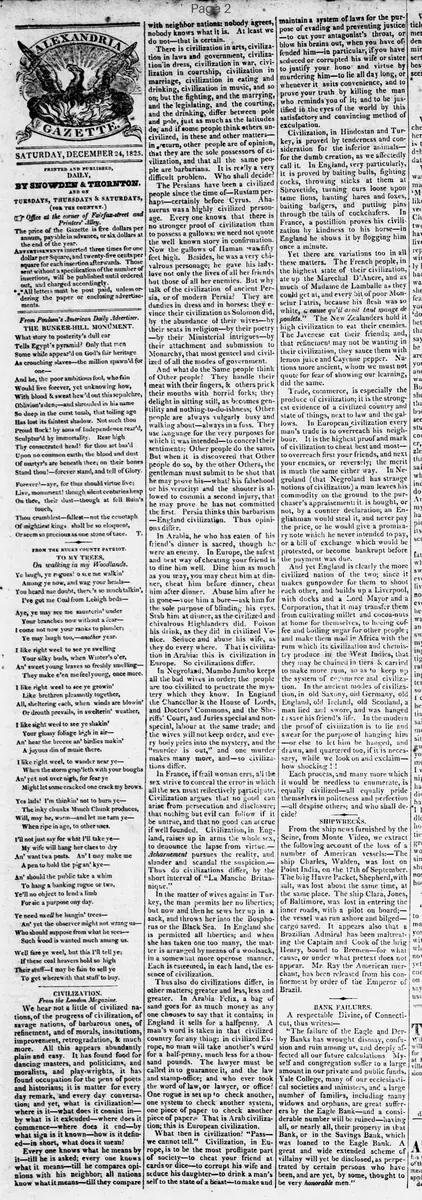
CIVILIZATION.
From the London Magazine.
We hear not a little of civilized nations, of the progress of civilization, of savage nations, of barbarous ones, of refinement, and of morals, institutions, improvement, retrogradation, & much more.
All this appears abundantly plain and easy. It has found food for dancing masters, and politicians, and moralists, and play-wrights, it has found occupation for the pens of poets and historians; it is matter for every day remark, and every day conversation; and yet, what is civilization? where is it--what does it consist in-- by what is it executed--where does it commence--where does it end--by what sign is it known--how is it defined--in short, what does it mean?
Every one knows what he means by it--till he is asked; every one knows what it means--till he compares opinions with his neighbor; all nations know what it means--till they compare with neighbor nations: nobody agrees, nobody knows what it is. At least we do not--that is certain.
There is civilization in arts, civilization in laws and government, civilization in dress, civilization in war, civilization in courtship, civilization in marriage, civilization in eating and drinking, civilization in music, and so on; but the fighting, and the marrying, and the legislating, and the courting, and the drinking, differ between pole and pole, just as much as the latitudes do; and if some people think others uncivilized, in these and other matters-- in return, other people are of opinion, that they are the sole possessors of civilization, and that all the same people are barbarians. It is really a very difficult problem. Who shall decide?
The Persians have been a civilized people since the time of--Rustam perhaps--certainly before Cyrus. Ahasuerus was a highly civilized personage. Every one knows that there is no stronger proof of civilization than to possess a gallows: we need not quote the well known story in confirmation. Now the gallows of Haman was fifty feet high. Besides, he was a very chivalrous personage; he gave his lady-love not only the lives of all her friends but those of all her enemies. But why talk of the civilization of ancient Persia, or of modern Persia? They are dandies in dress and in horses: they evince their civilization as Solomon did, by the abundance of their wives--by their sects in religion--by their poetry --by their Ministerial intrigues--by their attachment and submission to Monarchy, that most genteel and civilized of all the modes of government.
And what do the Same people think of Other people? They handle their meat with their fingers, & others prick their mouths with horrid forks; they delight in sitting still, as becomes gentility and nothing-to-do-ishness; Other people are always vulgarly busy and walking about--always in a fuss. They use language for the very purposes for which it was intended--to conceal their sentiments; Other people do the same. But when it is discovered that Other people do so, by the other Others, the gentleman must submit to be shot that he may prove his--what? his falsehood or his veracity: and the shooter is allowed to commit a second injury, that he may prove he has not committed the first. Persia thinks this barbarism --England civilization. Thus opinions differ.
In Arabia, he who has eaten of his friend's dinner is sacred, though he were an enemy. In Europe, the safest and best way of cheating your friend is to dine him well. Dine him as much as you may, you may cheat him at dinner, cheat him before dinner, cheat him after dinner. Abuse him after he is gone--vote him a bore--ask him for the sole purpose of blinding his eyes. Stab him at dinner, as the civilized and chivalrous Highlanders did. Poison his drink, as they did in civilized Venice. Seduce and abuse his wife, as they do every where. That is civilization in Arabia: this is civilization in Europe. So civilizations differ.
In Negroland, Mumbo Jumbo keeps all the bad wives in order; the people are too civilized to penetrate the mystery which they know. In England the Chancellor & the House of Lords, and Doctors' Commons, and the Sheriffs' Court, and Juries special and non special, labour at the same trade; and the wives will not keep order, and every body pries into the mystery, and the "murder is out," and one murder makes many more, and--so civilizations differ.
In France, if frail woman errs, all the sex strive to conceal the error in which all the sex must reflectively participate. Civilization argues that no good can arise from persecution and disclosure; that nothing but evil can follow if it be untrue, and that no good can accrue if well founded. Civilization, in England, raises up in arms the whole sex, to denounce the lapse from virtue.-- Acharnement pursues the reality, and slander and scandal the suspicion.-- Thus do civilizations differ, by the short interval of "La Manche Britannique."
In the matter of wives again: in Turkey, the man permits her no liberties; but now and then he sews her up in a sack, and throws her into the Bosphorus or the Black Sea. In England she is permitted all liberties; and when she has taken one too many, the matter is arranged by means of a woolsack, in a somewhat more operose manner. Each is esteemed, in each land, the essence of civilization.
Thus also do civilizations differ. in other matters; greater and less, less and greater. In Arabia-Felix, a bag of sand goes for as much money as any one chooses to say that it contains; in England it sells for a halfpenny. A man's word is taken in that civilized country for any thing: in civilized Europe, no man will take another's word for a half-penny, much less for a thousand pounds. The lawyer must be called in to guarantee it, and the law and stamp-office; and who ever took the word of law, or lawyer, or office? One rogue is set up to check another, one system to check another system, one piece of paper to check another piece of paper. That is Arab civilization; this is European civilization.
What then is civilization? "Pass we cannot tell." Civilization, in Europe, is to be the most profligate part of society--to cheat your friend at cards or dice--to corrupt his wife and seduce his daughter--to drink a man's self to the state of a beast--to make and maintain a system of laws for the purpose of evading and preventing justice --to cut your antagonist's throat, or blow his brains out, when you have offended him--in particular, if you have seduced or corrupted his wife or sister to justify your honor and virtue by murdering him--to lie all day long, or whenever it suits convenience, and to prove your truth by killing the man who reminds you of it; and to be justified in the eyes of the world by this satisfactory and convincing method of exculpation.
Civilization, in Hindostan and Turkey, is proved by tenderness and consideration for the inferior animals-- for the dumb creation, as we affectedly call it. In England, very particularly, it is proved by baiting bulls, fighting cocks, throwing sticks at them at Shrovetide, turning curs loose upon tame lions, hunting hares and foxes, baiting badgers, and putting pins through the tails of cockchafers. In France, a postillion proves his civilization by kindness to his horse--in England he shows it by flogging him once a minute.
Yet there are variations too in all these matters. The French people, in the highest state of their civilization, ate up the Marechal D'Ancre, and as much of Madame de Lamballe as they could get at, and every bit of poor Monsieur l'Attis, because his flesh was so white, "a cause qu'il avoit tant mange de poulets." The New Zealanders hold it high civilization to eat their enemies. The Javenese eat their friends; and, that refinement may not be wanting in their civilization, they sauce them with lemon juice and Cayenne pepper. Nations more ancient, whom we must not quote for fear of showing our learning, did the same.
Trade, commerce, is especially the produce of civilization; it is the strongest evidence of a civilized country and state of things, next to law and the gallows. In European civilization every man's trade is to overreach his neighbour. It is the highest proof and mark of civilization to cheat best and most-- to overreach first your friends, and next your enemies, or reversely; the merit is much the same either way. In Negroland (that Negroland has strange notions of civilization) a man leaves his commodity on the ground to the purchaser's appraisement: it is bought, or not, by a counter declaration; an Englishman would steal it, and never pay the price, or he would give a promissory note which he never intended to pay, or a bill of exchange which would be protested, or become bankrupt before the payment was due.
And yet England is clearly the more civilized nation of the two; since it makes gunpowder for them to shoot each other, and builds up a Liverpool with docks and a Lord Mayor and a Corporation, that it may transfer them from cultivating millet and cocoa-nuts at home for themselves, to hoeing coffee and boiling sugar for other people; and make them mad in Africa with the rum which its civilization and chemistry produce in the West Indies, that they may be chained in tiers & carried to make more rum, so as to keep up the system of commerce and civilization. In the ancient modes of civilization, in old Saxony, old Germany, old England, old Ireland, old Scotland, a man lied and swore, and was hanged to save his friend's life. In the modern the proof of civilization is to lie and swear for the purpose of hanging him --or else to let him be hanged, and drawn, and quartered too, if it is necessary, while we look on and exclaim-- how shocking!!
Each process, and many more which it would be needless to enumerate, is equally civilized--all equally pride themselves in politeness and perfection --all despise others; and who shall decide?
From the London Magazine.
We hear not a little of civilized nations, of the progress of civilization, of savage nations, of barbarous ones, of refinement, and of morals, institutions, improvement, retrogradation, & much more.
All this appears abundantly plain and easy. It has found food for dancing masters, and politicians, and moralists, and play-wrights, it has found occupation for the pens of poets and historians; it is matter for every day remark, and every day conversation; and yet, what is civilization? where is it--what does it consist in-- by what is it executed--where does it commence--where does it end--by what sign is it known--how is it defined--in short, what does it mean?
Every one knows what he means by it--till he is asked; every one knows what it means--till he compares opinions with his neighbor; all nations know what it means--till they compare with neighbor nations: nobody agrees, nobody knows what it is. At least we do not--that is certain.
There is civilization in arts, civilization in laws and government, civilization in dress, civilization in war, civilization in courtship, civilization in marriage, civilization in eating and drinking, civilization in music, and so on; but the fighting, and the marrying, and the legislating, and the courting, and the drinking, differ between pole and pole, just as much as the latitudes do; and if some people think others uncivilized, in these and other matters-- in return, other people are of opinion, that they are the sole possessors of civilization, and that all the same people are barbarians. It is really a very difficult problem. Who shall decide?
The Persians have been a civilized people since the time of--Rustam perhaps--certainly before Cyrus. Ahasuerus was a highly civilized personage. Every one knows that there is no stronger proof of civilization than to possess a gallows: we need not quote the well known story in confirmation. Now the gallows of Haman was fifty feet high. Besides, he was a very chivalrous personage; he gave his lady-love not only the lives of all her friends but those of all her enemies. But why talk of the civilization of ancient Persia, or of modern Persia? They are dandies in dress and in horses: they evince their civilization as Solomon did, by the abundance of their wives--by their sects in religion--by their poetry --by their Ministerial intrigues--by their attachment and submission to Monarchy, that most genteel and civilized of all the modes of government.
And what do the Same people think of Other people? They handle their meat with their fingers, & others prick their mouths with horrid forks; they delight in sitting still, as becomes gentility and nothing-to-do-ishness; Other people are always vulgarly busy and walking about--always in a fuss. They use language for the very purposes for which it was intended--to conceal their sentiments; Other people do the same. But when it is discovered that Other people do so, by the other Others, the gentleman must submit to be shot that he may prove his--what? his falsehood or his veracity: and the shooter is allowed to commit a second injury, that he may prove he has not committed the first. Persia thinks this barbarism --England civilization. Thus opinions differ.
In Arabia, he who has eaten of his friend's dinner is sacred, though he were an enemy. In Europe, the safest and best way of cheating your friend is to dine him well. Dine him as much as you may, you may cheat him at dinner, cheat him before dinner, cheat him after dinner. Abuse him after he is gone--vote him a bore--ask him for the sole purpose of blinding his eyes. Stab him at dinner, as the civilized and chivalrous Highlanders did. Poison his drink, as they did in civilized Venice. Seduce and abuse his wife, as they do every where. That is civilization in Arabia: this is civilization in Europe. So civilizations differ.
In Negroland, Mumbo Jumbo keeps all the bad wives in order; the people are too civilized to penetrate the mystery which they know. In England the Chancellor & the House of Lords, and Doctors' Commons, and the Sheriffs' Court, and Juries special and non special, labour at the same trade; and the wives will not keep order, and every body pries into the mystery, and the "murder is out," and one murder makes many more, and--so civilizations differ.
In France, if frail woman errs, all the sex strive to conceal the error in which all the sex must reflectively participate. Civilization argues that no good can arise from persecution and disclosure; that nothing but evil can follow if it be untrue, and that no good can accrue if well founded. Civilization, in England, raises up in arms the whole sex, to denounce the lapse from virtue.-- Acharnement pursues the reality, and slander and scandal the suspicion.-- Thus do civilizations differ, by the short interval of "La Manche Britannique."
In the matter of wives again: in Turkey, the man permits her no liberties; but now and then he sews her up in a sack, and throws her into the Bosphorus or the Black Sea. In England she is permitted all liberties; and when she has taken one too many, the matter is arranged by means of a woolsack, in a somewhat more operose manner. Each is esteemed, in each land, the essence of civilization.
Thus also do civilizations differ. in other matters; greater and less, less and greater. In Arabia-Felix, a bag of sand goes for as much money as any one chooses to say that it contains; in England it sells for a halfpenny. A man's word is taken in that civilized country for any thing: in civilized Europe, no man will take another's word for a half-penny, much less for a thousand pounds. The lawyer must be called in to guarantee it, and the law and stamp-office; and who ever took the word of law, or lawyer, or office? One rogue is set up to check another, one system to check another system, one piece of paper to check another piece of paper. That is Arab civilization; this is European civilization.
What then is civilization? "Pass we cannot tell." Civilization, in Europe, is to be the most profligate part of society--to cheat your friend at cards or dice--to corrupt his wife and seduce his daughter--to drink a man's self to the state of a beast--to make and maintain a system of laws for the purpose of evading and preventing justice --to cut your antagonist's throat, or blow his brains out, when you have offended him--in particular, if you have seduced or corrupted his wife or sister to justify your honor and virtue by murdering him--to lie all day long, or whenever it suits convenience, and to prove your truth by killing the man who reminds you of it; and to be justified in the eyes of the world by this satisfactory and convincing method of exculpation.
Civilization, in Hindostan and Turkey, is proved by tenderness and consideration for the inferior animals-- for the dumb creation, as we affectedly call it. In England, very particularly, it is proved by baiting bulls, fighting cocks, throwing sticks at them at Shrovetide, turning curs loose upon tame lions, hunting hares and foxes, baiting badgers, and putting pins through the tails of cockchafers. In France, a postillion proves his civilization by kindness to his horse--in England he shows it by flogging him once a minute.
Yet there are variations too in all these matters. The French people, in the highest state of their civilization, ate up the Marechal D'Ancre, and as much of Madame de Lamballe as they could get at, and every bit of poor Monsieur l'Attis, because his flesh was so white, "a cause qu'il avoit tant mange de poulets." The New Zealanders hold it high civilization to eat their enemies. The Javenese eat their friends; and, that refinement may not be wanting in their civilization, they sauce them with lemon juice and Cayenne pepper. Nations more ancient, whom we must not quote for fear of showing our learning, did the same.
Trade, commerce, is especially the produce of civilization; it is the strongest evidence of a civilized country and state of things, next to law and the gallows. In European civilization every man's trade is to overreach his neighbour. It is the highest proof and mark of civilization to cheat best and most-- to overreach first your friends, and next your enemies, or reversely; the merit is much the same either way. In Negroland (that Negroland has strange notions of civilization) a man leaves his commodity on the ground to the purchaser's appraisement: it is bought, or not, by a counter declaration; an Englishman would steal it, and never pay the price, or he would give a promissory note which he never intended to pay, or a bill of exchange which would be protested, or become bankrupt before the payment was due.
And yet England is clearly the more civilized nation of the two; since it makes gunpowder for them to shoot each other, and builds up a Liverpool with docks and a Lord Mayor and a Corporation, that it may transfer them from cultivating millet and cocoa-nuts at home for themselves, to hoeing coffee and boiling sugar for other people; and make them mad in Africa with the rum which its civilization and chemistry produce in the West Indies, that they may be chained in tiers & carried to make more rum, so as to keep up the system of commerce and civilization. In the ancient modes of civilization, in old Saxony, old Germany, old England, old Ireland, old Scotland, a man lied and swore, and was hanged to save his friend's life. In the modern the proof of civilization is to lie and swear for the purpose of hanging him --or else to let him be hanged, and drawn, and quartered too, if it is necessary, while we look on and exclaim-- how shocking!!
Each process, and many more which it would be needless to enumerate, is equally civilized--all equally pride themselves in politeness and perfection --all despise others; and who shall decide?
What sub-type of article is it?
Essay
Satire
What themes does it cover?
Political
Social Manners
Moral Virtue
What keywords are associated?
Civilization
Cultural Relativism
Satire
Europe
Persia
Arabia
Commerce
Morals
What entities or persons were involved?
From The London Magazine.
Literary Details
Title
Civilization.
Author
From The London Magazine.
Key Lines
Every One Knows What He Means By It Till He Is Asked; Every One Knows What It Means Till He Compares Opinions With His Neighbor; All Nations Know What It Means Till They Compare With Neighbor Nations: Nobody Agrees, Nobody Knows What It Is.
What Then Is Civilization? "Pass We Cannot Tell."
Thus Opinions Differ.
So Civilizations Differ.
Each Process, And Many More Which It Would Be Needless To Enumerate, Is Equally Civilized All Equally Pride Themselves In Politeness And Perfection All Despise Others; And Who Shall Decide?