Thank you for visiting SNEWPapers!
Sign up free
Poem
February 1, 1802
Jenks's Portland Gazette
Portland, Cumberland County, Maine
What is this article about?
An 18th-century riddle poem personifying 'Naught' or 'Nothing' as omnipresent and paradoxical in human affairs, from creation to morality. Includes a line-by-line solution rephrasing the verses to reveal the answer.
Clipping
OCR Quality
95%
Excellent
Full Text
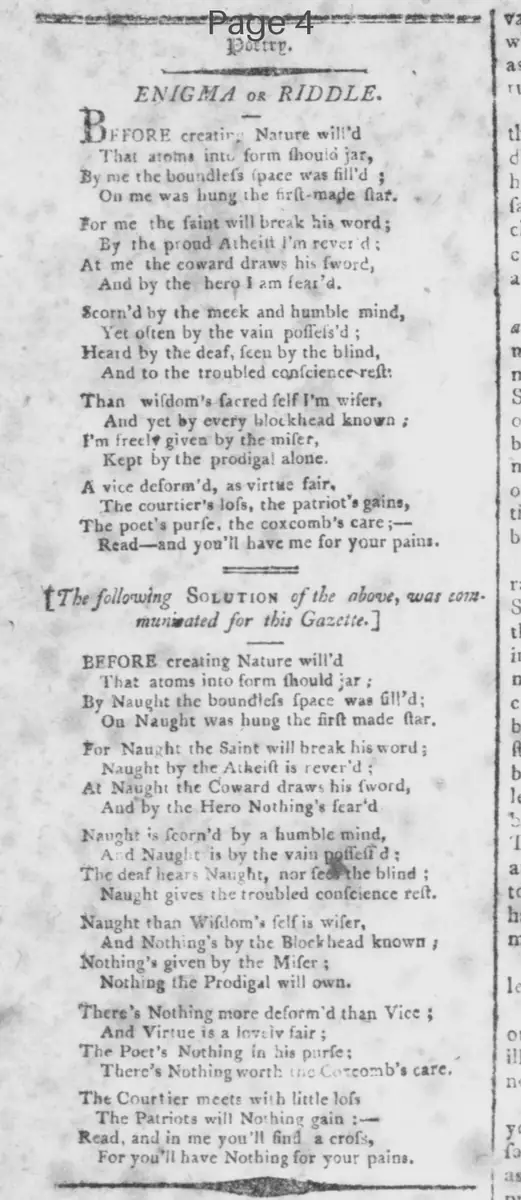
Poetry.
ENIGMA OR RIDDLE.
Before creating Nature will'd,
That atoms into form should jar,
By me the boundless space was fill'd;
On me was hung the first-made star,
For me the saint will break his word:
By the proud Atheist I'm rever'd;
At me the coward draws his sword,
And by the hero I am fear'd.
Scorn'd by the meek and humble mind,
Yet often by the vain possess'd;
Heard by the deaf, seen by the blind,
And to the troubled conscience rest:
Than wisdom's sacred self I'm wiser,
And yet by every blockhead known;
I'm freely given by the miser,
Kept by the prodigal alone.
A vice deform'd, as virtue fair,
The courtier's loss, the patriot's gains,
The poet's pure, the coxcomb's care;-
Read--and you'll have me for your pains.
The following Solution of the above, was communicated for this Gazette.
BEFORE creating Nature will'd
The atoms into form should jar;
By Naught the boundless space was fill'd;
On Naught was hung the first made star,
For Naught the Saint will break his word;
Naught by the Atheist is rever'd;
At Naught the Coward draws his sword,
And by the Hero Nothing's fear'd.
Naught is scorn'd by a humble mind
And Naught is by the vain possess'd:
The deaf hears Naught, nor sees the blind;
Naught gives the troubled conscience rest.
Naught than Wisdom's self is wiser,
And Nothing's by the Blockhead known
Nothing's given by the Miser;
Nothing the Prodigal will own.
There's Nothing more deform'd than Vice;
And Virtue is a lovely fair;
The Poet's Nothing in his purse;
There's Nothing worth the Coxcomb's care.
The Courtier meets with little loss
The Patriots will Nothing gain:-
Read, and in me you'll find a cross,
For you'll have Nothing for your pains.
ENIGMA OR RIDDLE.
Before creating Nature will'd,
That atoms into form should jar,
By me the boundless space was fill'd;
On me was hung the first-made star,
For me the saint will break his word:
By the proud Atheist I'm rever'd;
At me the coward draws his sword,
And by the hero I am fear'd.
Scorn'd by the meek and humble mind,
Yet often by the vain possess'd;
Heard by the deaf, seen by the blind,
And to the troubled conscience rest:
Than wisdom's sacred self I'm wiser,
And yet by every blockhead known;
I'm freely given by the miser,
Kept by the prodigal alone.
A vice deform'd, as virtue fair,
The courtier's loss, the patriot's gains,
The poet's pure, the coxcomb's care;-
Read--and you'll have me for your pains.
The following Solution of the above, was communicated for this Gazette.
BEFORE creating Nature will'd
The atoms into form should jar;
By Naught the boundless space was fill'd;
On Naught was hung the first made star,
For Naught the Saint will break his word;
Naught by the Atheist is rever'd;
At Naught the Coward draws his sword,
And by the Hero Nothing's fear'd.
Naught is scorn'd by a humble mind
And Naught is by the vain possess'd:
The deaf hears Naught, nor sees the blind;
Naught gives the troubled conscience rest.
Naught than Wisdom's self is wiser,
And Nothing's by the Blockhead known
Nothing's given by the Miser;
Nothing the Prodigal will own.
There's Nothing more deform'd than Vice;
And Virtue is a lovely fair;
The Poet's Nothing in his purse;
There's Nothing worth the Coxcomb's care.
The Courtier meets with little loss
The Patriots will Nothing gain:-
Read, and in me you'll find a cross,
For you'll have Nothing for your pains.
What sub-type of article is it?
Riddle
What themes does it cover?
Moral Virtue
What keywords are associated?
Riddle
Enigma
Naught
Nothing
Vice
Virtue
Paradox
Poem Details
Title
Enigma Or Riddle.
Form / Style
Rhymed Couplets
Key Lines
Read And You'll Have Me For Your Pains.
By Naught The Boundless Space Was Fill'd;
Naught Than Wisdom's Self Is Wiser,