Thank you for visiting SNEWPapers!
Sign up free
Poem
February 13, 1840
Watchman Of The South
Richmond, Virginia
What is this article about?
Meditative prose poem on winter snow, contrasting wealthy comfort with poor suffering, urging charity and reflection on God's creation, with biblical allusions to nature's beauty and divine word's efficacy.
Clipping
OCR Quality
98%
Excellent
Full Text
THE SNOW.
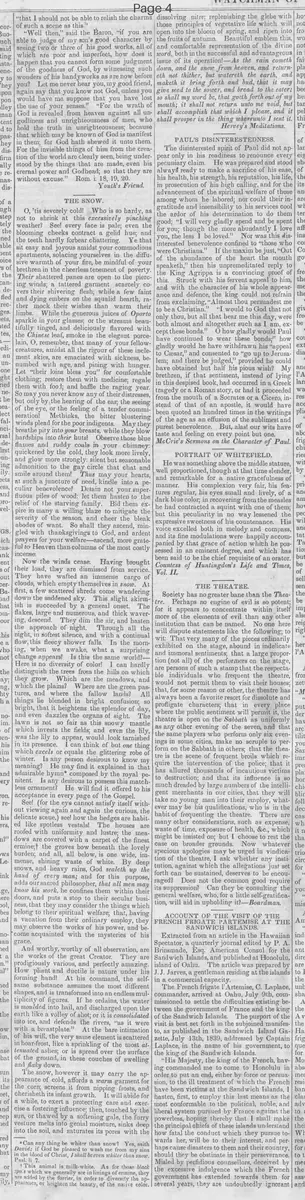
O, 'tis severely cold! Who is so hardy, as not to shrink at this excessively pinching weather? See! every face is pale; even the blooming cheeks contract a gelid hue; and the teeth hardly forbear chattering. Ye that sit easy and joyous amidst your commodious apartments, solacing yourselves in the diffusive warmth of your fire, be mindful of your brethren in the cheerless tenement of poverty. Their shattered panes are open to the piercing winds: a tattered garment scarcely covers their shivering flesh; while a few faint and dying embers on the squalid hearth, rather mock their wishes than warm their limbs. While the generous juices of Oporto sparkle in your glasses; or the streams beautifully tinged, and deliciously flavored with the Chinese leaf, smoke in the elegant porcelain, O, remember, that many of your fellow-creatures, amidst all the rigour of these inclement skies, are emaciated with sickness, benumbed with age, and pining with hunger. Let "their loins bless you" for comfortable clothing; restore them with medicine; regale them with food; and baffle the raging year. So may you never know any of their distresses, but only by the hearing of the ear; the seeing of the eye, or the feeling of a tender commiseration! Methinks, the bitter blustering winds plead for the poor indigents. May they breathe pity into your breasts, while they blow hardships into their huts! Observe those blue flames and ruddy coals in your chimney: quickened by the cold, they look more lively, and glow more strongly: silent but seasonable admonition to the gay circle that chat and smile around them! Thus may your hearts, at such a juncture of need, kindle into a peculiar benevolence! Detain not your superfluous piles of wood: let them hasten to the relief of the starving family. Bid them expire in many a willing blaze to mitigate the severity of the season, and cheer the bleak abodes of want. So shall they ascend, mingled with thanksgivings to God, and ardent prayers for your welfare—ascend, more grateful to Heaven than columns of the most costly incense:
Now the winds cease. Having brought their load, they are dismissed from service. They have wafted an immense cargo of clouds, which empty themselves in snow. At first, a few scattered shreds come wandering down the saddened sky. This slight skirmish is succeeded by a general onset. The flakes, large and numerous, and thick wavering, descend. They dim the air, and hasten the approach of night. Through all the night, in softest silence, and with a continual flow, this fleecy shower falls. In the morning, when we awake, what a surprising change appears! Is this the same world? Here is no diversity of color! I can hardly distinguish the trees from the hills on which they grow. Which are the meadows, and which the plains? Where are the green pastures, and where the fallow lands? All things lie blended in bright confusion; so bright, that it heightens the splendor of day, and even dazzles the organs of sight. The lawn is not so fair as this snowy mantle which invests the fields; and even the lily, was the lily to appear, would look tarnished in its presence. I can think of but one thing which excels or equals the glittering robe of winter. Is any person desirous to know my meaning? He may find it explained in that admirable hymn* composed by the royal penitent. Is any desirous to possess this matchless ornament? He will find it offered to his acceptance in every page of the Gospel. See! (for the eye cannot satisfy itself without viewing again and again the curious, the delicate scene,) see! how the hedges are habited like spotless vestals! The houses are roofed with uniformity and lustre; the meadows are covered with a carpet of the finest ermine; the groves bow beneath the lovely burden; and all, all below, is one wide, immense, shining waste of white. By deep snows, and heavy rains, God sealeth up the hand of every man; and for this purpose, adds our sacred philosopher, that all men may know his work, he confines them within their doors, and puts a stop to their secular business, that they may consider the things which belong to their spiritual welfare; that, having a vacation from their ordinary employ, they may observe the works of his power, and become acquainted with the mysteries of his grace.
And worthy, worthy of all observation, are the works of the great Creator. They are prodigiously various, and perfectly amazing. How pliant and ductile is nature under his forming hand! At his command, the self-same substance assumes the most different shapes, and is transformed into an endless multiplicity of figures. If he ordains, the water is moulded into hail, and discharged upon the earth like a volley of shot; or it is consolidated into ice, and defends the rivers, "as it were with a breastplate." At the bare intimation of his will, the very same element is scattered in hoar-frost, like a sprinkling of the most attenuated ashes; or is spread over the surface of the ground, in these couches of swelling and flaky down.
The snow, however it may carry the appearance of cold, affords a warm garment for the corn; screens it from nipping frosts, and cherisheth its infant growth. It will abide for a while, to exert a protecting care and exercise a fostering influence; then, touched by the sun, or thawed by a softening gale, the furry vesture melts into genial moisture, sinks deep into the soil, and saturates its pores with the dissolving nitre: replenishing the glebe with those principles of vegetative life which will open into the bloom of spring, and ripen into the fruits of autumn. Beautiful emblem this, and comfortable representation of the divine word, both in the successful and advantageous issue of its operation!—As the rain cometh down, and the snow from heaven, and returneth not thither, but watereth the earth, and maketh it bring forth and bud, that it may give seed to the sower, and bread to the eater; so shall my word be, that goeth forth out of my mouth; it shall not return unto me void, but shall accomplish that which I please, and it shall prosper in the thing whereunto I sent it.
Hervey's Meditations.
*Can any thing be whiter than snow? Yes, saith David; if God be pleased to wash me from my sins in the blood of Christ, I shall be even whiter than snow. Psal. li 7.
+ This animal is milk-white. As for those black spots which we generally see in linings of ermine, they are added by the furrier, in order to diversify the appearance, or heighten the beauty, of the native color.
O, 'tis severely cold! Who is so hardy, as not to shrink at this excessively pinching weather? See! every face is pale; even the blooming cheeks contract a gelid hue; and the teeth hardly forbear chattering. Ye that sit easy and joyous amidst your commodious apartments, solacing yourselves in the diffusive warmth of your fire, be mindful of your brethren in the cheerless tenement of poverty. Their shattered panes are open to the piercing winds: a tattered garment scarcely covers their shivering flesh; while a few faint and dying embers on the squalid hearth, rather mock their wishes than warm their limbs. While the generous juices of Oporto sparkle in your glasses; or the streams beautifully tinged, and deliciously flavored with the Chinese leaf, smoke in the elegant porcelain, O, remember, that many of your fellow-creatures, amidst all the rigour of these inclement skies, are emaciated with sickness, benumbed with age, and pining with hunger. Let "their loins bless you" for comfortable clothing; restore them with medicine; regale them with food; and baffle the raging year. So may you never know any of their distresses, but only by the hearing of the ear; the seeing of the eye, or the feeling of a tender commiseration! Methinks, the bitter blustering winds plead for the poor indigents. May they breathe pity into your breasts, while they blow hardships into their huts! Observe those blue flames and ruddy coals in your chimney: quickened by the cold, they look more lively, and glow more strongly: silent but seasonable admonition to the gay circle that chat and smile around them! Thus may your hearts, at such a juncture of need, kindle into a peculiar benevolence! Detain not your superfluous piles of wood: let them hasten to the relief of the starving family. Bid them expire in many a willing blaze to mitigate the severity of the season, and cheer the bleak abodes of want. So shall they ascend, mingled with thanksgivings to God, and ardent prayers for your welfare—ascend, more grateful to Heaven than columns of the most costly incense:
Now the winds cease. Having brought their load, they are dismissed from service. They have wafted an immense cargo of clouds, which empty themselves in snow. At first, a few scattered shreds come wandering down the saddened sky. This slight skirmish is succeeded by a general onset. The flakes, large and numerous, and thick wavering, descend. They dim the air, and hasten the approach of night. Through all the night, in softest silence, and with a continual flow, this fleecy shower falls. In the morning, when we awake, what a surprising change appears! Is this the same world? Here is no diversity of color! I can hardly distinguish the trees from the hills on which they grow. Which are the meadows, and which the plains? Where are the green pastures, and where the fallow lands? All things lie blended in bright confusion; so bright, that it heightens the splendor of day, and even dazzles the organs of sight. The lawn is not so fair as this snowy mantle which invests the fields; and even the lily, was the lily to appear, would look tarnished in its presence. I can think of but one thing which excels or equals the glittering robe of winter. Is any person desirous to know my meaning? He may find it explained in that admirable hymn* composed by the royal penitent. Is any desirous to possess this matchless ornament? He will find it offered to his acceptance in every page of the Gospel. See! (for the eye cannot satisfy itself without viewing again and again the curious, the delicate scene,) see! how the hedges are habited like spotless vestals! The houses are roofed with uniformity and lustre; the meadows are covered with a carpet of the finest ermine; the groves bow beneath the lovely burden; and all, all below, is one wide, immense, shining waste of white. By deep snows, and heavy rains, God sealeth up the hand of every man; and for this purpose, adds our sacred philosopher, that all men may know his work, he confines them within their doors, and puts a stop to their secular business, that they may consider the things which belong to their spiritual welfare; that, having a vacation from their ordinary employ, they may observe the works of his power, and become acquainted with the mysteries of his grace.
And worthy, worthy of all observation, are the works of the great Creator. They are prodigiously various, and perfectly amazing. How pliant and ductile is nature under his forming hand! At his command, the self-same substance assumes the most different shapes, and is transformed into an endless multiplicity of figures. If he ordains, the water is moulded into hail, and discharged upon the earth like a volley of shot; or it is consolidated into ice, and defends the rivers, "as it were with a breastplate." At the bare intimation of his will, the very same element is scattered in hoar-frost, like a sprinkling of the most attenuated ashes; or is spread over the surface of the ground, in these couches of swelling and flaky down.
The snow, however it may carry the appearance of cold, affords a warm garment for the corn; screens it from nipping frosts, and cherisheth its infant growth. It will abide for a while, to exert a protecting care and exercise a fostering influence; then, touched by the sun, or thawed by a softening gale, the furry vesture melts into genial moisture, sinks deep into the soil, and saturates its pores with the dissolving nitre: replenishing the glebe with those principles of vegetative life which will open into the bloom of spring, and ripen into the fruits of autumn. Beautiful emblem this, and comfortable representation of the divine word, both in the successful and advantageous issue of its operation!—As the rain cometh down, and the snow from heaven, and returneth not thither, but watereth the earth, and maketh it bring forth and bud, that it may give seed to the sower, and bread to the eater; so shall my word be, that goeth forth out of my mouth; it shall not return unto me void, but shall accomplish that which I please, and it shall prosper in the thing whereunto I sent it.
Hervey's Meditations.
*Can any thing be whiter than snow? Yes, saith David; if God be pleased to wash me from my sins in the blood of Christ, I shall be even whiter than snow. Psal. li 7.
+ This animal is milk-white. As for those black spots which we generally see in linings of ermine, they are added by the furrier, in order to diversify the appearance, or heighten the beauty, of the native color.
What sub-type of article is it?
Ode
Pastoral
Hymn
What themes does it cover?
Nature Seasons
Religious Faith
Moral Virtue
What keywords are associated?
Snow
Winter
Poverty
Charity
Gods Creation
Biblical Snow
Nature Emblem
Spiritual Reflection
What entities or persons were involved?
Hervey's Meditations.
Poem Details
Title
The Snow.
Author
Hervey's Meditations.
Subject
Meditation On Snow And Winter Charity
Form / Style
Prose Meditation With Poetic Language
Key Lines
O, 'Tis Severely Cold! Who Is So Hardy, As Not To Shrink At This Excessively Pinching Weather?
By Deep Snows, And Heavy Rains, God Sealeth Up The Hand Of Every Man;
As The Rain Cometh Down, And The Snow From Heaven, And Returneth Not Thither, But Watereth The Earth... So Shall My Word Be...