Thank you for visiting SNEWPapers!
Sign up free
The National Intelligencer And Washington Advertiser
Washington, District Of Columbia
What is this article about?
Transcript of U.S. House debates on April 7, 1806, over publishing President Jefferson's message on Spanish aggressions and Florida purchase appropriation. Speakers like Campbell, Kelly, Clay, and Eppes defend negotiation over military buildup, comparing to 1803 Louisiana purchase. Continued remarks on April 30 justify peaceful acquisition policy.
Merged-components note: Merged as they form a continuous narrative of the congressional debate on Spanish affairs and related measures, with explicit 'CONTINUED' indicators.
Clippings
1 of 2
OCR Quality
Full Text
HOUSE OF REPRESENTATIVES.
MONDAY, APRIL 7.
SPANISH AFFAIRS.
Debate on the motion of Mr. J. Randolph to publish the President's message.
(CONTINUED.)
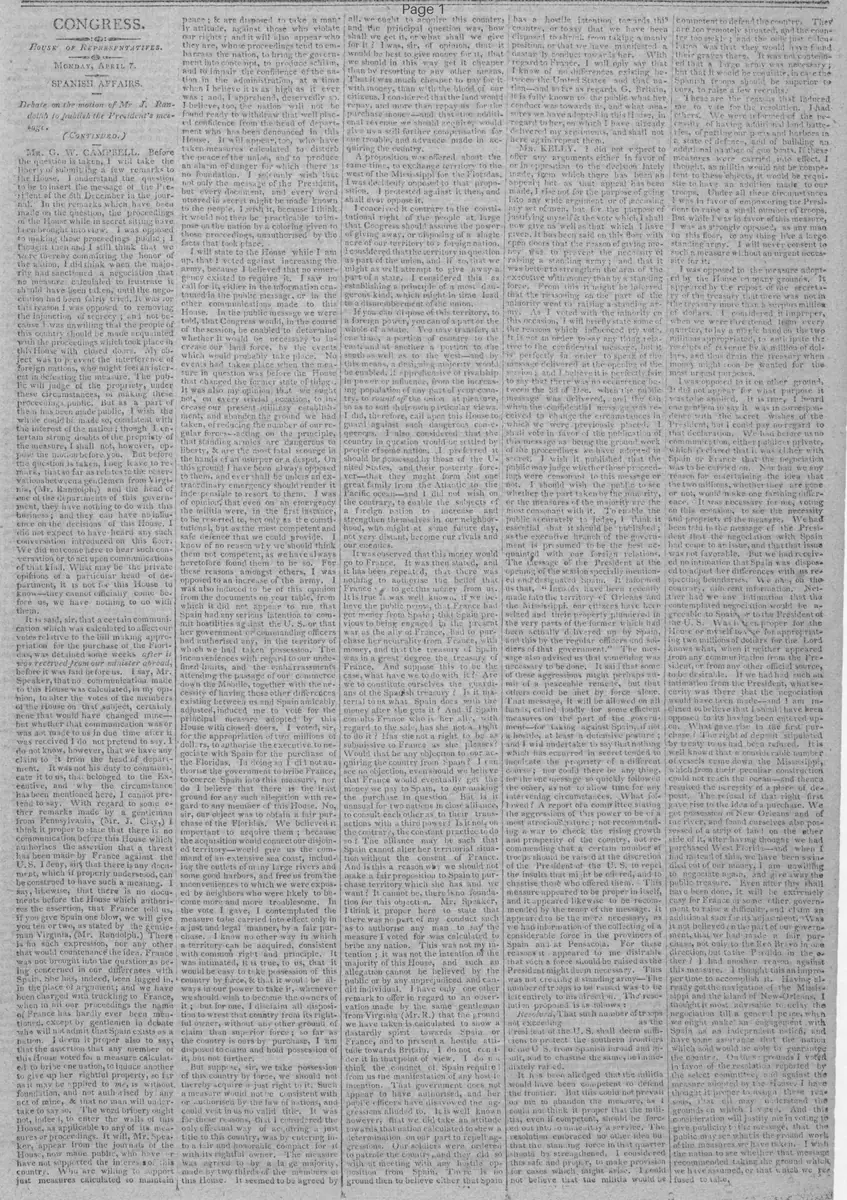
MR. G. W. CAMPBELL. Before the question is taken, I will take the liberty of submitting a few remarks to the House. I understand the question to be to insert the message of the President of the 6th December in the journal. In the remarks which have been made on the question, the proceedings of the House while in secret sitting have been brought into view. I was opposed to making those proceedings public; I thought then and I still think that we were thereby committing the honor of the nation. I did think when the majority had sanctioned a negotiation that no measure calculated to frustrate it should have been taken, until the negotiation had been fairly tried. It was for this reason I was opposed to removing the injunction of secrecy; and not because I was unwilling that the people of this country should be made acquainted with the proceedings which took place in this House with closed doors. My object was to prevent the interference of foreign nations, who might feel an interest in defeating the measure. The public will judge of the propriety, under these circumstances, of making these proceedings public. But as a part of the whole has been made public, I wish the whole could be made so, consistent with the interest of the nation; though I entertain strong doubts of the propriety of the measure, I shall not, however, oppose the motion before you. But before the question is taken, I beg leave to remark, that so far as relates to the observations between a gentleman from Virginia, (Mr. Randolph,) and the head of one of the departments of this government, they have nothing to do with this business; and they can have no influence on the decisions of this House. I did not expect to have heard any such conversation introduced on this floor. We did not come here to hear such conversation or to act upon communications of that kind. What may be the private opinions of a particular head of department, it is not for this House to know—they cannot officially come before us, we have nothing to do with them.
It is said, sir, that a certain communication which was calculated to affect our votes relative to the bill making appropriation for the purchase of the Floridas, was detained some weeks after it was received from our minister abroad, before it was laid before us. I say, Mr. Speaker, that no communication made to this House was calculated, in my opinion, to alter the votes of the members of the House on that subject, certainly none that would have changed mine—but whether that communication was or was not made to us in due time after it was received I do not pretend to say. I do not know, however, that we have any claim to it from the head of department. It was not his duty to communicate it to us, that belonged to the Executive, and why the circumstance has been mentioned here, I cannot pretend to say. With regard to some other remarks made by a gentleman from Pennsylvania, (Mr. J. Clay,) I think it proper to state that there is no communication before this House which authorizes the assertion that a threat has been made by France against the U. S. I deny, sir, that there is any document, which if properly understood, can be construed to have such a meaning. I say, likewise, that there is no document before the House which authorizes the assertion, that France told us, if you give Spain one blow, we will give you ten or two, as stated by the gentleman from Virginia, (Mr. Randolph.) There is no such expression, nor any other that would countenance the idea. France was not brought into the question as being concerned in our differences with Spain. She has, indeed, been dragged in, in the place of argument; and we have been charged with truckling to France, when in all our proceedings the name of France has hardly ever been mentioned, except by gentlemen in debate who will not admit that Spain exists as a nation. I deem it proper also to say, that the assertion that any member of this House voted for a measure calculated to bribe one nation, to induce another to give up her rightful property, so far as it may be applied to me, is without foundation, and not authorized by any act of mine, & that no man will undertake to say so. The word bribery ought not, indeed, to enter the walls of this House, as applicable to any of its measures or proceedings. It will, Mr. Speaker, appear from the journals of the House, now made public, who have or have not supported the interests of this country. Who are willing to support just measures calculated to maintain peace: & are disposed to take a manly attitude against those who violate our rights; and it will also appear who they are, whose proceedings tend to embarrass the nation, to bring the government into contempt, to produce schism, and to impair the confidence of the nation in the administration, at a time when I believe it is as high as it ever was; and, I apprehend, deservedly so. I believe, too, the nation will not be found ready to withdraw that well placed confidence from the head of department who has been denounced in this House. It will appear, too, who have taken measures calculated to disturb the peace of the union, and to produce an alarm of danger for which there is no foundation, I solemnly wish that not only the message of the President, but every document, and every word uttered in secret might be made known to the people. I wish it, because I think it would not then be practicable to impose on the nation by a coloring given to those proceedings, unauthorised by the facts that took place.
I will state to the House while I am up, that I voted against increasing the army, because I believed that no emergency existed to require it. I saw no call for it, either in the information contained in the public message, or in the other communications made to this House. In the public message we were told, that Congress would, in the course of the session, be enabled to determine whether it would be necessary to increase our land force, by the events which would probably take place. No events had taken place when the measure in question was before the House that changed the former state of things. It was also my opinion that we ought not, on every trivial occasion, to increase our present military establishment, and abandon the ground we had taken, of reducing the number of our regular forces—acting on the principle, that standing armies are dangerous to liberty, & are the most fatal scourge in the hands of an usurper or a despot. On this ground I have been always opposed to them, and ever shall be unless an extraordinary emergency should render it indispensable to resort to them. I was of opinion, that even on an emergency the militia were, in the first instance, to be resorted to, not only as the constitutional, but as the most competent and safe defence that we could provide. I know of no reason why we should think them not competent, as we have always heretofore found them to be so. For these reasons amongst others, I was opposed to an increase of the army. I was also induced to be of this opinion from the documents on your table, from which it did not appear to me that Spain had any serious intention to commit hostilities against the U. S. or that her government or commanding officers had authorised any, in the territory of which we had taken possession. The inconveniences with regard to our undefined limits, and the embarrassments attending the passage of our commerce down the Mobile, together with the necessity of having those other differences existing between us and Spain amicably adjusted, induced me to vote for the principal measure adopted by this House with closed doors. I voted, sir, for the appropriation of two millions of dollars, to authorise the executive to negotiate with Spain for the purchase of the Floridas. In doing so I did not authorise the government to bribe France, to coerce Spain into this measure, nor do I believe that there is the least ground for any such allegation with regard to any member of this House. No, sir, our object was to obtain a fair purchase of the Floridas. We believed it important to acquire them; because the acquisition would connect our disjoined territory—would give us the command of an extensive sea coast, including the outlets of many large rivers and some good harbors, and free us from the inconveniences to which we were exposed by neighbors who were likely to become more and more troublesome. In the vote I gave, I contemplated the measure to be carried into effect only in a just and legal manner, by a fair purchase. I know no other way in which a territory can be acquired, consistent with common right and principle. It was intimated, it is true, to us, that it would be easy to take possession of this country by force, & that it would be always in our power to take it, whenever we should wish to become the owners of it; but for one, I disclaim all disposition to wrest that country from its rightful owner, without any other ground of claim than superior force; so far as the country is ours by purchase, I am disposed to claim and hold possession of it, but not further.
But suppose, sir, we take possession of this country by force, we should not thereby acquire a just right to it. Such a measure would not be consistent with or authorised by the law of nations, and could vest in us no valid title. It was for these reasons, that I considered the only effectual way of acquiring a just title to this country, was by entering into a fair and honorable compact for it with its rightful owner. The measure was agreed to by a large majority, made by two thirds of the members of this House. It seemed to be agreed by all, we ought to acquire this country and the principal question was, how shall we get it, or what shall we give for it? I was, sir, of opinion, that it would be best to give money for it, that we should in this way get it cheaper than by resorting to any other means. That it was much cheaper to pay for it with money, than with the blood of our citizens. I considered that the land would repay, and more than repay us for the purchase money—and that the additional revenue we should acquire, would give us a still further compensation for our trouble, and advance made in acquiring the country.
A proposition was offered about the same time, to exchange territory to the west of the Mississippi for the Floridas. I was decidedly opposed to that proposition. I protested against it then, and shall ever oppose it. I conceived it contrary to the constitutional right of the people at large that Congress should assume the power of giving away, or disposing of a single acre of our territory to a foreign nation. I considered that the territory in question as part of the union, and if so, that we might as well attempt to give away a part of a state. I considered this as establishing a principle of a most dangerous kind, which might in time lead to a dismemberment of the union. If you can dispose of this territory, to a foreign power, you can of a part or the whole of a state, You may transfer, at one time, a portion of country to the east. and at another a portion to the south as well as to the west—and by this means, a designing majority would be enabled, if apprehensive of rivalship in power or influence, from the increasing population of any part of your country. to round off the union at pleasure, so as to suit their own particular views. I did, therefore, call upon this House to guard against such dangerous consequences. I also considered that the country in question would be settled by people of some nation. I preferred it should be possessed by those of the U. nited States, and their posterity forever—that they might form but one great family, from the Atlantic to the Pacific ocean—and I did not wish on the contrary, to enable the subjects of a foreign nation to increase and strengthen themselves in our neighborhood, who might at some future day, not very distant, become our rivals and our enemies.
It was observed that this money would go to France. It was then stated, and it has been repeated, that there was nothing to authorise the belief that France was to get this money from us. It is true it was well known, if we believe the public prints. that France had got money from Spain; that Spain previous to being engaged in the present war as the ally of France, had to purchase her neutrality from France, with money, and that the treasury of Spain was in a great degree the treasury of France. And suppose this to be the case, what have we to do with it? Are we to constitute ourselves the guardians of the Spanish treasury? Is it material to us what Spain does with the money after she gets it? And if Spain consults France who is her ally, with regard to the sale, has she not a right to do it? Has she not a right to be as submissive to France as she pleases? Would that be any objection to our acquiring the country from Spain? I can see no objection, even should we believe that France would eventually get the money we pay to Spain, to our making the purchase in question But is it unusual for two nations in close alliance, to consult each other as to their transactions with a third power? Is it not, on the contrary, the constant practice to do so? The alliance may be such that Spain cannot alter her territorial situation without the consent of France. And is this a reason why we should not make a fair proposition to Spain to purchase territory which she has and we want? It cannot be, there is no foundation for this objection. Mr. Speaker, I think it proper here to state that there was no part of my conduct such as to authorise any man to say the measure I voted for was calculated to bribe any nation. This was not my intention; it was not the intention of the majority of this House, and such an allegation cannot be believed by the public or by any unprejudiced and candid individual. I have only one other remark to offer in regard to an observation made by the same gentleman from Virginia (Mr. R.) that the ground we have taken is calculated to show a dastardly spirit towards Spain or France, and to present a hostile attitude towards Britain. I do not consider it in that point of view. I do not think the conduct of, Spain requires from us the manifestation of any hostile intention. That government does not appear to have authorised, and her public officers have disavowed the aggressions alluded to. It is well known however, that we did take an attitude towards that nation calculated to shew a determination on our part to repell aggressions. Our soldiers were ordered to patrole the country, and they did so without meeting with any hostile opposition from Spain. There is no ground then to believe either that Spain has a hostile intention towards this country, or to say that we have been disposed to shrink from taking a manly position, or that we have manifested a dastardly conduct towards her. With regard to France, I will only say that I know of no differences existing between the United States' and that nation—and so far as regards G. Britain, it is fully known to the public what her conduct was towards us, and what measures we have adopted in this House, in regard to her, on which I have already delivered my sentiments, and shall not here again repeat them.
MR. KELLY. I did not expect to offer any arguments either in favor of or in opposition to the decision lately made, from which there has been an appeal; but as that appeal has been made, I rise not for the purpose of going into any wide argument or of accusing any set of men. but for the purpose of justifying myself & the vote which I shall now give as well as that which I have given. It has been said on this floor with open doors that the reason of giving money was to prevent the necessity of raising a standing army; and that it was better to strengthen the arm of the executive with money than by a standing force. From this it might be inferred that the reasoning on the part of the minority went to raising a standing army. As I voted with the minority on this occasion, I will briefly state some of the reasons which influenced my vote. It is not in order to say any thing relative to the confidential message, but it is perfectly in order to speak of the message delivered at the opening of the session; and I believe it is perfectly fair to say that there was no occurrence between the 3d of Dec. when the public message was delivered, and the 6th when the confidential message was received to change the circumstances in which we were previously placed. I shall vote in favor of the publication of this message as being the ground work of the proceedings we have adopted in secret. I wish it published that the public may judge whether those proceedings were consonant to this message or not. I should wish the public to see whether the part taken by the minority, or the measures of the majority are the most consonant with it. To enable the public accurately to judge, I think it essential that it should be published; as the executive branch of the government is presumed to be the best acquainted with our foreign relations. The message of the President at the opening of the session specially mentioned and designated Spain, It informed us that, "Inroads have been recently made into the territory of Orleans and the Mississippi, our citizens have been seized and their property plundered in the very parts of the former which had been actually delivered up by Spain, and this by the regular officers and soldiers of that government." The message also advised us that something was necessary to be done. It said that some of these aggressions might perhaps admit of a peaceable remedy, but that others could be met by force alone. That message, it will be allowed on all hands, called loudly for some efficient measures on the part of the government for taking against Spain, if not a hostile, at least a defensive posture; and I will undertake to say that nothing which has occurred in secret tended to inculcate the propriety of a different course ; nor could there be any thing, for the one message so quickly followed the other, as not to allow time for any intervening circumstances. What followed ? A report of a committee stating the aggressions of this power to be of a most atrocious nature; not recommending a war to check the rising growth and prosperity of the country, but recommending that a certain number of troops should be raised at the discretion of the President of the U. S. to repel the insults that might be offered, and to chastise those who offered them. This measure appeared to be proper in itself, and it appeared likewise to be recommended by the tenor of the message. It appeared to be the most necessary, as we had information of the collecting of a considerable force in the provinces of Spain and at Pensacola. For these reasons it appeared to me desirable that such a force should be raised as the President might deem necessary. This was not creating a standing army—The number of troops to be raised was to be left entirely to his direction. The resolution was as follows:
Resolved, That such number of troops not exceeding as the President of the U. S. shall deem sufficient to protect the southern frontiers of the U. S. from Spanish inroad and insult, and to chastise the same, be immediately raised.
It has been alleged that the militia would have been competent to defend the frontier. But this could not prevail on me to abandon the measure, as I could not think it proper that the militia, even if competent, should be forced out into a sickly territory a service. The resolution embraced no other idea but that the standing force in that quarter should be strengthened, I considered this safe and proper, to make provision for cases which might arise. I could not believe that the militia would be competent to defend the country. They are too remotely situated, and the country too sickly: and the only just calculation was that they would have found their graves there, It was not contended that a large army was necessary; but that it would be requisite, in case the Spanish troops should be superior to ours, to raise a few recruits. These are the reasons that induced me to vote for the resolution. I had others. We were informed of the necessity of having additional land batteries, of putting our ports and harbors in a state of defence. and of building an additional number of gun boats. If these measures were carried into effect. I thought, as militia would not be competent to these objects. it would be requisite to have an addition made to our troops. Under all these circumstances I was in favor of empowering the President to raise a small number of troops. But while I was in favor of this measure, I was as strongly opposed as any man on this floor. to any thing like a large standing army. I will never consent to such a measure without an urgent necessity for it:
I was opposed to the measure adopted by the House on many grounds. It appeared by the report of the secretary of the treasury that there was not in the treasury more than a surplus million of dollars. I considered it improper, when we were threatened from every quarter, to lay a magic hand on the two millions appropriated, to anticipate the receipts of revenue by a million of dollars, and thus drain the treasury when money might soon be wanted for the most urgent purposes.
I was opposed to it on other ground It did not appear for what purpose it was to be applied, It is true, I heard one gentleman say it was in correspondence with the secret wishes of the President, but I could pay no regard to that declaration, We had before us no communication, either public or private. which declared that it was either with Spain or France that the negotiation was to be carried on. Nor had we any reason for entertaining the idea that the two millions, whether they are gone or not, would make one farthing difference, It was necessary for me, voting on this occasion, to see the necessity and propriety of the measure, We had been told in the message of the President that the negotiation with Spain had come to an issue, and that that issue was not favorable. But we had received no intimation that Spain was disposed to adjust her differences with us respecting boundaries. We had, on the contrary, different information. Neither had we any intimation that the contemplated negotiation would be agreeable to Spain or to the President of the U. S. Was it then proper for the House or myself to vote for appropriating two millions of dollars for the Lord knows what. when it neither appeared from any communication from the President, or from any other official source, to be desirable. If we had had such an intimation from the President, what security was there that the negotiation would have been made—and I am inclined to believe that I should have been opposed to its having been entered upon. What gave rise to the first purchase ? The right of deposit stipulated by treaty to us had been refused. It is well known that a considerable number of vessels come down the Mississippi which from their peculiar construction could not reach the ocean—and thence resulted the necessity of a place of deposit. The refusal of that right first gave rise to the idea of a purchase. We took possession of New Orleans and of the river, and found ourselves also possessed of a strip of land on the other side of it, after having thought we had purchased West Florida—and when I find instead of this, we have been swindled out of our money, I am unwilling to negotiate again, and give away the public treasure. Even after this shall have been done, it will be extremely easy for France or some other. government to raise a difficulty, and claim an additional sum for its adjustment. as it not believed on the part of our government, that we had made a fair purchase, not only to the Rio Bravo in one direction, but to the Perdido in the other ? I had another reason against this measure, I thought this an improper time to accomplish it. Having already got the navigation of the Mississippi and the island of New-Orleans, I thought it most advisable to delay the negotiation till a general peace, when we might make an engagement with Spain as an independent nation, and have some assurance that the nation which sold would be able to guarantee the country. On these grounds I voted in favor of the resolution reported by the select committee, and against the measure adopted by the House, I have thought it proper to assign these reasons, that all may understand the grounds on which I voted And this consideration will justify me in voting to give publicity to the message. that the public may see what is the ground work of the measures we have taken, I wish the nation to see whether that message recommended taking the ground which we have assumed, or that which we refused to take,
Mr. J. CLAY. I must say that the observations which have fallen from my colleague and other gentlemen who have taken a part in this debate, have strongly impressed me with the propriety of the motion under consideration.
There appears to be a material difference of opinion as to the true construction of the message and the documents communicated by the President. It is apparent that I understand those communications in one way, and my colleague in another. We have been told that one nation, France, has been improperly dragged into this discussion. The message of the President ought, in my opinion, to be published to show that this is not so. There are other sources of differences of opinion which can only be understood by giving publicity to the message. Gentlemen have gone into a long detail of the motives which governed them in the votes which they have given. It is not necessary for me to imitate the example they have set. I hope when my motives are called in question, it will be before the public and not here. I shall be ready to defend them by all the means I possess, the vote of this House notwithstanding. I believed when the injunction of secrecy was removed, it was removed from all our proceedings, and I considered all that was laid before this House as so far my property that I had a right to use it in my defence. We have been told there is one for voting against the resolution—that a standing army was proposed to be raised by it while the militia would have answered every useful purpose. This may be a very good and popular argument, but we have been within a few days told from the same quarter, that it is necessary to have a brigadier general in the armies of the United States to defend one of the very provinces attacked by Spain. Some allusion has been made to a conversation held out of doors; and my colleague has shown some squeamishness to act by such authority. But I will ask him if he invariably makes up his votes from official documents laid on this table, and whether he does not sometimes travel out of the record. When a gentleman tells you such and such a thing, in which the honor of the nation is implicated, ought he to be considered as out of order? Was it not his duty to give that information to the House? I will say, if I had been acquainted with these things, my doubts as to the propriety of the appropriation of two millions would have been much increased. Permit me here to observe, that when a gentleman intimated that the money was already gone out of the country, no man in his senses could have dreamt that it was intended to assert that it was sent out in so many actual Spanish milled dollars. Does the secretary of the treasury, when he informs us there is so many dollars in the treasury, mean to say there are so many gold and silver dollars there? No. He only means to say we have a credit to such an amount. So with regard to our transactions with Spain, I understand that our credit is in Holland, and that the fund is created there from which we are to draw. Is not this to all intents and purposes, the same as transmitting the money to Holland? When a man pays a debt, is it to be supposed that he carries the actual dollars with him? To say the least of such an objection it is a mere quibble. As there is a material difference of opinion as to the construction of the documents and the message of the President, it is a duty which we owe to ourselves, to lay before the people all the information on which we acted, that we may stand justified or condemned by it before them.
Mr. EPPES. I rejoice that the period has at length arrived, when our public conduct is to be submitted to the people. When what we have done in our representative capacity is to be collected not from eloquent representations on this floor of what other gentlemen would not do, but from the record of our proceedings. The secret is out—the bubble has burst, and gentlemen find themselves and the public disappointed. I consider the publication of the secret journal as an appeal to the people. I am willing to indulge gentlemen in making it as perfect as they can. I shall vote for the amendment of the gentleman from Virginia, or for any other calculated to bring this subject fairly before those to whom we are responsible for our conduct. The journal is the best answer to their speeches. Lend it as they will they cannot realize the public expectations. Its publication, I firmly believe, will excite no sentiment but surprise. On the day the injunction of secrecy was taken off, your doors were crowded with persons anxious to hear this tremendous secret. I witnessed nothing but disappointment. Congress has appropriated two millions of dollars to buy Florida. Is this all? Have you not confiscated the public debt? Or at any event the Louisiana stock? Most certainly you have voted money to bribe Talleyrand? No, I assure you, we have done nothing more than appropriate two millions of dollars for the purchase of Florida in a law, containing precisely the same words with the one passed for that purpose, in the year 1803, and supported by the very persons who have denounced this measure. Gentlemen have attempted to draw a distinction between the situation of the U. S. in the year 1803, and in the year 1806. I am not so unacquainted as to say that the present differences with Spain, are precisely such as we had in the year 1803. This however, I will say—that every objection urged against the present appropriation, applies with equal force to the measure of 1803. Let us examine what was the situation of the U. S. with Spain at these two periods. In the year 1803, Spain had committed spoliations on our commerce to a considerable amount, the payment of which had been either wholly or in part refused. She had cut off the whole western country, from an outlet to the ocean, by prohibiting a deposit at New Orleans, and refusing to assign an equivalent one elsewhere, as stipulated by treaty. The remedy adopted by the collected wisdom of the nation was holding in readiness a detachment of militia, and making a secret appropriation to buy Florida.
In the year 1806, Spain had refused an amicable adjustment of limits—had refused to pay spoliations on our commerce—had in one instance violated our territory. The remedy resorted to, has been to hold in readiness a detachment of militia, and to appropriate money for the purchase of Florida.
This was the situation of the nation at these two periods. Whether at either period, the wisest course has been pursued, I shall not attempt to prove. In both cases the nation adopted the same principle. To avoid war if possible, and to purchase territory, rather than fight for it. All the strong objections urged against the measure at present adopted, apply with equal force to the measure adopted in 1803. The two laws contain precisely the same words, and neither specify the object of appropriation. The law of 1803 was passed in secret, with closed doors. The law of 1806, was passed in the same manner. The appropriation in 1803, was not recommended by the executive, but founded on a resolution submitted by a member of the House of Representatives. The appropriation in 1806, was not recommended by the executive, but founded on a resolution submitted by a member of the House of Representatives also. The object of the appropriation in the year 1803, concealed from the people twelve months—In the year 1806, made public in a few weeks. Gentlemen may draw nice distinctions, but they will find it difficult to make the people believe, that the measure adopted in 1803, was wise and virtuous, and the same measure in 1806, infamous. I appeal with confidence to the people, they will and must see, that this is the very same measure adopted three years ago, without noise, in a law containing the same words, passed in secret in the same manner, and supported by the very persons who have denounced this measure.
When, however, this measure shall be fairly brought before the public, it, will be found, that notwithstanding the noise and clamour which has been made, the difference between the majority and minority on this question is not very considerable. Every member of the House of Representatives admitted the necessity of doing something. What were the remedies within our reach
1st. To declare war.
2. Either to increase our standing army for the purpose of strengthening our posts or holding in readiness a detachment of militia.
3. To exchange territory or to purchase.
As to the first of these, declaring war, no member of the House of Representatives wished to pursue that course. The gentleman from Virginia certainly did not. His report speaks only the language of peace—all the evils of war to this country, are dwelt on to that report with care and labor. If, however, we had not this proof, that he did not wish for war with Spain, he has given unequivocal proofs of it in his arguments on another question. A war with Spain we know, must be a war with Spain and France combined. They are joined by alliance offensive and defensive. To a war against France and Spain combined, all the objections urged against war with England, would apply with full force. If war with England would have increased executive patronage, and endangered the constitution and the liberty of the people, so also would war with France and Spain combined—we put war aside therefore, as a course which no man wished to pursue. The next course was either to increase our standing troops, or to hold in readiness a detachment of militia. Here was room for an honest diversity of opinion. A majority of the House preferred depending on a militia—I was of that number. I thought the standing troops in that country sufficient for the protection of it, unless Spain determined to force a war. Subsequent events, have shewn the correctness of that opinion. No violation of territory has taken place since the case of the Kemper's, except by twenty Spaniards, who crossed the Sabine, and were driven off by the American troops. The next course was either to exchange territory, or to purchase. A majority of the House were in favor of both. I was of that number. On the east side of the Mississippi there was territory to which Spain had an undoubted right. There was territory to which the U. S. had an undoubted right—and there was territory which Spain and the U. S. both claimed. On the west side of the Mississippi, the situation was the same. Each nation had an undoubted right to territory, and there was territory claimed by both. It was not to be supposed that Spain, while she held the territory to the east of the Perdido, would be disposed to relinquish the claim which she sets up to the country between the Perdido and Mississippi. It was necessary to purchase the territory to the east of the Perdido, to which Spain has an undoubted right, and after disposing of which, it would certainly be her interest to relinquish her claim between the Perdido and Mississippi, on obtaining an equivalent surrender on the part of the U. S. to claims west of the Mississippi. I see nothing dishonorable in this transaction, and really it appears to me that the difference between the majority and minority is narrowed down to this. The majority were in favor of militia. The minority of standing troops. The majority were in favor of exchange and of purchase. The minority in favor of exchange only.
On the importance of Florida to the U. S. I shall not say any thing. The foes to this measure have admitted its importance in the fullest extent, and their willingness to acquire it on fair and honorable terms. All their objections have been made not to the purchase but to the mode. It is said we have appropriated money not for the purchase of Florida, but to induce France to bully Spain out of her right. On this subject, I have never had but one opinion. I have always believed, and I still believe, that the money will be fairly employed in purchasing Florida of the rightful owner. The gentleman from Virginia will do me the justice to recollect, that I held this language with closed doors. I hold it now in the presence of the people. That France may ultimately get the money is highly probable, and why? Has not the gentleman from Virginia told us the sovereignty of Spain is annihilated, that the powers of her minister are signed Charles Maurice Talleyrand? But of what importance is it to us what becomes of the money we pay Spain? Are we to become the guardians of Spain? Shall we not purchase a territory important to the U. S. because Spain may be bullied or cheated out of the money she receives from us? If Spain is really in such a degraded state that she has no will of her own, has her conduct towards the U. S. been such, as to induce us not to avail ourselves of the situation in which we find her? For my own part, I care not what use Spain makes of the money paid to her for Florida. It is of no importance to me as a representative, nor to the people. That the purchase will be fairly made of Spain, and the money paid to Spain, I have no doubt. The government dare not employ it in any other way. I shall vote for amending the journal by inserting the message. I know, however, that this will not satisfy the gentlemen. They will next want the correspondence of our foreign ministers, and this they know cannot be published. I am willing, with these observations, to trust my conduct with those by whom I am elected. A representative is not responsible for the wisdom of measures. All he is answerable for, is an honest exercise of his judgment. On the present, as on every other occasion, I am certain, I have honestly exercised for the public good, that understanding which God and nature has bestowed on me.
(Debate to be continued)
WASHINGTON CITY.
WEDNESDAY, APRIL 30.
REMARKS On the measures of the last session of Congress.
[CONTINUED.]
Events of subsequent occurrence have fully justified the opinions expressed in the foregoing report, by proving that so long as this country shall be held by a foreign government, the free passage of the streams that empty themselves into the gulf will be obstructed, as its sense of interest, however mistaken, shall dictate. There is one consideration which demonstrates the justice of the opinion of the committee that this country, at least so far as respects the free navigation of its great streams, must be ours either by purchase or force. Such will be the vast mass of interest at stake, and dependent on their free passage, when the population of the western country, shall have reached but a small stage of that extension to which it is rapidly progressing, that no power, possessed by the government of the U. S. or by any foreign nation, can restrain the people from availing themselves of what they will deem, their natural rights; and hence, if the enjoyment of these cannot be acquired by amicable arrangements, they will inevitably be got by the exertion of physical power.
It is the province of a wise government to foresee events such as these, and to avert evils instead of waiting for their arrival.
It was on the basis of this report, and the resolution it recommended, that the purchase of Louisiana was made. This measure has passed the ordeal of investigation, and has been sanctioned by a vast majority of the nation. If it was correct, can a measure then right be now wrong; for though the negotiation that ensued issued in the purchase of Louisiana, the whole tenor of the report shows that the real object was the purchase of the Floridas.
Let us very concisely compare the circumstances attending the appropriation in 1803, and those attending the appropriation in 1806, to determine whether they are or are not sufficiently alike to justify the conclusion that if the first appropriation was correct, so likewise is the last.
In 1803 an undisputed right, a right actually possessed, was violated under circumstances of peculiar aggravation. An important right was taken from us, which we actually enjoyed. This was, therefore, an act of perfect hostility, and we should have been justified, so far as related to Spain, in applying force to force. But true to ourselves, and paying less regard to the usages of other nations than to our own interests, we determined to negotiate—for what? For the purchase of the Floridas, and New Orleans. We then considered it no violation of national honor, though our undoubted right to a deposit was violated, to negotiate for remedying this evil, in connection with the obtaining another important acquisition.
Just so in the present instance. Spain had invaded our territorial rights—had kept possession of what we deemed ours, had violated what she acknowledged to be ours. For the redressing these evils, for the ascertaining disputed boundaries, for the amicable adjustment of differences, we say to Spain, we offer you a certain sum of money for the undisturbed enjoyment of what we consider ourselves rightfully entitled to, in connection with another important acquisition. Agree to a boundary to the north, and cede to us the Floridas, not merely West Florida, already indisputable between us, but both the Floridas, and we will pay you a proper price for them.
So far the cases run parallel. In both we ask to be secured in an invaded right, and negotiate for the acquisition of new rights, on the payment of a stipulated sum of money.
Other differences, it is true, exist at present between the U. S. and Spain; such as the spoliations on our property and the injury derived from the suspension of the right of deposit.
Similar differences, to a certain extent, however, existed in 1803: and as in the purchase of Louisiana, in which the negotiation then issued, a part of the price paid for that country was appropriated to the payment of our citizens as an indemnity for the violation of their rights; so in the present instance, should the negotiation succeed, it is extremely probable a like reparation will be made in the same way.
By the measures pursued in 1803, peace was preserved. The same result will follow from the present measures if they terminate in the like success.
This short view is a sufficient answer to the charge of pusillanimity brought against the administration. If the measures of 1803 were not considered pusillanimous, can those of 1806, so similar to them, bear this construction? The republicans in the former year said, let us in the first instance resort to negotiation, and let us offer to make a bargain on the terms of fair reciprocity;—they say the same thing now. The result was then successful, and the administration received the thanks of their country. The result in the present instance may likewise be successful, & a grateful nation may be equally lavish of its thanks.
In making these remarks, it is not our intention to criminate the motives of those who voted for measures different from those adopted. We know full well that on this point an honest difference of opinion may have prevailed. Nor are we insensible of the many strong arguments which might be urged in favor of strengthening our southern frontier against possible aggressions. We know full well that the maxims of justice are not the invariable guides of those with whom our foreign relations are conducted. But we are, nevertheless, firmly of the opinion, that in the first instance, in compliance with the policy of the United States, it becomes us to exhaust every means in our power to adjust our differences, without resorting to offensive operations, or incurring that great expense which would necessarily have attended the adoption of defensive measures on a large scale. We are the more strengthened in this opinion from the continued conviction that in case the aggressions of any foreign power shall hereafter be of such a nature as to justify retaliation, we shall have in our hands the means of resorting to it, & of inflicting a fatal vengeance. Should the property of our citizens be attacked by violence, our hardy yeomen, inured to toil and danger, will, at a moment's warning, repel the assailants. Can the government of Spain say the same thing? Is not every possession she holds vulnerable, and are not the seeds of dissolution sown in all her institutions? Let us then patiently, though confidently wait for events, & not resort to extreme measures till necessity not less than justice shall demand them. By pursuing this course we shall follow the advice, so emphatically given us in the memorable report of 1803. In the language of that report we may say,
"The great question which presents itself is, shall we at this time lay the foundation for future peace, by offering a fair and equivalent consideration; or shall we hereafter incur the hazards and the horrors of war?—The government of the United States is differently organized from any other in the world. Its object is the happiness of man; its policy and its interest, to pursue right by right means. War is the great scourge of the human race, and should never be resorted to but in cases of the most imperious necessity. A wise government will avoid it, when its views can be attained by peaceful measures. Princes fight for glory, and the blood and treasure of their subjects is the price they pay. In all nations the people bear the burthen of war, and in the United States, the people rule. Their representatives are the guardians of their rights, and it is the duty of those representatives to provide against any event, which may, even at a distant day, involve the interests and the happiness of the nation. We may indeed have our rights restored to us by treaty, but there is a want of fortitude in applying temporary remedies to permanent evils; thereby imposing on our posterity a burthen which we ourselves ought to bear. If the purchase can be made, we ought not to hesitate. If the attempt should fail, we shall have discharged an important duty. War may be the result; but the American nation, satisfied with our conduct, will be animated by one soul, and will unite all its energies in the contest. Foreign powers will be convinced that it is not a war of aggrandisement on our part and will therefore feel no unreasonable jealousies towards us. We shall have proved that our object was justice; it will be seen that our propositions were fair; and it will be acknowledged that our cause is honorable. Should alliances be necessary they may be advantageously formed. We shall have merited and shall therefore possess general confidence. Our measures will stand justified not only to ourselves and our country, but to the world."
[To be Continued]
What sub-type of article is it?
What themes does it cover?
What keywords are associated?
What entities or persons were involved?
Where did it happen?
Story Details
Key Persons
Location
House Of Representatives, Washington City
Event Date
1806 04 07
Story Details
Debate on publishing the President's December 6 message regarding Spanish aggressions; speakers justify votes for $2 million appropriation to negotiate Florida purchase over army increase, emphasizing peaceful acquisition and comparing to 1803 Louisiana purchase; continued remarks defend policy of negotiation to avoid war.