Thank you for visiting SNEWPapers!
Sign up free
Editorial
July 24, 1940
Mcallen Daily Press
Mcallen, Hidalgo County, Texas
What is this article about?
Editorial criticizes President Roosevelt's July 1, 1940 message urging a steeply graduated excess profits tax as unnecessary political maneuvering, noting Congress had already directed the Treasury to prepare such measures under the Revenue Act of 1940, warning of potential hasty and imperfect legislation.
Clipping
OCR Quality
92%
Excellent
Full Text
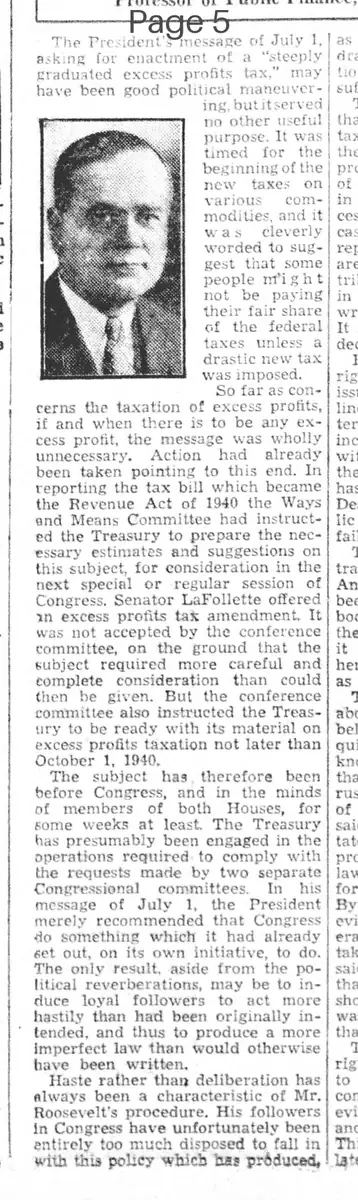
The President's message of July 1, asking for enactment of a "steeply graduated excess profits tax," may have been good political maneuvering, but it served no other useful purpose. It was timed for the beginning of the new taxes on various commodities, and it was cleverly worded to suggest that some people might not be paying their fair share of the federal taxes unless a drastic new tax was imposed.
So far as concerns the taxation of excess profits, if and when there is to be any excess profit, the message was wholly unnecessary. Action had already been taken pointing to this end. In reporting the tax bill which became the Revenue Act of 1940 the Ways and Means Committee had instructed the Treasury to prepare the necessary estimates and suggestions on this subject, for consideration in the next special or regular session of Congress.
Senator LaFollette offered an excess profits tax amendment. It was not accepted by the conference committee, on the ground that the subject required more careful and complete consideration than could then be given. But the conference committee also instructed the Treasury to be ready with its material on excess profits taxation not later than October 1, 1940.
The subject has therefore been before Congress, and in the minds of members of both Houses, for some weeks at least. The Treasury has presumably been engaged in the operations required to comply with the requests made by two separate Congressional committees.
In his message of July 1, the President merely recommended that Congress do something which it had already set out, on its own initiative, to do. The only result, aside from the political reverberations, may be to induce loyal followers to act more hastily than had been originally intended, and thus to produce a more imperfect law than would otherwise have been written.
Haste rather than deliberation has always been a characteristic of Mr. Roosevelt's procedure. His followers in Congress have unfortunately been entirely too much disposed to fall in with this policy which has produced.
So far as concerns the taxation of excess profits, if and when there is to be any excess profit, the message was wholly unnecessary. Action had already been taken pointing to this end. In reporting the tax bill which became the Revenue Act of 1940 the Ways and Means Committee had instructed the Treasury to prepare the necessary estimates and suggestions on this subject, for consideration in the next special or regular session of Congress.
Senator LaFollette offered an excess profits tax amendment. It was not accepted by the conference committee, on the ground that the subject required more careful and complete consideration than could then be given. But the conference committee also instructed the Treasury to be ready with its material on excess profits taxation not later than October 1, 1940.
The subject has therefore been before Congress, and in the minds of members of both Houses, for some weeks at least. The Treasury has presumably been engaged in the operations required to comply with the requests made by two separate Congressional committees.
In his message of July 1, the President merely recommended that Congress do something which it had already set out, on its own initiative, to do. The only result, aside from the political reverberations, may be to induce loyal followers to act more hastily than had been originally intended, and thus to produce a more imperfect law than would otherwise have been written.
Haste rather than deliberation has always been a characteristic of Mr. Roosevelt's procedure. His followers in Congress have unfortunately been entirely too much disposed to fall in with this policy which has produced.
What sub-type of article is it?
Taxation
Economic Policy
Partisan Politics
What keywords are associated?
Excess Profits Tax
Revenue Act 1940
President's Message
Congressional Committees
Hasty Legislation
Political Maneuvering
What entities or persons were involved?
President Roosevelt
Senator Lafollette
Ways And Means Committee
Conference Committee
Treasury
Editorial Details
Primary Topic
Critique Of President's Excess Profits Tax Message
Stance / Tone
Critical Of Political Maneuvering And Haste
Key Figures
President Roosevelt
Senator Lafollette
Ways And Means Committee
Conference Committee
Treasury
Key Arguments
President's Message Was Good Political Maneuvering But Unnecessary
Timed To Coincide With New Commodity Taxes To Suggest Unfair Sharing
Congress Already Instructed Treasury On Excess Profits Tax Via Revenue Act Of 1940
Lafollette's Amendment Rejected For Need Of More Consideration
Treasury To Prepare Material By October 1, 1940
Message Recommends What Congress Already Planned
May Induce Hasty Action Leading To Imperfect Law
Haste Characteristic Of Roosevelt's Procedure