Thank you for visiting SNEWPapers!
Sign up free
Douglas Daily Dispatch
Douglas, Cochise County, Arizona
What is this article about?
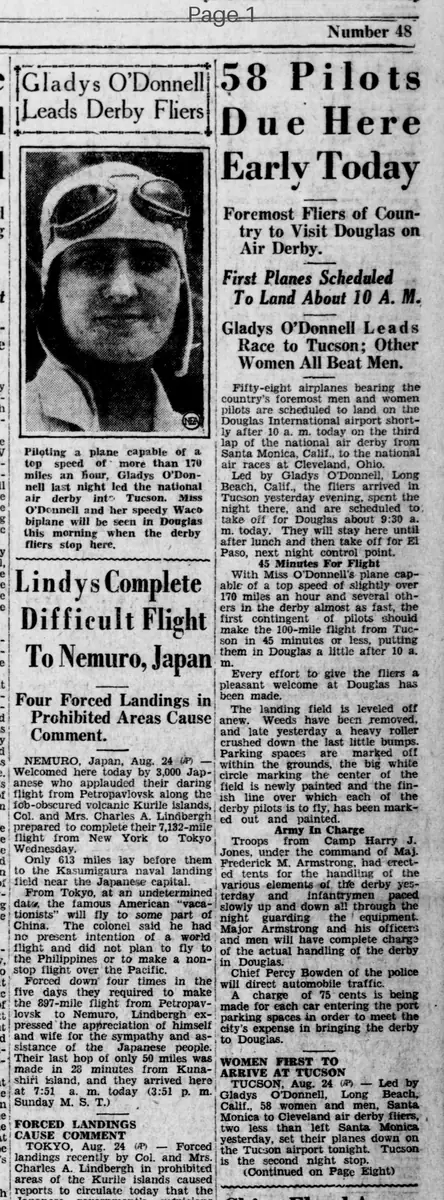
In the 1929 National Air Derby from Santa Monica to Cleveland, Gladys O'Donnell led 58 top pilots into Tucson on Aug. 24. They are set to arrive in Douglas around 10 a.m. the next day, with extensive preparations including military handling and field upgrades.
Merged-components note: Caption on Gladys O'Donnell piloting relates directly to the air derby story; merge as part of the same focused aviation news component.
Clipping
OCR Quality
Full Text
Number 48
58 Pilots Due Here Early Today
Foremost Fliers of Country to Visit Douglas on Air Derby.
First Planes Scheduled To Land About 10 A. M.
Gladys O'Donnell Leads Race to Tucson: Other Women All Beat Men.
Fifty-eight airplanes bearing the country's foremost men and women pilots are scheduled to land on the Douglas International airport shortly after 10 a. m. today on the third lap of the national air derby from Santa Monica, Calif., to the national air races at Cleveland, Ohio.
Led by Gladys O'Donnell, Long Beach, Calif., the fliers arrived in Tucson yesterday evening, spent the night there, and are scheduled to take off for Douglas about 9:30 a. m. today. They will stay here until after lunch and then take off for El Paso, next night control point.
45 Minutes For Flight
With Miss O'Donnell's plane capable of a top speed of slightly over 170 miles an hour and several others in the derby almost as fast, the first contingent of pilots should make the 100-mile flight from Tucson in 45 minutes or less, putting them in Douglas a little after 10 a. m.
Every effort to give the fliers a pleasant welcome at Douglas has been made.
The landing field is leveled off anew. Weeds have been removed, and late yesterday a heavy roller crushed down the last little bumps.
Parking spaces are marked off within the grounds, the big white circle marking the center of the field is newly painted and the finish line over which each of the derby pilots is to fly, has been marked out and painted.
Army In Charge
Troops from Camp Harry J. Jones, under the command of Maj. Frederick M. Armstrong, had erected tents for the handling of the various elements of the derby yesterday and infantrymen paced slowly up and down all through the night guarding the equipment.
Major Armstrong and his officers and men will have complete charge of the actual handling of the derby in Douglas.
Chief Percy Bowden of the police will direct automobile traffic.
A charge of 75 cents is being made for each car entering the port parking spaces in order to meet the city's expense in bringing the derby to Douglas.
WOMEN FIRST TO ARRIVE AT TUCSON
TUCSON, Aug. 24 (AP)—Led by Gladys O'Donnell, Long Beach, Calif., 58 women and men, Santa Monica to Cleveland air derby fliers, two less than left Santa Monica yesterday, set their planes down on the Tucson airport tonight. Tucson is the second night stop.
(Continued on Page Eight)
What sub-type of article is it?
What themes does it cover?
What keywords are associated?
What entities or persons were involved?
Where did it happen?
Story Details
Key Persons
Location
Douglas International Airport, Tucson
Event Date
Aug. 24
Story Details
Gladys O'Donnell leads 58 pilots in the national air derby from Santa Monica to Cleveland, arriving in Tucson on Aug. 24 and scheduled to land in Douglas shortly after 10 a.m. the next day before proceeding to El Paso. Preparations include field improvements and military oversight.