Thank you for visiting SNEWPapers!
Sign up free
The Augusta Courier
Augusta, Richmond County, Georgia
What is this article about?
Senator Richard Russell denounces the 1957 Civil Rights Act as a political fraud to curry favor with NAACP, predicting it will intimidate Southern officials and register unqualified voters to control elections. He explains the Southern senators' strategic decision against filibustering to amend the bill's worst provisions.
Merged-components note: These two components are parts of the same story about Senator Russell's speech on the civil rights bill, continued from page 1 to page 2. The text flows directly, and the label is changed to 'story' as it is a full narrative article on domestic political news.
Clippings
1 of 2
OCR Quality
Full Text
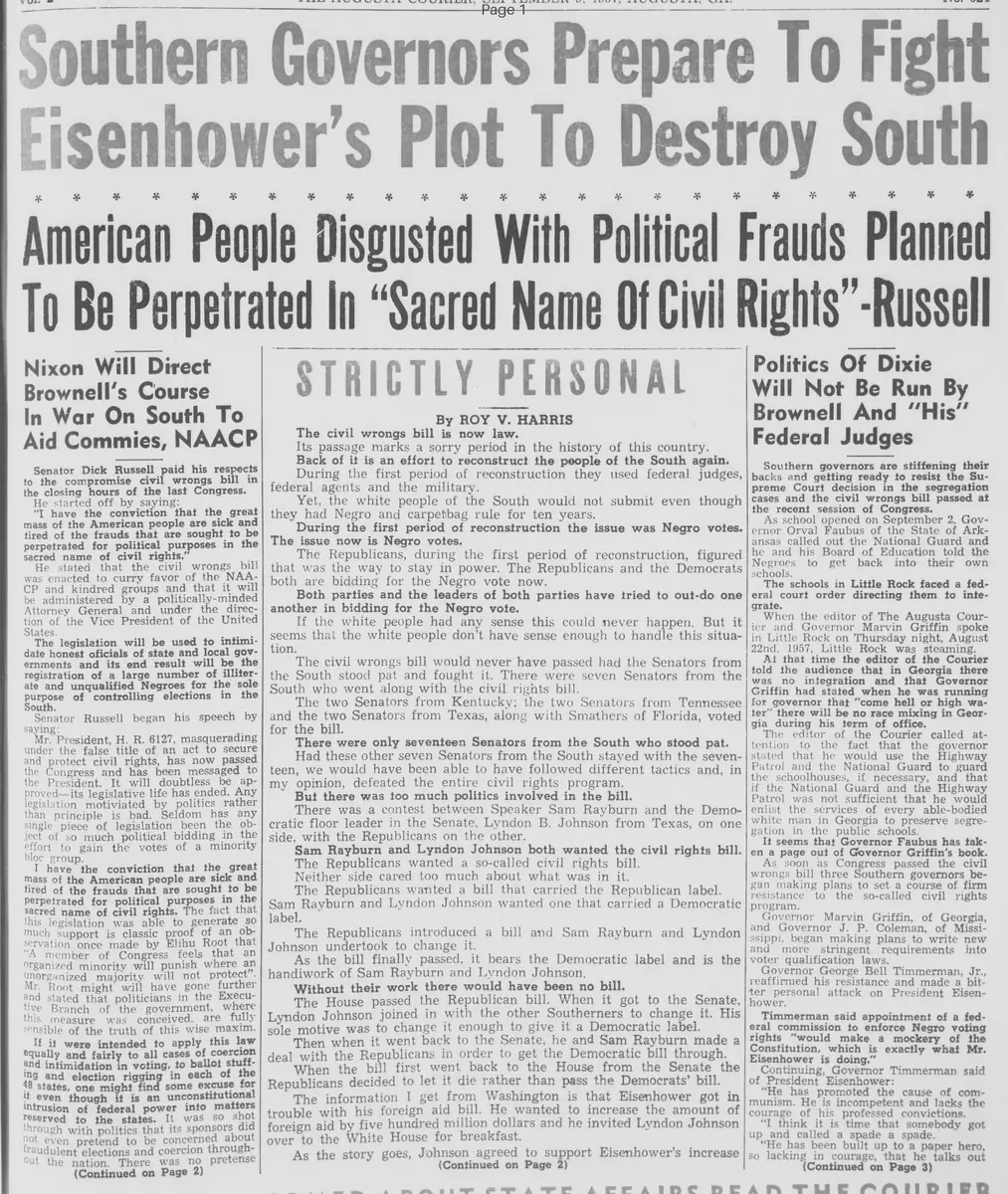
American People Disgusted With Political Frauds Planned To Be Perpetrated In "Sacred Name Of Civil Rights"
Russell
Nixon Will Direct Brownell's Course In War On South To Aid Commies, NAACP
Senator Dick Russell paid his respects to the compromise civil wrongs bill in the closing hours of the last Congress.
He started off by saying:
"I have the conviction that the great mass of the American people are sick and tired of the frauds that are sought to be perpetrated for political purposes in the sacred name of civil rights."
He stated that the civil wrongs bill was enacted to curry favor of the NAACP and kindred groups and that it will be administered by a politically-minded Attorney General and under the direction of the Vice President of the United States.
The legislation will be used to intimidate honest officials of state and local governments and its end result will be the registration of a large number of illiterate and unqualified Negroes for the sole purpose of controlling elections in the South.
Senator Russell began his speech by saying:
Mr. President. H. R. 6127, masquerading under the false title of an act to secure and protect civil rights, has now passed the Congress and has been messaged to the President. It will doubtless be approved—its legislative life has ended. Any legislation motivated by politics rather than principle is bad. Seldom has any single piece of legislation been the object of so much political bidding in the effort to gain the votes of a minority bloc group.
I have the conviction that the great mass of the American people are sick and tired of the frauds that are sought to be perpetrated for political purposes in the sacred name of civil rights. The fact that this legislation was able to generate so much support is classic proof of an observation once made by Elihu Root that "A member of Congress feels that an organized minority will punish where an unorganized majority will not protect".
Mr. Root might well have gone further and stated that politicians in the Executive Branch of the government, where this measure was conceived, are fully sensible of the truth of this wise maxim.
If it were intended to apply this law equally and fairly to all cases of coercion and intimidation in voting, to ballot stuffing and election rigging in each of the 48 states, one might find some excuse for it even though it is an unconstitutional intrusion of federal power into matters reserved to the states. It was so shot through with politics that its sponsors did not even pretend to be concerned about fraudulent elections and coercion throughout the nation. There was no pretense
(Continued on Page 2)
Nixon Will Direct Brownell's Course In War On South To Aid Commies, NAACP
(Continued from Page 1)
even that the bill was not aimed at the Southern states. It was undoubtedly enacted to curry favor with the National Colored People's Association and kindred groups and in response to their threats of political reprisal.
It will be administered by a political minded Attorney General. There can be little doubt that he will be constantly pressed by the Vice President of the United States to apply the great powers of the law to the Southern states, at such places and in such time and manner as the N.A.A.C.P., of which the Vice President is the most distinguished member, may demand.
The threat of this vicious legislation will be used to intimidate honest officials of state and local governments earnestly endeavoring to discharge their duties under their oaths of office and the laws of their states.
It is most likely that the application of this law will result in forcing the registration of a large number of Negroes who in fact cannot meet the qualifications prescribed for all electors under the laws of some states. It is a thoroughly bad bill and places dangerous powers in the hands of those who are to administer it.
Several Senators among the little group of 18 who organized early in the year to fight the mis-named civil rights bill have requested that I make a statement in respect to the criticisms leveled against several Southern Senators for not undertaking to filibuster H. R. 6127 to death.
At the outset I think I should say that a number of Senate bills in this field, including one identical with the original H. R. 6127, were introduced in the Senate at the beginning of this session of Congress. Those bills were the subject of extended hearings by the Committee on the Judiciary of the Senate. All of them are still in that Committee.
H. R. 6127 passed the House of Representatives on June 18th despite the valiant opposition of most of the Representatives from the Southern States, aided by a small number of Representatives from other sections who rose above the miasma of politics to defend constitutional government. When the bill was messaged from the Senate to the House a combination of Senators from both parties combined to prevent the bill from going to Committee which was the normal course.
Through a strained and devious application of the Rules of the Senate they succeeded in their purpose. Our group of 18 out of the 96 Senators who were opposed on principle to all parts of the bill were confronted with the necessity of making grave decisions in planning our opposition to the measure.
Few if any of us were strangers to the filibuster. A majority had been through many bone-wearying legislative struggles on similar legislation. We had not, however, been faced with such a vicious and far reaching bill under such difficult conditions.
There is a mistaken impression, widely held, that a filibuster in the Senate is a comparatively easy method whereby a few determined men can prevent the passage of almost any legislation if they are willing to talk. Even Senators sometimes refer to the right of unlimited debate in the Senate. Unfortunately for the country no such right has existed since 1917.
As a matter of fact the Senate has a previous question rule. It is a little slower in the process of strangulation but is equally effective in bringing a bill to a vote.
At any time they wish to do so 16 Senators may file a petition to end debate in the Senate. Under our rule a Senator who is speaking on the Floor can be interrupted in the course of his remarks so that the petition may be filed.
The most notable difference between the gag rule of the House of Representatives and that of the Senate lies in the fact that it requires a two-thirds vote of all the Senators to gag the Senate whereas in the House of Representatives a majority of those voting can cut off debate.
Several careful canvasses by our group revealed that we did not have as many as 32 Senators who would stand firmly against the application of cloture or gag rule to enable us to talk the bill to death.
The 18 Southerners were confronted with a hard choice. From a purely political point of view it would have been the easy course for the 18 of us to have planted our feet in concrete and announced that we would filibuster to the death against the bill. We could have proclaimed that we had died defending the breaches and thereby have undoubtedly won great plaudits from most of our constituents for our heroic last ditch resistance but there is little doubt that this would have resulted in the Senate passing the vicious bill which came to us from the House in its original form.
As sensible men experienced in the Senate, we knew that the easy course was sure to lead to defeat for us and an unparalleled disaster to the states we represent.
We are fully cognizant of the fact that our people have become accustomed to expect filibusters in these circumstances and that the adoption of any other course in a desperate effort to strip the bill of its most vicious provisions was likely to be misunderstood by the unthinking. The stakes were great. They involved the preservation of the social order and way of life of several of the Southern states.
We therefore pursued a policy of appeal to reason rather than launching a futile talkathon. Our speeches on the motion to take up the bill were designed for a maximum of length to appeal to the sense of fair play and justice of our colleagues and beyond them to the fair-minded masses of American people everywhere without bringing on a gag that would cut off our exposure of the vicious character of the original House bill.
The bill had been sailing under false colors. In two speeches in June on the majority procedure to bypass the Judiciary Committee I stressed the fact that supporters of the bill were referring to it as a voting bill while planning to use it to mix the races in the public schools of the South even at the point of federal bayonets.
This was authorized in Part III.
What sub-type of article is it?
What themes does it cover?
What keywords are associated?
What entities or persons were involved?
Where did it happen?
Story Details
Key Persons
Location
Southern States
Event Date
June 18th
Story Details
Senator Russell criticizes H.R. 6127 as a politically motivated civil rights bill aimed at the South to benefit NAACP, administered under Nixon's direction to intimidate officials and register unqualified voters; explains Southern senators' decision not to filibuster but to amend via appeals to reason, avoiding worse outcomes.