Thank you for visiting SNEWPapers!
Sign up free
The Potters Herald
East Liverpool, Columbiana County, Ohio
What is this article about?
The International Labor Organization urges member countries to address equal pay for women, highlighting its acceptance but uneven application as a matter of social justice and economic efficiency, with discussions planned for the 1950 conference.
Clipping
OCR Quality
Full Text
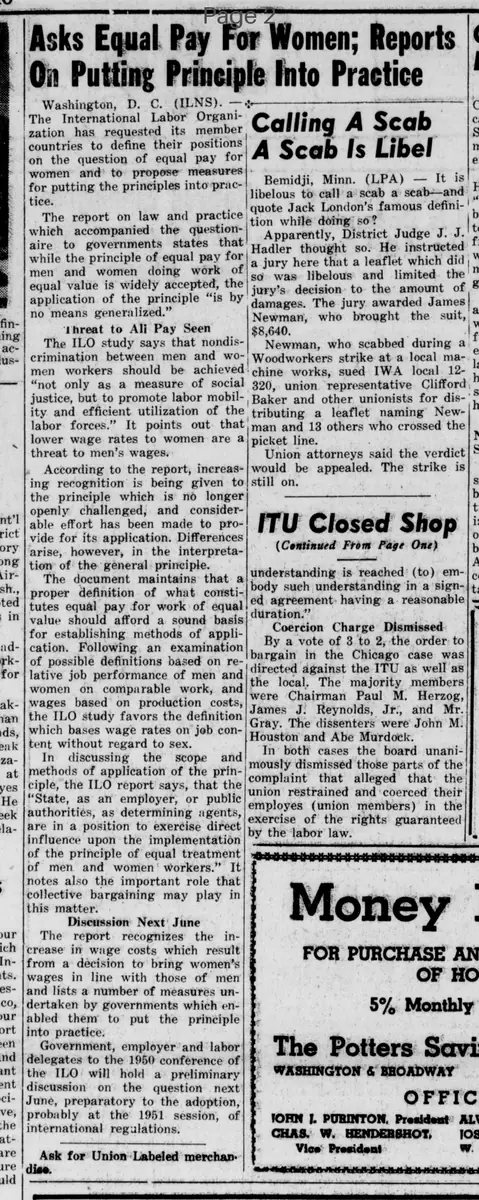
Washington, D. C. (ILNS). — The International Labor Organization has requested its member countries to define their positions on the question of equal pay for women and to propose measures for putting the principles into practice.
The report on law and practice which accompanied the questionnaire to governments states that while the principle of equal pay for men and women doing work of equal value is widely accepted, the application of the principle "is by no means generalized."
Threat to All Pay Seen
The ILO study says that nondiscrimination between men and women workers should be achieved "not only as a measure of social justice, but to promote labor mobility and efficient utilization of the labor forces." It points out that lower wage rates to women are a threat to men's wages.
According to the report, increasing recognition is being given to the principle which is no longer openly challenged, and considerable effort has been made to provide for its application. Differences arise, however, in the interpretation of the general principle.
The document maintains that a proper definition of what constitutes equal pay for work of equal value should afford a sound basis for establishing methods of application. Following an examination of possible definitions based on relative job performance of men and women on comparable work, and wages based on production costs, the ILO study favors the definition which bases wage rates on job content without regard to sex.
In discussing the scope and methods of application of the principle, the ILO report says that the "State, as an employer, or public authorities, as determining agents, are in a position to exercise direct influence upon the implementation of the principle of equal treatment of men and women workers." It notes also the important role that collective bargaining may play in this matter.
Discussion Next June
The report recognizes the increase in wage costs which result from a decision to bring women's wages in line with those of men and lists a number of measures undertaken by governments which enabled them to put the principle into practice.
Government, employer and labor delegates to the 1950 conference of the ILO will hold a preliminary discussion on the question next June, preparatory to the adoption, probably at the 1951 session, of international regulations.
Ask for Union Labeled merchandise.
What sub-type of article is it?
What themes does it cover?
What keywords are associated?
What entities or persons were involved?
Where did it happen?
Story Details
Key Persons
Location
Washington, D. C.
Event Date
1950
Story Details
The International Labor Organization requests member countries to define positions on equal pay for women and propose implementation measures. The report notes wide acceptance of the principle but limited application, emphasizing social justice, labor mobility, and threat to men's wages. It favors defining equal pay based on job content regardless of sex, discusses state and collective bargaining roles, and anticipates discussion at the 1950 ILO conference.