Thank you for visiting SNEWPapers!
Sign up free
Western Statesman
Carrollton, Carroll County, Mississippi
What is this article about?
Letter critiques inconsistent pro-annexation arguments from U.S. figures like President Tyler, Secretary Upshur, Generals Jackson and Cass, Senator Walker, and others, on grounds including military, economic, slavery, and treaty rights. Author supports annexation but opposes the 1844 treaty's debt provisions and political exploitation by Polk's campaign.
Clipping
OCR Quality
Full Text
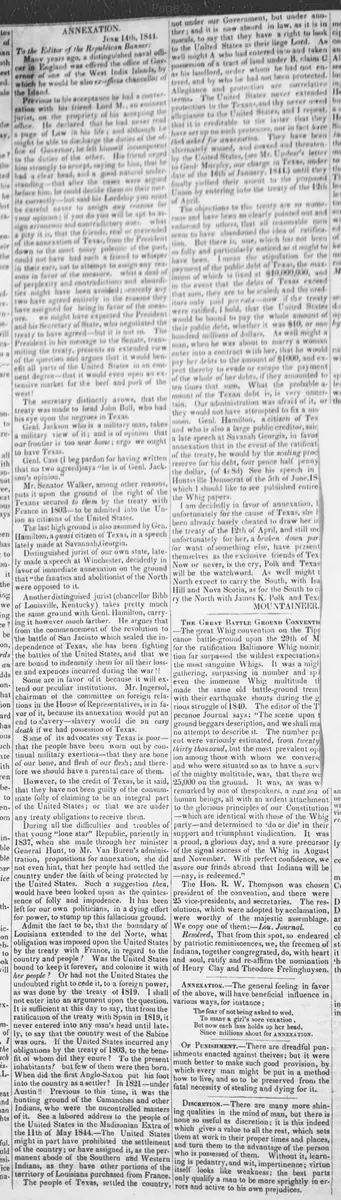
June 14th, 1841.
To the Editor of the Republican Banner:
Many years ago, a distinguished naval officer in England was offered the office of Governor of one of the West India Islands, by which he would be also ex-officio chancellor of the Island. Previous to his acceptance he had a consultation with his friend Lord M., an eminent jurist, on the propriety of his accepting the office. He declared that he had never read a page of law in his life; and although he might be able to discharge the duties of the office of Governor, he felt himself incompetent to the duties of the other. His friend urged him strongly to accept, saying to him, that he had a clear head, and a grand natural understanding—that after the cases were argued before him, he could decide them on their merits correctly—but said his Lordship you must be careful never to assign any reasons for your opinion; if you do you will be apt to assign erroneous and contradictory cases, what of the annexation of Texas, from the President down to the most noisy polemic of the press, could not have had such a friend to whisper in their ears, not to attempt to assign any reasons for their opinions, what a deal of perplexity and contradictions and absurdities might have been avoided; scarcely any two have agreed entirely in the reasons they urge. We might have expected the President and his Secretary of State, who negotiated the treaty to have agreed—but it is not so. The President in his message to the Senate, transmitting the treaty, presents an extended view of the question and argues that it would benefit all parts of the United States in an eminent degree—that it would even open an extensive market for the beef and pork of the west!
The Secretary distinctly avows, that the treaty was made to hoodwink John Bull, who had his eye upon the negroes in Texas.
Genl. Jackson who is a military man, takes a military view of it; and is of opinion that our frontier is too near home; ergo we ought to have Texas.
Genl. Cass (I beg pardon for having written that no two agreed) says "he is of Genl. Jackson's opinion."
Mr. Senator Walker, among other reasons, puts it upon the ground of the right of the Texans secured to them by the treaty with France in 1803—to be admitted into the Union as citizens of the United States.
The last high ground is also assumed by Gen. Hamilton, a quasi citizen of Texas, in a speech lately made at Savannah, Georgia.
A distinguished jurist of our own state, lately made a speech at Winchester, decidedly in favor of immediate annexation on the ground that "the fanatics and abolitionists of the North were opposed to it."
Another distinguished jurist (Chancellor Bibb of Louisville, Kentucky) takes pretty much the same ground with Genl. Hamilton, carrying it however much farther. He argues that from the commencement of the revolution to the battle of San Jacinto which sealed the independence of Texas, she has been fighting the battles of the United States, and that we are bound to indemnify them for all their losses and expenses incurred during the war!!
Some are in favor of it because it will extend our peculiar institutions. Mr. Ingersoll, chairman of the committee on foreign relations in the House of Representatives, is in favor of it, because its annexation would put an end to slavery—slavery would die an easy death if we had possession of Texas.
Some of its advocates say Texas is poor—that the people have been worn out by continual military exertions—that they are bone of our bone, and flesh of our flesh; and therefore we should have a parental care of them. However, to the credit of Texas, be it said, that they have not been guilty of the consummate folly of claiming to be an integral part of the United States; or that we are under any treaty obligations to receive them.
During all the difficulties and troubles of that young "lone star" Republic, patiently in 1837, when she made through her minister General Hunt, to Mr. Van Buren's administration, propositions for annexation, she did not even hint, that her people had settled the country under the faith of being protected by the United States. Such a suggestion then, would have been looked upon as the quintessence of folly and impudence. It has been left for our own politicians, in a dying effort for power, to stump up this fallacious ground.
Admit the fact to be, that the boundary of Louisiana extended to the del Norte, what obligation was imposed upon the United States by the treaty with France, in regard to the country and people? Was the United States bound to keep it forever, and colonize it with her people? Or had not the United States the undoubted right to cede it, to a foreign power, as was done by the treaty of 1819. I shall not enter into an argument upon the question. It is sufficient at this day to say, that from the ratification of the treaty with Spain in 1819, it never entered into any man's head until lately, to say that the country west of the Sabine was ours. If the United States incurred any obligations by the treaty of 1803, to the benefit of whom did they enure? To the present inhabitants? but few of them were then born. When did the first Anglo-Saxon put his foot into the country as a settler? In 1821—under Austin!! Previous to this time, it was the hunting ground of the Camanches and other Indians, who were the uncontrolled masters of it. See a labored address to the people of the United States in the Madisonian Extra of the 11th of May 1844.—The United States might in part have prohibited the settlement of the country; or have assigned it, as the permanent abode of the Southern and Western Indians, as they have other portions of the territory of Louisiana purchased from France. The people of Texas, settled the country not under our Government, but under another; and it is now absurd in law, as it is in morals, to say that they have a right to look to the United States as their liege Lord. A possession of a tract of land under B. claim C well might A who had entered into and taken as his landlord, under whom he had not entered, and by whom he had not been protected.
Allegiance and protection are correlative terms. The United States never extended protection to the Texans, and they never owed allegiance to the United States, and I repeat, that it is creditable to the latter that they have set up no such pretences, nor in fact have they, alternately wooed, and coaxed and threatened by the United States. (See Mr. Upshur's letter to Genl. Murphy, our charge in Texas, under date of the 14th of January, 1844) until they finally yielded their assent to the proposed Union by entering into the treaty of the 12th of April.
The objections to the treaty are too numerous and have been so clearly pointed out and enforced by others, that all reasonable men seem to have abandoned the idea of ratification, but there is, one, which has not been, I mean the stipulation for the payment of the public debt of Texas, the maximum of which is fixed at $10,000,000, and in the event that the debts of Texas exceed that sum, they are to be scaled; and the creditors to be paid pro rata. If the treaty were ratified, I hold, that the United States would be bound to pay the whole amount of their public debt, whether it was $10, or one hundred millions of dollars. As well might a man, when he was about to marry a woman enter into a contract with her, that he would pay her debts to the amount of $1000, and expect thereby to evade or escape the payment of the whole of her debts, if they amounted to ten times that sum. What the probable amount of the Texan debt is, is very uncertain. Our administration was afraid of it, or they would not have attempted to fix a maximum. Genl. Hamilton, a citizen of Texas and who is also a large public creditor, said in a late speech at Savannah Georgia, in favor of annexation that in the event of the ratification of the treaty, he would by the scaling process reserve for his debt, four pence halfpenny the dollar. (of 4s d) See his speech in the Huntsville Democrat of the 5th of June. I should like to see it published entire in the Whig papers.
I am decidedly in favor of annexation, I unfortunately for the cause of Texas, she has been already basely cheated to draw her into the treaty of the 12th of April, and still more unfortunately for her, a broken down party for want of something else, have presented themselves as the exclusive friends of Texas. Now or never, is the cry, Polk and Texas will be the watchword. As well might the North expect to carry the South, with Isaiah Hill and Nova Scotia, as for the South to carry the North with James K. Polk and Texas!
MOUNTAINEER.
What sub-type of article is it?
What themes does it cover?
What keywords are associated?
What entities or persons were involved?
Letter to Editor Details
Author
Mountaineer.
Recipient
To The Editor Of The Republican Banner
Main Argument
the author supports the annexation of texas but criticizes the inconsistent and contradictory reasons provided by various proponents, including political figures, and opposes the 1844 treaty's provisions on debt assumption and its exploitation for partisan gain by the polk campaign.
Notable Details