Thank you for visiting SNEWPapers!
Sign up free
The Liberator
Boston, Suffolk County, Massachusetts
What is this article about?
In the US Senate, during a debate on Southern rights and slavery, Senator Benton of Missouri approached Senator Foote of Mississippi aggressively, prompting Foote to draw a pistol in self-defense. No shots were fired, but the chamber erupted in chaos, leading to calls for investigation and a committee of five to examine the incident.
Clipping
OCR Quality
Full Text
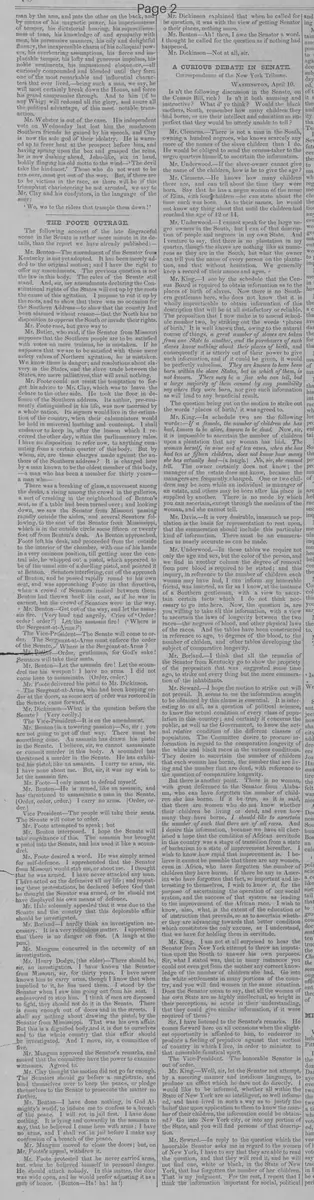
The following account of the late disgraceful scene in the Senate is rather more minute in its details, than the report we have already published:—
Mr. Benton—The amendment of the Senator from Kentucky is not yet adopted. It has been merely added to the original motion; and I have the right to offer my amendments. The previous question is not the law in this body. The rules of the Senate still stand. And, sir, my amendments declaring the Constitutional rights of the States will cut up by the roots the cause of this agitation. I propose to cut it up by the roots, and to show that there was no occasion for the Southern Address—to show that the country had been alarmed without reason—that the North has no disposition to oppress the South or invade their rights.
Mr. Foote rose, but gave way to Mr. Butler, who said, if the Senator from Missouri supposes that the Southern people are to be satisfied with votes on mere truisms, he is mistaken. If he supposes that we are to be satisfied with these mere safety valves of Northern agitation, he is mistaken. We know there is danger; and resolutions about slavery in the States, and the slave trade between the States, are mere palliatives, that will avail nothing.
Mr. Foote could not resist the temptation to forget his advice to Mr. Clay, which was to leave the debate to the other side. He took the floor in defence of the Southern address. Its author, pre-eminently distinguished in his life, was now mourned by a whole nation. Its signers would live in the estimation of the country, when their calumniators would be held in universal loathing and contempt. I shall endeavor to keep in, after the lesson which I received the other day, within the parliamentary rules. I have no disposition to refer now, to anything emanating from a certain quarter of this body. But by whom, sir, are these charges made against the authors of the Southern address? It is charged here by a man known to be the oldest member of this body,—a man who has been a member for thirty years a man who
There was a breaking of glass, a movement among the desks, a rising among the crowd in the galleries, a sort of crashing in the neighborhood of Benton's seat, as if a table had been turned over; and looking down, we saw the Senator from Missouri passing rapidly outside the aisles, and several Senators following, to the seat of the Senator from Mississippi, which is in the outside circle some fifteen or twenty feet off from Benton's desk. As Benton approached, Foote left his desk, and proceeded from the outside to the interior of the chamber, with one of his hands in a very ominous position, till getting near the central aisle, he whipped out a pistol, which appeared to be of the usual size of a duelling pistol, and pointed it at Benton. Senators interfering, cut off the approach of Benton, and he passed rapidly round to his own seat, and was approaching Foote in that direction, when a crowd of Senators rushed between them. Benton had thrown back his coat, as if he was in earnest, but the crowd of Senators were in the way.
Mr. Benton—Get out of the way, and let the assassin fire. (Very loud and angrily. Cries of 'Order order! order!') Let the assassin fire! ('Where is the Sergeant-at-Arms?')
The Vice-President—The Senate will come to order. The Sergeant-at-Arms must enforce the order of the Senate. Where is the Sergeant-at-Arms?
Mr. Butler—Order, gentlemen, for God's sake! Senators will take their seats.
Mr. Benton—Let the assassin fire! Let the scoundrel use his weapon! I have no arms. I did not come here to assassinate. (Order, order.)
Mr. Foote delivered his pistol to Mr. Dickinson.
The Sergeant-at-Arms, who had been keeping order at the doors, as some sort of order was restored in the Senate, came forward.
Mr. Dickinson—What is the question before the Senate? (Very coolly.)
The Vice-President—It is on the amendment.
Mr. Benton (in a towering passion)—No, sir; you are not going to get off that way. There must be something done. An assassin has drawn his pistol in the Senate. I believe, sir, we cannot assassinate or commit murder in this body. A scoundrel has threatened a murder in the Senate. He has exhibited his pistol, like an assassin. I carry no arms, sir. I have none about me. But, sir, it was my wish to let the assassin fire.
Mr. Foote—I only meant to defend myself
Mr. Benton—He is armed, like an assassin, and has threatened to assassinate a man in the Senate. (Order, order, order.) I carry no arms. (Order, order.)
Vice President—The people will take their seats. The Senate will come to order.
Mr. Foote attempted to speak: but Mr. Benton interposed. I hope the Senate will take cognizance of this. The assassin has brought a pistol into the Senate, and has used it like a scoundrel.
Mr. Foote desired a word. He was simply armed for self-defence. I apprehended that the Senator from Missouri would stab me, or shoot me. I thought that he was armed. I have never attacked any man. I have acted on the defensive all my life; and repeating these protestations, he declared before God that he thought the Senator was armed, or he should not have displayed his own means of defence.
Mr. Hale solemnly appealed that it was due to the Senate and the country that this deplorable affair should be investigated.
Mr. Borland—I hardly think an investigation necessary. It is a very ridiculous matter. I apprehend that there is no danger on foot. (A laugh at the pun.)
Mr. Mangum concurred in the necessity of an investigation.
Mr. Henry Dodge, (the elder)—There should be, sir, an investigation. I have known the Senator from Missouri, sir, for thirty years. I have never known him to carry arms, though I know that when impelled to it, he has used them. I stood by the Senator when I saw him going out from his seat. I endeavored to stop him. I think if men are disposed to fight, they should not do it in the Senate. There is room enough out of doors and in the streets. I shall say nothing about drawing the pistol, by the Senator from Mississippi. That was his own affair. But this is a dignified body, and it is due to ourselves and to the whole country that this affair should be investigated. And I move, sir, a committee of five.
Mr. Mangum approved the Senator's remarks, and moved that the committee have the power to examine witnesses. Agreed to.
Mr. Clay thought the motion did not go far enough. The Senators should go before a magistrate, and bind themselves over to keep the peace, or pledge themselves to the Senate to prosecute the matter no further.
Mr. Benton—I have done nothing, in God Almighty's world, to induce me to confess to a breach of the peace. I will rot in jail first. I have done nothing. It is lying and cowardly in the assassin to say, that he believed I came here with arms; I have no arms, and I shall rot in jail before I make any confession of a breach of the peace.
Mr. Mangum moved to close the doors; but, on Mr. Foote's appeal, withdrew it.
Mr. Foote protested that he never carried arms, but when he believed himself in personal danger. He should attack nobody. In this matter, the door was wide open, and he would prefer adjusting it as a man of honor. (Benton—Ha! ha! ha!)
Mr. Dickinson explained that when he called for the question, it was with the view of getting Senators to their places, nothing more.
Mr. Benton—Ah! then, I owe the Senator a word. I thought he called for the question as if nothing had happened.
Mr. Dickinson—Not at all, sir.
What sub-type of article is it?
What keywords are associated?
What entities or persons were involved?
Where did it happen?
Domestic News Details
Primary Location
Senate
Key Persons
Outcome
no injuries or deaths; pistol drawn but not fired; senate formed a committee of five to investigate the incident, with power to examine witnesses.
Event Details
During a Senate debate on amendments related to Southern rights and the Southern Address, Senator Benton of Missouri approached Senator Foote of Mississippi aggressively after Foote defended the Address. Foote drew a pistol in self-defense, believing Benton was armed. Senators intervened to separate them. Benton accused Foote of being an assassin; Foote claimed self-defense. The chamber was in disorder, with calls for order from the Vice-President and others. Debate ensued on whether to investigate, leading to the formation of an investigative committee.