Thank you for visiting SNEWPapers!
Sign up free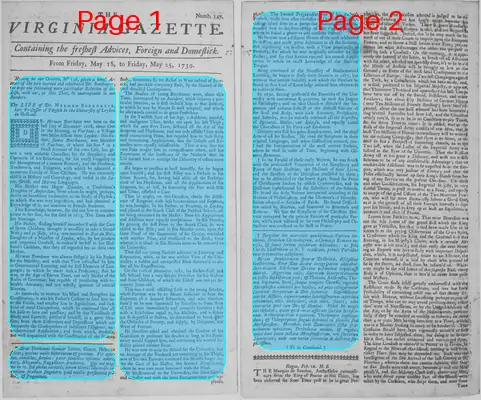
The Virginia Gazette
Richmond, Williamsburg, Richmond County, Virginia
What is this article about?
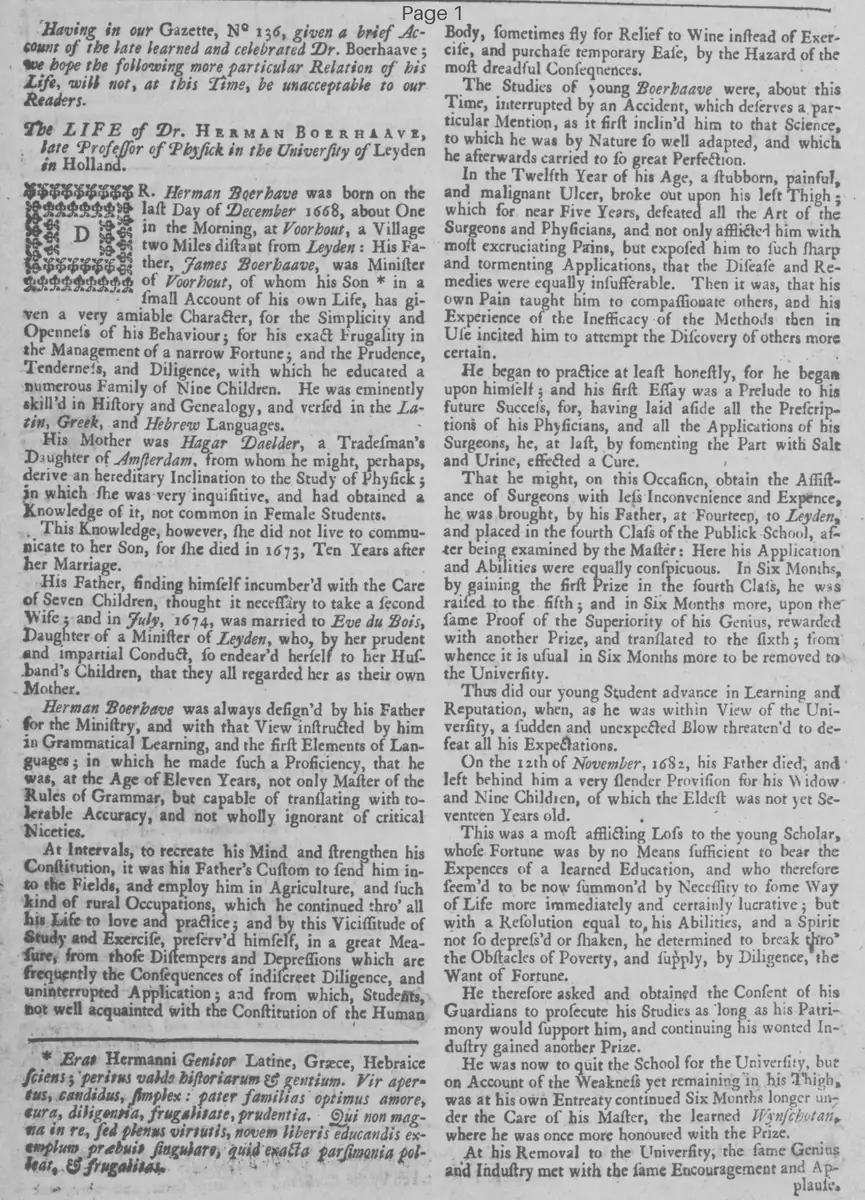
Biographical account of Dr. Herman Boerhaave's early life: born 1668 in Voorbout, son of a minister; mother's death; stepmother; education in languages, agriculture, divinity, mathematics; degree in philosophy 1690; deep study of Scriptures and early Church Fathers, critiquing later scholastic corruptions.
Merged-components note: This is the biography of Dr. Herman Boerhaave, a serialized narrative that spans pages 1 and 2, including the Latin footnote describing his father. The content fits 'literary' as a narrative essay/biography better than 'story', so label changed accordingly.
Clippings
1 of 2
OCR Quality
Full Text
The LIFE of Dr. HERMAN BOERHAAVE, late Professor of Physic in the University of Leyden in Holland.
Dr. Herman Boerhaave was born on the last Day of December 1668, about One o'Clock in the Morning, at Voorbout, a Village two Miles distant from Leyden: His Father, James Boerhaave, was Minister of Voorhout, of whom his Son who in a small Account of his own Life, has given a very amiable Character, for the Simplicity and Openness of his Behaviour; for his exact Frugality in the Management of a narrow Fortune; and the Prudence, Tenderness, and Diligence, with which he educated a numerous Family of Nine Children. He was eminently skill'd in History and Genealogy, and versed in the Latin, Greek, and Hebrew Languages.
His Mother was Hagar Daelder, a Tradesman's Daughter of Amsterdam, from whom he might, perhaps, derive an hereditary Inclination to the Study of Physic; in which she was very inquisitive, and had obtained a Knowledge of it, not common in Female Students.
This Knowledge, however, she did not live to communicate to her Son, for she died in 1673, Ten Years after her Marriage.
His Father, finding himself incumber'd with the Care of Seven Children, thought it necessary to take a second Wife; and in July, 1674, was married to Eve du Bois, Daughter of a Minister of Leyden, who, by her prudent and impartial Conduct, so endear'd herself to her Husband's Children, that they all regarded her as their own Mother.
Herman Boerhaave was always design'd by his Father for the Ministry, and with that View instructed by him in Grammatical Learning, and the first Elements of Languages; in which he made such a Proficiency, that he was, at the Age of Eleven Years, not only Master of the Rules of Grammar, but capable of translating with tolerable Accuracy, and not wholly ignorant of critical Niceties.
At Intervals, to recreate his Mind and strengthen his Constitution, it was his Father's Custom to send him into the Fields, and employ him in Agriculture, and such kind of rural Occupations, which he continued thro' all his Life to love and practice; and by this Vicissitude of Study and Exercise, preserved himself, in a great Measure, from those Distempers and Depressions which are frequently the Consequences of indiscreet Diligence, and uninterrupted Application; and from which, Students, not well acquainted with the Constitution of the Human
Erat Hermanni Genitor Latine, Græce, Hebraice Sciens; peritus variis historiarum & gentium. Vir apertus, candidus, simplex: pater familias optimus amore, cura, diligentia, frugalitate, prudentia. Qui non magna in re, sed plenus virtutis, novem liberis educandis exemplum praebuit singulare, quid exacta parsimonia possit. Frugalitas.
Please. The learned Triglandius, one of his Father's Friends, made soon after Professor of Divinity at Leyden, distinguished him in a particular Manner, and recommended him to the Friendship of Mr. Van Apphen, in whom he found a generous and constant Patron.
He became now a diligent Hearer of the most celebrated Professors, and made great Advances in all the Sciences, till regulating his Studies with a View principally to Divinity, for which he was originally intended by his Father; and for that Reason exerted his utmost Application to attain an exact Knowledge of the Hebrew Tongue.
Being convinced of the Necessity of Mathematical Learning, he began to study those Sciences in 1685, but without that intense Industry with which the Pleasure he found in that kind of Knowledge induced him afterwards to cultivate them.
In 1690, having performed the Exercises of the University with uncommon Reputation, he took his Degree in Philosophy; and on that Occasion discussed the important and arduous Subject of the distinct Natures of the Soul and Body, with such Accuracy, Perspicuity, and Subtilty, that he entirely confuted all the Sophistry of Epicurus, Hobbes, and Spinoza, and equally raised the Characters of his Piety and Erudition.
Divinity was still his great Employment, and the chief Aim of all his Studies. He read the Scriptures in their original Languages, and when Difficulties occurred, consulted the Interpretations of the most ancient Fathers, whom he read in order of Time, beginning with Clemens Romanus.
In the Perusal of these early Writers, he was struck with the profoundest Veneration of the Simplicity and Purity of their Doctrine, the Holiness of their Lives, and the Sanctity of the Discipline practiced by them; but as he descended to the lower Ages, found the Peace of Christianity broken by useless Controversies, and its Doctrines sophisticated by the Subtilties of the Schools.
He found the holy Writers interpreted according to the Notions of Philosophers, and the Chimeras of Metaphysicians adopted as Articles of Faith. He found Difficulties raised by Niceties, and fomented to Bitterness and Rancour. He saw the Simplicity of the Christian Doctrine corrupted by the private Fancies of particular Parties, while each adhered to its own Philosophy and Orthodoxy was confined to the Sect in Power.
Fungebat his exercitiis quotidianam Patrum lectionem, Secundum Chronologiam, a Clemente Romano exorsus, & juxta Jeriem Seculorum descendens: ut Jesu Christi Doctrinam in N. T. traditam, primis Patribus interpretantibus addisceret.
Horum simplicitatem in Doctrina, disciplinae Sanctitatem, Vitae Deo dicatae integritatem adorabat. Subtilitatem Scholarium Divina potmodum inquinasse dolebat. Aegerrime tulit, Sacrorum interpretationem ex festis Sophistarum peti; & Platonis, Aristotelis, Thomae Aquinatis, Scoti, quoque tempore Cartesii, cogitata Metaphysica adhiberi pro legibus, ad quas castigarentur Sacrorum Scriptorum de Deo sententiae. Experiebatur acerba dissidia, ingeniorumque subtilissimorum acerrima certamina, odia, ambitiones, inde cieri, foveri; adeo contraria paci cum Deo & Homine. Nihil hic magis illi obturbabat; quam quod omnes asserant sacram Scripturam Anthropopathos loquentem, Theoproprias explanandam; Theoproprias singuli definiant ex placitis suae Metaphysices. Horrebat, inde Dominantiae Sectae praevalentem opinionem, Orthodoxiam modum, & regulas, unice dari juxta dicta Metaphysicorum, non Sacrarum Literarum; unde tam variae Sententiae de doctrina simplicissima.
[To be Continued.]
What sub-type of article is it?
What themes does it cover?
What keywords are associated?
Literary Details
Title
The Life Of Dr. Herman Boerhaave, Late Professor Of Physic In The University Of Leyden In Holland.
Subject
Biography Of Dr. Herman Boerhaave
Key Lines