Thank you for visiting SNEWPapers!
Sign up free
The Hope Pioneer
Hope, Steele County, Griggs County, North Dakota
What is this article about?
Elderly banker Joseph Tidywaite joins as a special constable in London amid social unrest. Despite family concerns, he patrols in bad weather, mistakenly arrests an Irish nationalist outside the Duke of Dublin's home, gets captured by Clan-na-Gael, swears allegiance under duress, and is later released via his daughter's suitor Edward O'Brien, gaining family approval.
Clipping
OCR Quality
Full Text
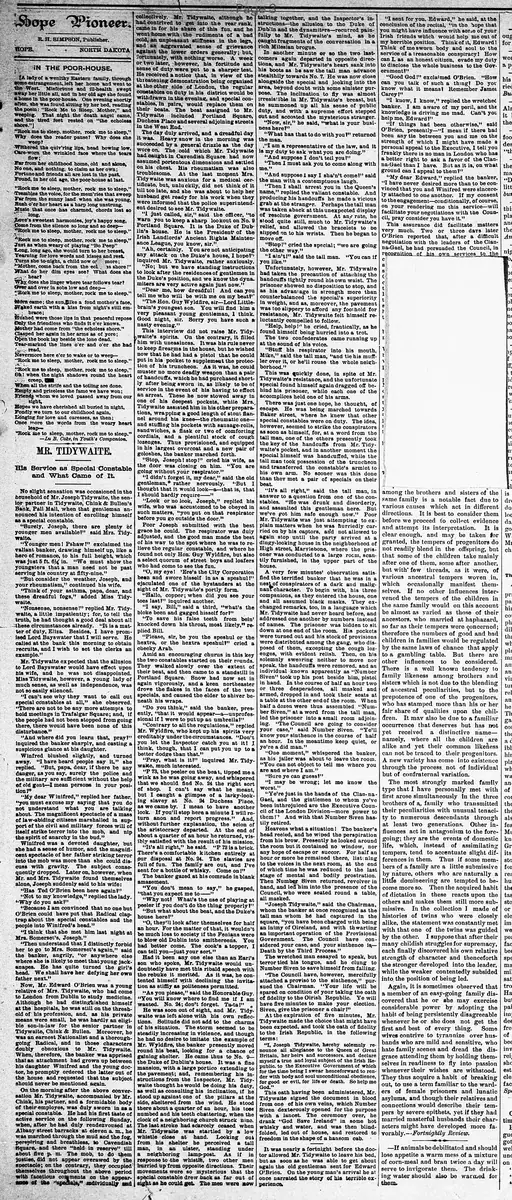
His Service as Special Constable and What Came of It.
No slight sensation was occasioned in the household of Mr. Joseph Tidywaite, the senior partner in Tidywaite, Chink & Bullen's Bank, Pall Mall, when that gentleman announced his intention of enrolling himself as a special constable.
"Surely, Joseph, there are plenty of younger men available?" said Mrs. Tidywaite.
"Younger men! Pshaw!" exclaimed the valiant banker, drawing himself up, like a hero of romance, to his full height, which was just 5 ft. 6 in. "We must show the youngsters that a man need not be past serving his country at fifty-nine."
"But consider the weather, Joseph, and your rheumatism," continued his wife.
"Think of your asthma, papa, dear, and these dreadful fogs," added Miss Tidywaite.
"Nonsense, nonsense!" replied Mr. Tidywaite, a little impatiently; for, to tell the truth, he had thought a good deal about all these circumstances already. "It is a matter of duty, Eliza. Besides, I have promised Lord Bayswater that I will serve. He called at the bank this morning to obtain recruits, and I wish to set the clerks an example."
Mr. Tidywaite expected that the allusion to Lord Bayswater would have effect upon his wife, and he was not disappointed. Miss Tidywaite, however, a young lady of much sense, as well as independence, was not so easily silenced.
"I can't see why they want to call out special constables at all," she observed. "There are not to be any more attempts to hold meetings in Trafalgar Square; and, if the people had not been stopped from going there, there would have been none of this disturbance."
"And where did you learn that, pray?" inquired the banker sharply, and casting a suspicious glance at his daughter.
Winifred blushed slightly, and turned away. "I have heard people say it," she replied. "But, papa, dear, if there be any danger, as you say, surely the police and the military are sufficient without the help of old gent-I mean persons in your position!"
"My dear Winifred," replied her father, "you must excuse my saying that you do not understand what you are talking about. The magnificent spectacle of a mass of law-abiding citizens marshalled in support of the civil and military forces will of itself strike terror into the mob, and nip the spirit of anarchy in the bud."
Winifred was a devoted daughter, but she had a sense of humor, and the magnificent spectacle of her father striking terror into the mob was more than she could discuss with gravity. The subject consequently dropped. Later on, however, when Mr. and Mrs. Tidywaite found themselves alone, Joseph suddenly said to his wife:
"Has Ted O'Brien been here again?"
"Not to my knowledge," replied the lady. "Why do you ask?"
"Because I am convinced that no one but O'Brien could have put that Radical clap-trap about the special constables and the people into Winifred's head."
"I think that she met him last night at Mrs. Somerset's, Joseph."
"Then understand that I distinctly forbid her to go to Mrs. Somerset's again," said the banker, angrily, "or anywhere else where she is likely to meet that young jackanapes. He has quite turned the girl's head. We shall have her defying her own father next."
Now, Mr. Edward O'Brien was a young relative of Mrs. Tidywaite, who had come to London from Dublin to study medicine. Although he had distinguished himself at the hospitals, he was still on the threshold of his profession, and, as his private means were small, he was hardly an eligible son-in-law for the senior partner in Tidywaite, Chink & Bullen. Moreover, he was an earnest Nationalist and a thorough-going Radical, and in those characters doubly obnoxious to Mr. Tidywaite.
When, therefore, the banker was apprised that an attachment had grown up between his daughter Winifred and the young doctor, he promptly ordered the latter out of the house and requested that the subject should never be mentioned again.
On the morning after the above conversation Mr. Tidywaite, accompanied by Mr. Chink, his partner, and a formidable body of their employes, was duly sworn in as a special constable. He had his first taste of active service on the following Sunday, when, after he had duly rendezvoused at Albany street barracks at eleven a. m., he was marched through the mud and the fog, perspiring and breathless, to Cavendish Square, and there "held in reserve" till about five p. m. The mob, to do them justice, did not appear overawed by the spectacle; on the contrary, they occupied themselves throughout the above period with facetious comments on the appearance of the "specials" individually and collectively. Mr. Tidywaite, although he had contrived to get into the rear rank, came in for his share of this fun, and he went home with the rudiments of a bad cold, an unpleasant stiffness in the legs, and an aggravated sense of grievance against the lower orders generally; but, fortunately, with nothing worse. A week or two later, however, his fortitude and sense of duty were put to a sharper test.
He received a notice that, in view of the threatening demonstration being organized at the other side of London, the regular constables on duty in his district would be withdrawn in the evening, and special constables, in pairs, would replace them on their beats. The beat assigned to Mr. Tidywaite included Portland Square, Duchess Place and several adjoining streets in the West End.
The day duly arrived, and a dreadful day it was. Heavy snow in the morning was succeeded by a general drizzle as the day wore on. The cold which Mr. Tidywaite had caught in Cavendish Square had now assumed portentous dimensions and settled on his chest. His rheumatism was also troublesome. At the last moment Mrs. Tidywaite was anxious for a medical certificate, but, unluckily, did not think of it till too late, and she was about to help her husband get ready for his work when they were informed that the police superintendent desired to see Mr. Tidywaite.
"I just called, sir," said the officer, "to warn you to keep a sharp lookout on No. 9 Portland Square. It is the Duke of Dublin's house. He is the President of the Irish Landlords' Ancient Rights Maintenance League, you know, sir."
"Ah, certainly. You are not anticipating any attack on the Duke's house, I hope!" inquired Mr. Tidywaite, rather anxiously.
"No; but we have standing instructions to look after the residences of gentlemen in the Duke's position, and we know the dynamiters are very active again just now."
"Dear me, how dreadful! And can you tell me who will be with me on my beat!"
"The Hon. Guy Wyldfire, sir-Lord Littlebrain's youngest son. You will find him a very pleasant young gentleman, I think. Good night, sir. Sorry you have such a nasty evening."
This interview did not raise Mr. Tidywaite's spirits. On the contrary, it filled him with uneasiness. It was his rule never to keep firearms in the house, but he wished now that he had had a pistol that he could put in his pocket to supplement the protection of his truncheon. As it was, he could muster no more deadly weapon than a pair of handcuffs, which he had purchased shortly after being sworn in, as likely to be of service in the event of his having to effect an arrest. These he now stowed away in one of his deepest pockets, while Mrs. Tidywaite assisted him in his other preparations, wrapping a good length of stout flannel around his knee-the rheumatic one--and stuffing his pockets with sausage-rolls, sandwiches, a flask or two of comforting cordials, and a plentiful stock of cough lozenges. Thus provisioned, and equipped in his largest overcoat and a new pair of goloshes, the banker marched forth.
"Stop, Joseph! stop!" cried his wife, as the door was closing on him. "You are going without your respirator."
"I didn't forget it, my dear," said the old gentleman, rather nervously. "But I thought that it would look-a-that is, that I should hardly require
"Look or no look, Joseph," replied his wife, who was accustomed to be obeyed in such matters, "you put on that respirator before you go outside the door."
Poor Joseph submitted with the best grace he could. The respirator was duly adjusted, and the good man made the best of his way to the spot where he was to relieve the regular constable, and where he found not only Hon. Guy Wyldfire, but also a select quorum of street boys and loafers who had come to see the fun.
"O, my eye! 'Ere's the City Corporation been and swored 'isself in as a speshul!' ejaculated one of the bystanders at the sight of Mr. Tidywaite's portly form.
"Hallo, copper; when did you see your toes last?" inquired another.
"I say, Bill," said a third, "what's the bloke been and gagged 'isself for?"
"To save his false teeth from bein' knocked down his throat, most likely," replied Bill.
"Please, sir, be you the speshul or the hextra, or the hextra speshul!" cried a cheeky Arab.
Amid an encouraging chorus in this key the two constables started on their rounds. They walked slowly over the extent of their beat, and then came to a standstill in Portland Square. Snow had now set in again vigorously, and a keen northeaster drove the flakes in the faces of the two specials, and caused the elder to shiver beneath his wraps.
"Do you think," said the banker, presently, "that it would appear-a--unprofessional if I were to put up an umbrella?"
"Contrary to all the regulations," replied Mr. Wyldfire, who kept up his spirits very creditably under the circumstances. "Don't you let the Inspector catch you at it! I think, though, that I can put you up to a better dodge than that."
"Pray, what is it?" inquired Mr. Tidywaite, much interested.
"P 73, the peeler on the beat, tipped me a wink as he was going away, and whispered that we should find No. 2A the right sort of shop. I can't say what he meant, but I caught a glimpse of a larky-looking slavey at No. 14 Duchess Place, as we came by. I mean to have another look. If you'll stop here a minute I will return anon and report progress." And, without further explanation, the scion of the aristocracy departed. At the end of about a quarter of an hour he returned, visibly satisfied with the result of his mission.
"It's all right," he said. "P 73 is a brick. There's a comfortable kitchen entirely at our disposal at No. 24. The slavies are full of fun. The family are out, and I've sent for a bottle of whisky. Come on!"
The banker gazed at his comrade in blank amazement.
"You don't mean to say,"
he gasped,
"that you expect me to
"Why not? What's the use of playing at peeler if you don't do the thing properly?"
"But what about the beat, and the Duke's house here?"
"O, they'll look after themselves for half an hour. For the matter of that, it wouldn't be much loss to society if the Fenians were to blow old Dublin into smithereens. You had better come. The cook's a topper, I can tell you-just your sort."
Had it been any one else than an Earl's son who spoke, Mr. Tidywaite would undoubtedly have met this ribald speech with the rebuke it merited. As it was, he contented himself with declining the invitation as stiffly as politeness permitted.
"As you please," said the Honorable Guy. "You will know where to find me if I am wanted. No. 24; don't forget. Ta-ta!"
He was soon out of sight, and Mr. Tidywaite was left alone with his own reflections. Solitude did not add to the charms of his situation. The storm seemed to be steadily increasing in violence, and though he had no desire to imitate the example of Mr. Wyldfire, the banker presently moved round his beat, looking for a chance of gaining shelter. He came thus to No. 9-the Duke of Dublin's house. It was a fine mansion, with a large portico extending to the pavement; and, remembering his instructions from the Inspector, Mr. Tidywaite thought he would be doing his duty, as well as consulting his inclination, if he stood up against one of the pillars at the side, sheltered from the wind. He stood there about a quarter of an hour, his toes numbed and his teeth chattering, when the clock of a neighboring church struck nine.
The last stroke had scarcely ceased when Mr. Tidywaite was startled by a low whistle close at hand. Looking out from his shelter he perceived a tall man, in an ulster, standing under a neighboring lamp-post. As if in response to the whistle, two other men hurried up from opposite directions. Their movements were so mysterious that the special constable drew back as far out of sight as he could get. The men were now talking together, and the Inspector's instructions-the allusion to the Duke of Dublin and the dynamiters-recurred painfully to Mr. Tidywaite's mind, as he caught fragments of the conversation in a rich Milesian brogue.
In another minute or so the two last-comers again departed in opposite directions, and Mr. Tidywaite's heart sank into his boots as he saw the tall man advance stealthily towards No. 9. He was now close alongside the special and looking into the area, beyond doubt with some sinister purpose. The inclination to fly was almost irresistible in Mr. Tidywaite's breast, but he summoned up all his sense of public duty, and with a supreme effort stepped out and accosted the mysterious stranger.
"Now, sir," he said, "what is your business here!"
"What has that to do with you?" returned the man.
"I am a representative of the law, and it is my duty to ask what you are doing."
"And suppose I don't tell you?"
"Then I must ask you to come along with me."
"And suppose I say I sha'n't come?" said the man with a contemptuous laugh.
"Then I shall arrest you in the Queen's name," replied the valiant constable. And producing his handcuffs he made a vicious grab at the stranger. Perhaps the tall man was taken aback at this unexpected display of resolute government. At any rate, he stood quite still, much to Mr. Tidywaite's relief, and allowed the bracelets to be slipped on to his wrists. Then he began to move off.
"Stop!" cried the special; "we are going the other way."
"I ain't," said the tall man. "You can if you like."
Unfortunately, however, Mr. Tidywaite had taken the precaution of attaching the handcuffs tightly round his own waist. The prisoner showed no disposition to stop, and as his advantage in strength more than counterbalanced the special's superiority in weight, and as, moreover, the pavement was too slippery to afford any foothold for resistance, Mr. Tidywaite felt himself reluctantly compelled to follow.
"Help, help!" he cried, frantically, as he found himself being hurried into a trot. The two confederates came running up at the sound of his voice.
"Stuff his respirator into his mouth, Mike," said the tall man, "and tie his muffler over it, or he'll rouse the whole neighborhood."
This was quickly done, in spite of Mr. Tidywaite's resistance, and the unfortunate special found himself again dragged off behind his prisoner, while each one of the accomplices held one of his arms.
There was just one hope, he thought, of escape. He was being marched towards Baker street, where he knew that other special constables were on duty. The idea, however, seemed to strike the conspirators as soon as himself, for, at a word from the tall man, one of the others presently took the key of the handcuffs from Mr. Tidywaite's pocket, and in another moment the special himself was handcuffed, while the tall man took possession of the truncheon and transferred the constable's armlet to his own arm. No sooner was this done than they met a pair of specials on their beat.
"It's all right," said the tall man, in answer to a question from one of the constables. "He was drunk and disorderly, and assaulted this gentleman here. But we've got him safe enough now." Poor Mr. Tidywaite was just attempting to explain matters when he was hurriedly carried on by his captors, and not allowed to again stop until the party arrived at a dingy-looking house in the neighborhood of High street, Marylebone, where the prisoner was conducted to a large room, scantily furnished, in the upper part of the house.
A very few minutes' observation satisfied the terrified banker that he was in a nest of conspirators of a dark and malignant character. To begin with, his three companions, as they entered the house, one and all assumed black masks. They exchanged remarks, too, in a language which Mr. Tidywaite had never heard before, and addressed one another by numbers instead of names. The prisoner was bidden to sit down at one end of the room. His pockets were turned out and his stock of provisions were distributed among the gang, who disposed of them, excepting the cough lozenges, with evident relish. Then, on his solemnly swearing neither to move nor speak, the handcuffs were removed, and an individual known apparently as "Number Seven" took up his post beside him, pistol in hand. In the course of half an hour two or three desperadoes, all masked and armed, dropped in and took their seats at a table at the other end of the room. When half a dozen were thus assembled "Number Seven," at a word from the tall man, led the prisoner into a small room adjoining. "The Council are going to consider your case," said Number Seven. "Ye'll know your sentence in the course of half an hour. In the meantime keep quiet, or ye're a dead man."
"One moment," whispered the banker as his jailer was about to leave the room. "You can not object to tell me where you are and where I am."
"Sure ye can guess?"
"I may be wrong;
let me know the worst."
"Ye're just in the hands of the Clan-na-Gael, und the gintlemen to whom ye've been inthrojuiced are the Executive Council of the London Division-more power to them!" And with that Number Seven hastily retired.
Heavens what a situation! The banker's head reeled, and he wiped the perspiration from his brow. Presently he looked around the room but it contained no window, nor any hope of escape or succor. For half an hour or more he remained there, listening to the voices in the next room, at the end of which time he was reduced to the last stage of mental and bodily prostration. Then Number Seven returned, revolver in hand, and led him into the presence of the Council, who were seated round a table, all masked.
"Joseph Tidywaite," said the Chairman, whom the banker at once recognized as the tall man whom he had captured in the square, "you have been charged with being an enemy of Oireland, and with thwarting an important operation of the Provisional Government. The Council have considered your case, and your sentence is-Death by the Third Process."
The wretched man essayed to speak, but terror tied his tongue, and he clung to Number Seven to save himself from falling.
"The Council have, however, mercifully attached a proviso to the sentence," pursued the Chairman. "Your life will be spared on condition of your taking the oath of fidelity to the Oirish Republic. Ye will have five minutes to make your election. Seven, give the prisoner a chair!"
At the expiration of five minutes, Mr. Tidywaite made the choice that might have been expected, and took the oath of fidelity to the Irish Republic, in the following terms:
"I, Joseph Tidywaite, hereby solemnly renounce all allegiance to the Queen of Great Britain, her heirs and successors, and declare myself a true and loyal subject of the Irish Republic, to the Executive Government of which for the time being I swear henceforward to render with body and soul unconditional obedience, for good or evil, for life or death. So help me God."
This oath having been administered, Mr. Tidywaite signed the document in blood from one of his own veins, which Number Seven dexterously opened for the purpose with a lancet. The ceremony over, he drank "God Save Ireland" in some hot whisky and water, and was then blindfolded, led out of house, and restored to freedom in the shape of a hansom cab.
It was nearly a fortnight before the doctor allowed Mr. Tidywaite to leave his bed, but as soon as he was able to get about again the old gentleman sent for Edward O'Brien. On the young man's arrival he at once narrated the story of his terrible experience.
"I sent for you, Edward," he said, at the conclusion of the recital, "in the hope that you might have influence with some of your Irish friends which would help me out of my horrible position. Think of it, Edward! Think of me-sworn body and soul to the service of a treasonable conspiracy! How can I, as an honest citizen, evade my duty to disclose the whole business to the Government?"
"Good God!" exclaimed O'Brien. "How can you talk of such a thing? Do you know what it means? Remember James Carey!"
"I know, I know," replied the wretched banker. "I am aware of my peril, and the knowledge is driving me mad. Can't you help me, Edward?"
"If things had been otherwise," said O'Brien, presently "I mean if there had been any tie between you and me on the strength of which I might have made a personal appeal to the Executive, I tell you frankly there is no man in London who has a better right to ask a favor of the Clan-na-Gael than I have. But as it is, on what ground can I appeal to them?"
"My dear Edward," replied the banker, "I have never desired more than to be convinced that you and Winifred were sincerely attached to one another. If my consent to the engagement-conditionally, of course, on your rendering me this service-will facilitate your negotiations with the Council, pray consider you have it."
This assurance did facilitate matters very much. Two or three days later O'Brien reported that, after a difficult negotiation with the leaders of the Clan-na-Gael, he had persuaded the Council, in recognition of his own services to the cause, to release Mr. Tidywaite from his oath.
What sub-type of article is it?
What themes does it cover?
What keywords are associated?
What entities or persons were involved?
Where did it happen?
Story Details
Key Persons
Location
West End, London
Story Details
Banker Joseph Tidywaite enrolls as special constable despite health issues and family opposition. On patrol in bad weather, he arrests a suspicious man outside the Duke of Dublin's house but is overpowered and captured by Clan-na-Gael members. Forced to swear allegiance to the Irish Republic to save his life. Later seeks help from Edward O'Brien, his daughter's suitor, who negotiates his release from the oath, gaining paternal approval for the marriage.