Thank you for visiting SNEWPapers!
Sign up free
Story
October 3, 1935
The Western News
Libby, Lincoln County, Montana
What is this article about?
Nearly 100 old-time Texas longhorns, nearly extinct, are protected on the 61,000-acre Wichita game preserve in southwestern Oklahoma alongside over 1,000 big-game animals including buffalo, elk, deer, and turkeys. A recent census counted them using various methods.
Clipping
OCR Quality
92%
Excellent
Full Text
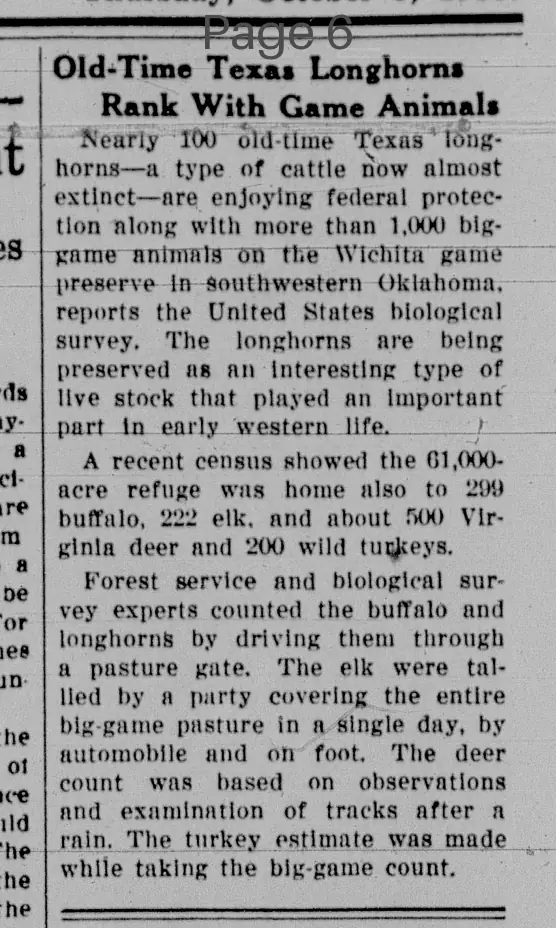
Old-Time Texas
Longhorns
Rank With
Game Animals
Nearly 100 old-time Texas longhorns-a type of cattle now almost extinct-are enjoying federal protection along with more than 1,000 big-game animals on the Wichita game preserve in southwestern Oklahoma, reports the United States biological survey. The longhorns are being preserved as an interesting type of livestock that played an important part in early western life. A recent census showed the 61,000-acre refuge was home also to 299 buffalo, 222 elk, and about 500 Virginia deer and 200 wild turkeys. Forest service and biological survey experts counted the buffalo and longhorns by driving them through a pasture gate. The elk were tallied by a party covering the entire big-game pasture in a single day, by automobile and on foot. The deer count was based on observations and examination of tracks after a rain. The turkey estimate was made while taking the big-game count.
Longhorns
Rank With
Game Animals
Nearly 100 old-time Texas longhorns-a type of cattle now almost extinct-are enjoying federal protection along with more than 1,000 big-game animals on the Wichita game preserve in southwestern Oklahoma, reports the United States biological survey. The longhorns are being preserved as an interesting type of livestock that played an important part in early western life. A recent census showed the 61,000-acre refuge was home also to 299 buffalo, 222 elk, and about 500 Virginia deer and 200 wild turkeys. Forest service and biological survey experts counted the buffalo and longhorns by driving them through a pasture gate. The elk were tallied by a party covering the entire big-game pasture in a single day, by automobile and on foot. The deer count was based on observations and examination of tracks after a rain. The turkey estimate was made while taking the big-game count.
What sub-type of article is it?
Curiosity
Historical Event
What themes does it cover?
Nature
Survival
What keywords are associated?
Texas Longhorns
Game Preserve
Oklahoma
Animal Census
Wildlife Protection
Buffalo
Elk
Deer
Turkeys
Where did it happen?
Wichita Game Preserve In Southwestern Oklahoma
Story Details
Location
Wichita Game Preserve In Southwestern Oklahoma
Event Date
Recent
Story Details
Nearly extinct Texas longhorns are federally protected on a wildlife refuge with other big-game animals; a census tallied 100 longhorns, 299 buffalo, 222 elk, 500 Virginia deer, and 200 wild turkeys using various counting methods.