Thank you for visiting SNEWPapers!
Sign up free
The Wilmington Morning Star
Wilmington, New Hanover County, North Carolina
What is this article about?
Dr. Harold G. Moulton, president of the Brookings Institution, speaks at the North Carolina Bankers conference in Chapel Hill on July 9, advocating financing the U.S. defense program via taxation and public securities sales to maintain fiscal stability and prevent wartime inflation through curtailed spending and restrained wages.
Clipping
OCR Quality
Full Text
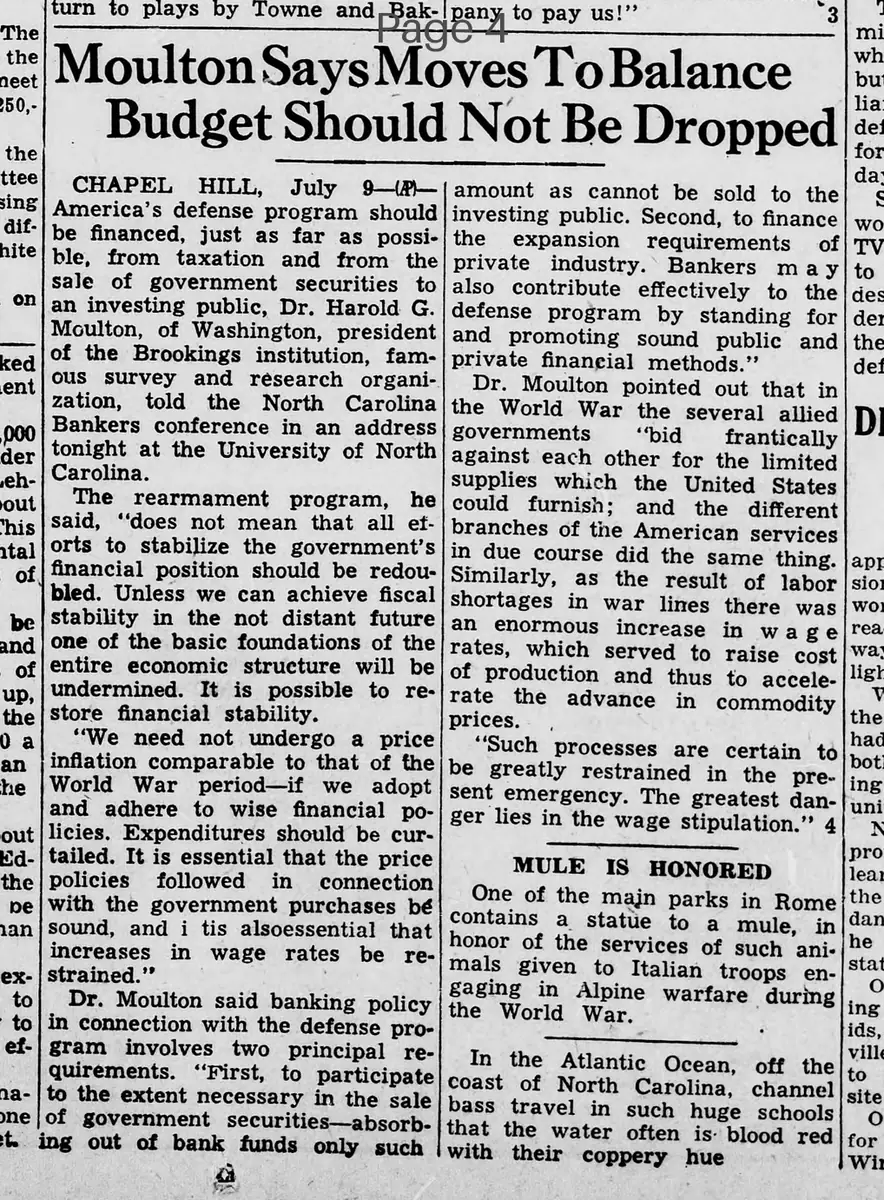
CHAPEL HILL, July 9-(A)- America's defense program should be financed, just as far as possible, from taxation and from the sale of government securities to an investing public. Dr. Harold G. Moulton, of Washington, president of the Brookings institution, famous survey and research organization, told the North Carolina Bankers conference in an address tonight at the University of North Carolina.
The rearmament program, he said, "does not mean that all efforts to stabilize the government's financial position should be redoubled. Unless we can achieve fiscal stability in the not distant future one of the basic foundations of the entire economic structure will be undermined. It is possible to restore financial stability.
"We need not undergo a price inflation comparable to that of the World War period-if we adopt and adhere to wise financial policies. Expenditures should be curtailed. It is essential that the price policies followed in connection with the government purchases be sound, and it is also essential that increases in wage rates be restrained."
Dr. Moulton said banking policy in connection with the defense program involves two principal requirements. "First, to participate to the extent necessary in the sale of government securities--absorbing out of bank funds only such amount as cannot be sold to the investing public. Second, to finance the expansion requirements of private industry. Bankers may also contribute effectively to the defense program by standing for and promoting sound public and private financial methods."
Dr. Moulton pointed out that in the World War the several allied governments 'bid frantically against each other for the limited supplies which the United States could furnish; and the different branches of the American services in due course did the same thing.
Similarly, as the result of labor shortages in war lines there was an enormous increase in wage rates, which served to raise cost of production and thus to accelerate the advance in commodity prices.
'Such processes are certain to be greatly restrained in the present emergency. The greatest danger lies in the wage stipulation.'
What sub-type of article is it?
What themes does it cover?
What keywords are associated?
What entities or persons were involved?
Where did it happen?
Story Details
Key Persons
Location
Chapel Hill, University Of North Carolina
Event Date
July 9
Story Details
Dr. Harold G. Moulton advises financing America's defense program through taxation and government securities sold to the public, emphasizes achieving fiscal stability to avoid inflation like in World War, suggests curtailing expenditures, sound price policies, restrained wage increases, and banks' role in selling securities and financing private industry.