Thank you for visiting SNEWPapers!
Sign up free
Editorial
July 10, 1951
The Daily Express
Dayton, Montgomery County, Ohio
What is this article about?
Editorial column by S.J. Phillips praising Booker T. Washington's rise from slavery, his educational and economic contributions to African American uplift, and critiquing modern leaders for ignoring his practical philosophy of self-reliance, thrift, and business ownership.
Clipping
OCR Quality
95%
Excellent
Full Text
THE OHIO DAILY EXPRESS
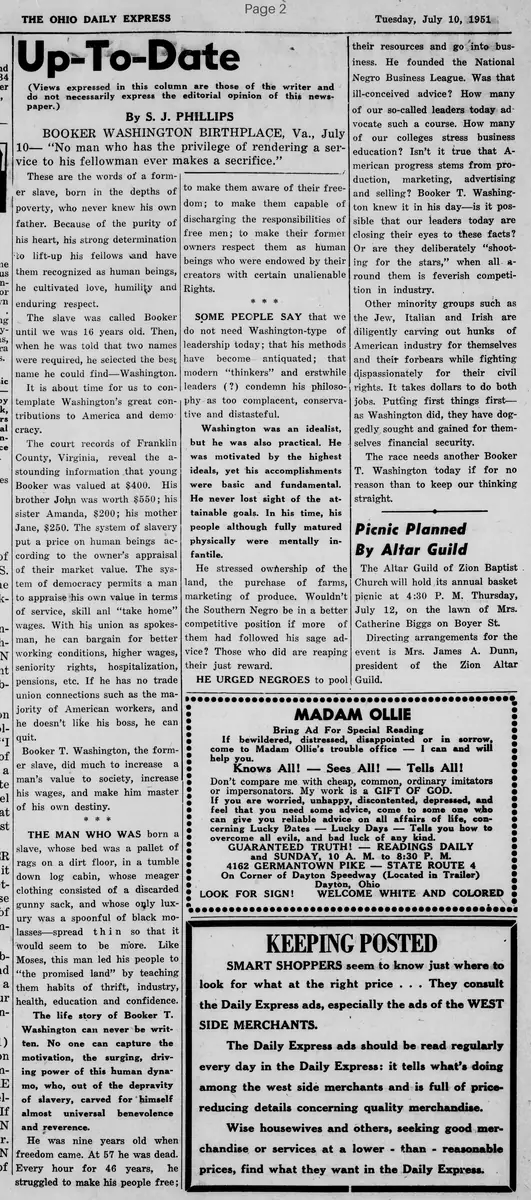
Up-To-Date
(Views expressed in this column are those of the writer and do not necessarily express the editorial opinion of this newspaper.)
By S. J. PHILLIPS
BOOKER WASHINGTON BIRTHPLACE, Va., July 10 "No man who has the privilege of rendering a service to his fellowman ever makes a sacrifice."
These are the words of a former slave, born in the depths of poverty, who never knew his own father. Because of the purity of his heart, his strong determination to lift-up his fellows and have them recognized as human beings, he cultivated love, humility and enduring respect.
The slave was called Booker until he was 16 years old. Then, when he was told that two names were required, he selected the best name he could find--Washington.
It is about time for us to contemplate Washington's great contributions to America and democracy.
The court records of Franklin County, Virginia, reveal the astounding information that young Booker was valued at $400. His brother John was worth $550; his sister Amanda, $200; his mother Jane, $250. The system of slavery put a price on human beings according to the owner's appraisal of their market value. The system of democracy permits a man to appraise his own value in terms of service, skill and "take home" wages. With his union as spokesman, he can bargain for better working conditions, higher wages, seniority rights, hospitalization, pensions, etc. If he has no trade union connections such as the majority of American workers, and he doesn't like his boss, he can quit.
Booker T. Washington, the former slave, did much to increase a man's value to society, increase his wages, and make him master of his own destiny.
THE MAN WHO WAS born a slave, whose bed was a pallet of rags on a dirt floor, in a tumble down log cabin, whose meager clothing consisted of a discarded gunny sack, and whose only luxury was a spoonful of black molasses spread thin so that it would seem to be more. Like Moses, this man led his people to "the promised land" by teaching them habits of thrift, industry, health, education and confidence.
The life story of Booker T. Washington can never be written. No one can capture the motivation, the surging, driving power of this human dynamo, who, out of the depravity of slavery, carved for himself almost universal benevolence and reverence.
He was nine years old when freedom came. At 57 he was dead. Every hour for 46 years, he struggled to make his people free; to make them aware of their freedom; to make them capable of discharging the responsibilities of free men; to make their former owners respect them as human beings who were endowed by their creators with certain unalienable Rights.
SOME PEOPLE SAY that we do not need Washington-type of leadership today; that his methods have become antiquated; that modern "thinkers" and erstwhile leaders (?) condemn his philosophy as too complacent, conservative and distasteful.
Washington was an idealist, but he was also practical. He was motivated by the highest ideals, yet his accomplishments were basic and fundamental. He never lost sight of the attainable goals. In his time, his people although fully matured physically were mentally infantile.
He stressed ownership of the land, the purchase of farms, marketing of produce. Wouldn't the Southern Negro be in a better competitive position if more of them had followed his sage advice? Those who did are reaping their just reward.
Tuesday, July 10, 1951 their resources and go into business. He founded the National Negro Business League. Was that ill-conceived advice? How many of our so-called leaders today advocate such a course. How many of our colleges stress business education? Isn't it true that American progress stems from production, marketing, advertising and selling? Booker T. Washington knew it in his day--is it possible that our leaders today are closing their eyes to these facts? Or are they deliberately "shooting for the stars," when all around them is feverish competition in industry.
Other minority groups such as the Jew, Italian and Irish are diligently carving out hunks of American industry for themselves and their forebears while fighting dispassionately for their civil rights. It takes dollars to do both jobs. Putting first things first--as Washington did, they have doggedly sought and gained for themselves financial security.
The race needs another Booker T. Washington today if for no reason than to keep our thinking straight.
Up-To-Date
(Views expressed in this column are those of the writer and do not necessarily express the editorial opinion of this newspaper.)
By S. J. PHILLIPS
BOOKER WASHINGTON BIRTHPLACE, Va., July 10 "No man who has the privilege of rendering a service to his fellowman ever makes a sacrifice."
These are the words of a former slave, born in the depths of poverty, who never knew his own father. Because of the purity of his heart, his strong determination to lift-up his fellows and have them recognized as human beings, he cultivated love, humility and enduring respect.
The slave was called Booker until he was 16 years old. Then, when he was told that two names were required, he selected the best name he could find--Washington.
It is about time for us to contemplate Washington's great contributions to America and democracy.
The court records of Franklin County, Virginia, reveal the astounding information that young Booker was valued at $400. His brother John was worth $550; his sister Amanda, $200; his mother Jane, $250. The system of slavery put a price on human beings according to the owner's appraisal of their market value. The system of democracy permits a man to appraise his own value in terms of service, skill and "take home" wages. With his union as spokesman, he can bargain for better working conditions, higher wages, seniority rights, hospitalization, pensions, etc. If he has no trade union connections such as the majority of American workers, and he doesn't like his boss, he can quit.
Booker T. Washington, the former slave, did much to increase a man's value to society, increase his wages, and make him master of his own destiny.
THE MAN WHO WAS born a slave, whose bed was a pallet of rags on a dirt floor, in a tumble down log cabin, whose meager clothing consisted of a discarded gunny sack, and whose only luxury was a spoonful of black molasses spread thin so that it would seem to be more. Like Moses, this man led his people to "the promised land" by teaching them habits of thrift, industry, health, education and confidence.
The life story of Booker T. Washington can never be written. No one can capture the motivation, the surging, driving power of this human dynamo, who, out of the depravity of slavery, carved for himself almost universal benevolence and reverence.
He was nine years old when freedom came. At 57 he was dead. Every hour for 46 years, he struggled to make his people free; to make them aware of their freedom; to make them capable of discharging the responsibilities of free men; to make their former owners respect them as human beings who were endowed by their creators with certain unalienable Rights.
SOME PEOPLE SAY that we do not need Washington-type of leadership today; that his methods have become antiquated; that modern "thinkers" and erstwhile leaders (?) condemn his philosophy as too complacent, conservative and distasteful.
Washington was an idealist, but he was also practical. He was motivated by the highest ideals, yet his accomplishments were basic and fundamental. He never lost sight of the attainable goals. In his time, his people although fully matured physically were mentally infantile.
He stressed ownership of the land, the purchase of farms, marketing of produce. Wouldn't the Southern Negro be in a better competitive position if more of them had followed his sage advice? Those who did are reaping their just reward.
Tuesday, July 10, 1951 their resources and go into business. He founded the National Negro Business League. Was that ill-conceived advice? How many of our so-called leaders today advocate such a course. How many of our colleges stress business education? Isn't it true that American progress stems from production, marketing, advertising and selling? Booker T. Washington knew it in his day--is it possible that our leaders today are closing their eyes to these facts? Or are they deliberately "shooting for the stars," when all around them is feverish competition in industry.
Other minority groups such as the Jew, Italian and Irish are diligently carving out hunks of American industry for themselves and their forebears while fighting dispassionately for their civil rights. It takes dollars to do both jobs. Putting first things first--as Washington did, they have doggedly sought and gained for themselves financial security.
The race needs another Booker T. Washington today if for no reason than to keep our thinking straight.
What sub-type of article is it?
Social Reform
Education
Slavery Abolition
What keywords are associated?
Booker T Washington
Racial Uplift
Self Reliance
Education
Economic Progress
Civil Rights
National Negro Business League
What entities or persons were involved?
Booker T. Washington
National Negro Business League
Editorial Details
Primary Topic
Legacy And Relevance Of Booker T. Washington's Leadership For African American Uplift
Stance / Tone
Admiring And Advocacy For Washington's Practical Philosophy
Key Figures
Booker T. Washington
National Negro Business League
Key Arguments
Washington Rose From Slavery To Promote Education And Self Reliance
His Teachings On Thrift, Industry, And Land Ownership Remain Relevant
Modern Leaders Undervalue Practical Economic Strategies For Civil Rights
Minority Groups Succeed By Prioritizing Financial Security Alongside Rights