Thank you for visiting SNEWPapers!
Sign up free
Morning Star
Limerick, York County, Maine
What is this article about?
Extracts from U.S. President's message to Congress on national gratitude, international peace and trade relations (Russia, France, Britain, Austria, Latin America), strong revenue and debt reduction, agricultural prosperity, proposed Indian policy reforms, and postal service expansion.
Clipping
OCR Quality
Full Text
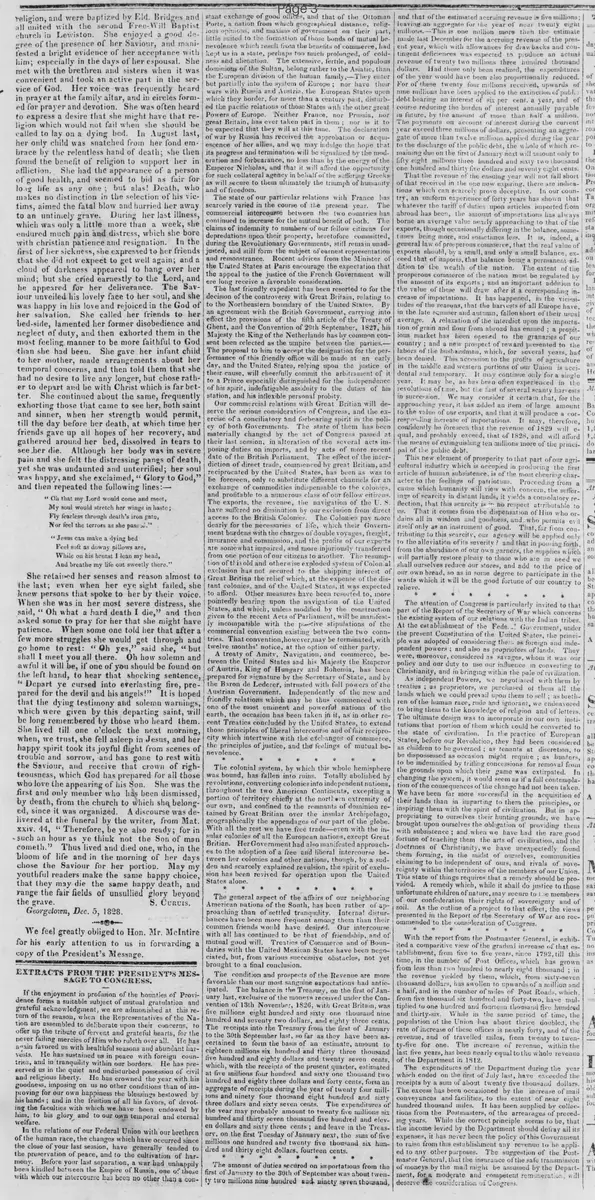
If the enjoyment in profusion of the bounties of Providence forms a suitable subject of mutual gratulation and grateful acknowledgment, we are admonished at this return of the season, when the Representatives of the Nation are assembled to deliberate upon their concerns, to offer up the tribute of fervent and grateful hearts, for the never failing mercies of Him who ruleth over all. He has again favored us with healthful seasons and abundant harvests. He has sustained us in peace with foreign countries, and in tranquility within our borders. He has preserved us in the quiet and undisturbed possession of civil and religious liberty. He has crowned the year with his goodness, imposing on us no other conditions than of improving for our own happiness the blessings bestowed by his hands; and in the fruition of all his favors, of devoting the faculties with which we have been endowed by him, to his glory and to our own temporal and eternal welfare.
In the relations of our Federal Union with our brethren of the human race, the changes which have occurred since the close of your last session, have generally tended to the preservation of peace, and to the cultivation of harmony. Before your last separation, a war had unhappily been kindled between the Empire of Russia, one of those with which our intercourse has been no other than a constant exchange of good offices, and that of the Ottoman Porte, a nation from which geographical distance, religious opinions, and maxims of government on their part, little suited to the formation of those bonds of mutual benevolence which result from the benefits of commerce, had kept us in a state, perhaps too much prolonged, of coldness and alienation. The extensive, fertile, and populous dominions of the Sultan, belong rather to the Asiatic, than the European division of the human family. They enter but partially into the system of Europe; nor have their wars with Russia and Austria, the European States upon which they border, for more than a century past, disturbed the pacific relations of those States with the other great Powers of Europe. Neither France, nor Prussia, nor Great Britain, has ever taken part in them: nor is it to be expected that they will at this time. The declaration of war by Russia has received the approbation or acquiescence of her allies, and we may indulge the hope that its progress and termination will be signalized by the moderation and forbearance, no less than by the energy of the Emperor Nicholas, and that it will afford the opportunity for such collateral agency in behalf of the suffering Greeks as will secure to them ultimately the triumph of humanity and of freedom.
The state of our particular relations with France has scarcely varied in the course of the present year. The commercial intercourse between the two countries has continued to increase for the mutual benefit of both. The claims of indemnity to numbers of our fellow citizens for depredations upon their property, heretofore committed, during the Revolutionary Governments, still remain unadjusted, and still form the subject of earnest representation and remonstrance. Recent advices from the Minister of the United States at Paris encourage the expectation that the appeal to the justice of the French Government will ere long receive a favorable consideration.
The last friendly expedient has been resorted to for the decision of the controversy with Great Britain, relating to the Northeastern boundary of the United States. By an agreement with the British Government, carrying into effect the provisions of the fifth article of the Treaty of Ghent, and the Convention of 29th September, 1827, his Majesty the King of the Netherlands has by common consent been selected as the umpire between the parties. The proposal to him to accept the designation for the performance of this friendly office will be made at an early day, and the United States, relying upon the justice of their cause, will cheerfully commit the arbitrament of it to a Prince especially distinguished for the independence of his spirit, indefatigable assiduity to the duties of his station, and his inflexible personal probity.
Our commercial relations with Great Britain will deserve the serious consideration of Congress, and the exercise of a conciliatory and forbearing spirit in the policy of both Governments. The state of them has been materially changed by the act of Congress passed at their last session, in alteration of the several acts imposing duties on imports, and by acts of more recent date of the British Parliament. The effect of the interdiction of direct trade, commenced by Great Britain, and reciprocated by the United States, has been as was to be foreseen, only to substitute different channels for an exchange of commodities indispensable to the colonies, and profitable to a numerous class of our fellow citizens. The exports, the revenue, the navigation of the U. S. have suffered no diminution by our exclusion from direct access to the British Colonies. The Colonies pay more dearly for the necessaries of life, which their Government burdens with the charges of double voyages, freight, insurance and commission, and the profits of our exports are somewhat impaired, and more injuriously transferred from one portion of our citizens to another. The resumption of the old and otherwise exploded system of Colonial exclusion has not secured to the shipping interest of Great Britain the relief which, at the expense of the distant colonies, and of the United States, it was expected to afford. Other measures have been resorted to, more pointedly bearing upon the navigation of the United States, and which, unless modified by the construction given to the recent Acts of Parliament, will be manifestly incompatible with the positive stipulations of the commercial convention existing between the two countries. That convention, however, may be terminated, with twelve months' notice, at the option of either party.
A treaty of Amity, Navigation, and commerce, between the United States and his Majesty the Emperor of Austria, King of Hungary and Bohemia, has been prepared for signature by the Secretary of State, and by the Baron de Lederer, intrusted with full powers of the Austrian Government. Independently of the new and friendly relations which may be thus commenced with one of the most eminent and powerful nations of the earth, the occasion has been taken in it, as in other recent Treaties concluded by the United States, to extend those principles of liberal intercourse and of fair reciprocity which intertwine with the exchanges of commerce, the principles of justice, and the feelings of mutual benevolence.
The colonial system, by which this whole hemisphere was bound, has fallen into ruins. Totally abolished by revolutions, converting colonies into independent nations, throughout the two American Continents, excepting a portion of territory chiefly at the northern extremity of our own, and confined to the remnants of dominion retained by Great Britain over the insular Archipelago, geographically the appendages of our part of the globe. With all the rest we have free trade—even with the insular colonies of all the European nations, except Great Britain. Her Government had also manifested approaches to the adoption of a free and liberal intercourse between her colonies and other nations, though, by a sudden and scarcely explained revulsion, the spirit of exclusion has been revived for operation upon the United States alone.
The general aspect of the affairs of our neighboring American nations of the South, has been rather of approaching than of settled tranquility. Internal disturbances have been more frequent among them than their common friends would have desired. Our intercourse with all has continued to be that of friendship, and of mutual good will. Treaties of Commerce and of Boundaries with the United Mexican States have been negotiated, but, from various successive obstacles, not yet brought to a final conclusion.
The condition and prospects of the Revenue are more favorable than our most sanguine expectations had anticipated. The balance in the Treasury, on the first of January last, exclusive of the moneys received under the Convention of 13th November, 1826, with Great Britain, was five millions eight hundred and sixty one thousand nine hundred and seventy two dollars, and eighty three cents. The receipts into the Treasury from the first of January to the 30th September last, so far as they have been ascertained to form the basis of an estimate, amount to eighteen millions six hundred and thirty three thousand five hundred and eighty dollars and twenty seven cents, which, with the receipts of the present quarter, estimated at five millions four hundred and sixty one thousand two hundred and eighty three dollars and forty cents, form an aggregate of receipts during the year of twenty four millions and ninety four thousand eight hundred and sixty three dollars and sixty seven cents. The expenditures of the year may probably amount to twenty five millions six hundred and thirty seven thousand five hundred and eleven dollars and sixty three cents; and leave in the Treasury, on the first Tuesday of January next, the sum of five millions one hundred and twenty five thousand six hundred and thirty eight dollars, fourteen cents.
The amount of duties secured on importations from the first of January to the 30th of September was about twenty two millions nine hundred and ninety seven thousand. and that of the estimated accruing revenue is five millions; leaving an aggregate for the year of near twenty eight millions. This is one million more than the estimate made last December for the accruing revenue of the present year, which with allowances for draw backs and contingent deficiencies was expected to produce an actual revenue of twenty two millions three hundred thousand dollars. Had these only been realized, the expenditures of the year would have been also proportionally reduced. For of these twenty four millions received, upwards of nine millions have been applied to the extinction of public debt bearing an interest of six per cent. a year, and of course reducing the burden of interest annually payable in future, by the amount of more than half a million. The payments on account of interest during the current year exceed three millions of dollars, presenting an aggregate of more than twelve millions applied during the year to the discharge of the public debt, the whole of which remaining due on the first of January next will amount only to fifty eight millions three hundred and sixty two thousand one hundred and thirty five dollars and seventy eight cents.
That the revenue of the ensuing year will not fall short of that received in the one now expiring, there are indications which can scarcely prove deceptive. In our country, an uniform experience of forty years has shown that whatever the tariff of duties upon articles imported from abroad has been, the amount of importations has always borne an average value nearly approaching to that of the exports, though occasionally differing in the balance, sometimes being more, and sometimes less. It is, indeed, a general law of prosperous commerce, that the real value of exports should, by a small, and only a small balance, exceed that of imports, that balance being a permanent addition to the wealth of the nation. The extent of the prosperous commerce of the nation must be regulated by the amount of its exports; and an important addition to the value of these will draw after it a corresponding increase of importations. It has happened, in the vicicissitudes of the seasons, that the harvests of all Europe have, in the late summer and autumn, fallen short of their usual average. A relaxation of the interdict upon the importation of grain and flour from abroad has ensued; a propitious market has been opened to the granaries of our country; and a new prospect of reward presented to the labors of the husbandman, which, for several years, has been denied. This accession to the profits of agriculture in the middle and western portions of our Union is accidental and temporary. It may continue only for a single year. It may be, as has been often experienced in the revolutions of time, but the first of several scanty harvests in succession. We may consider it certain that, for the approaching year, it has added an item of large amount to the value of our exports, and that it will produce a corresponding increase of importations. It may, therefore, confidently be foreseen that the revenue of 1829 will equal, and probably exceed, that of 1828, and will afford the means of extinguishing ten millions more of the principal of the public debt.
This new element of prosperity to that part of our agricultural industry which is occupied in producing the first article of human subsistence, is of the most cheering character to the feelings of patriotism. Proceeding from a cause which humanity will view with concern, the sufferings of scarcity in distant lands, it yields a consolatory reflection, that this scarcity is in no respect attributable to us. That it comes from the dispensation of Him who ordains all in wisdom and goodness, and who permits evil itself only as an instrument of good. That, far from contributing to this scarcity, our agency will be applied only to the alleviation of its severity? and that in pouring forth, from the abundance of our own garners, the supplies which will partially restore plenty to those who are in need we shall ourselves reduce our stores, and add to the price of our own bread, so as in some degree to participate in the wants which it will be the good fortune of our country to relieve.
The attention of Congress is particularly invited to that part of the Report of the Secretary of War which concerns the existing system of our relations with the Indian tribes. At the establishment of the Federal Government, under the present Constitution of the United States, the principle was adopted of considering them as foreign and independent powers; and also as proprietors of lands. They were, moreover, considered as savages, whom it was our policy and our duty to use our influence in converting to Christianity, and in bringing within the pale of civilization. As independent Powers, we negotiated with them by treaties; as proprietors, we purchased of them all the lands which we could prevail upon them to sell; as brethren of the human race, rude and ignorant, we endeavored to bring them to the knowledge of religion and of letters. The ultimate design was to incorporate in our own institutions that portion of them which could be converted to the state of civilization. In the practice of European States, before our Revolution, they had been considered as children to be governed; as tenants at discretion, to be dispossessed as occasion might require; as hunters, to be indemnified by trifling concessions for removal from the grounds upon which their game was extirpated. In changing the system, it would seem as if a full contemplation of the consequences of the change had not been taken. We have been far more successful in the acquisition of their lands than in imparting to them the principles, or inspiring them with the spirit of civilization. But in appropriating to ourselves their hunting grounds, we have brought upon ourselves the obligation of providing them with subsistence; and when we have had the rare good fortune of teaching them the arts of civilization, and the doctrines of Christianity, we have unexpectedly found them forming, in the midst of ourselves, communities claiming to be independent of ours, and rivals of sovereignty within the territories of the members of our Union. This state of things requires that a remedy should be provided. A remedy which, while it shall do justice to those unfortunate children of nature, may secure to the members of our confederation their rights of sovereignty and of soil. As the outline of a project to that effect, the views presented in the Report of the Secretary of War are recommended to the consideration of Congress.
With the report from the Postmaster General, is exhibited a comparative view of the gradual increase of that establishment, from five to five years, since 1792, till this time, in the number of Post Offices, which has grown from less than two hundred to nearly eight thousand; in the revenue yielded by them, which, from sixty-seven thousand dollars, has swollen to upwards of a million and a half, and in the number of miles of Post Roads, which, from five thousand six hundred and forty-two, have multiplied to one hundred and fourteen thousand five hundred and thirty-six. While in the same period of time, the population of the Union has about thrice doubled, the rate of increase of these offices is nearly forty, and of the revenue, and of travelled miles, from twenty to twenty-five for one. The increase of revenue, within the last five years, has been nearly equal to the whole revenue of the Department in 1812.
The expenditures of the Department during the year which ended on the first of July last, have exceeded the receipts by a sum of about twenty five thousand dollars. The excess has been occasioned by the increase of mail conveyances and facilities, to the extent of near eight hundred thousand miles. It has been supplied by collections from the Postmasters, of the arrearages of preceding years. While the correct principle seems to be, that the income levied by the Department should defray all its expenses, it has never been the policy of this Government to raise from this establishment any revenue to be applied to any other purposes. The suggestion of the Postmaster General, that the insurance of the safe transmission of moneys by the mail might be assumed by the Department, for a moderate and competent remuneration, will deserve the consideration of Congress.
What sub-type of article is it?
What keywords are associated?
What entities or persons were involved?
Where did it happen?
Domestic News Details
Primary Location
United States
Key Persons
Event Details
Extracts from the President's message to Congress expressing gratitude for bounties, peace, and liberty; discussing foreign relations with Russia, Ottoman Porte, France, Great Britain, Austria, and South American nations; reporting favorable revenue, debt reduction, and prospects for agriculture; recommending changes to Indian policy; and detailing growth of the postal service.