Thank you for visiting SNEWPapers!
Sign up free
Gazette Of The United States, & Philadelphia Daily Advertiser
Philadelphia, Philadelphia County, Pennsylvania
What is this article about?
Intercepted letter from Roetta, Egypt, describes the British naval victory over the French fleet in Aboukir Bay on 1 August 1798, with Admiral Brueys killed and most French ships destroyed or captured, four escaping.
Clipping
OCR Quality
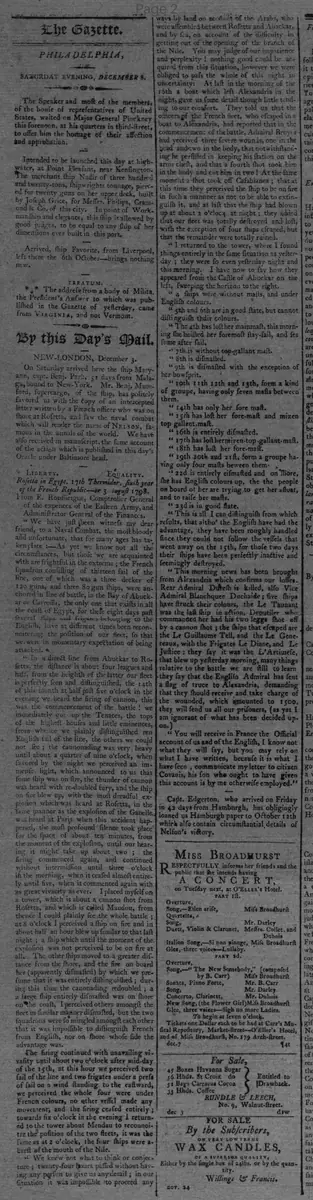
Full Text
NEW-LONDON, December 3.
On Saturday arrived here the ship Mary-Ann, capt. Benj. Park, 51 days from Malaga, bound to New-York. Mr. Benj. Mumford, supercargo, of the ship, has politely favored us with the copy of an intercepted letter written by a French officer who was on shore at Roetta, and saw the naval combat which will render the name of Nelson, famous in the annals of the world. We have also received in manuscript, the same account of the action which is published in this day's Oracle under Baltimore head.
LIBERTY,
EQUALITY.
Roetta in Egypt, 17th Thermidor, 6th year of the French Republic—or 3 August 1798.
From E. Roussièrgue, Comptroller General of the expences of the Eastern Army, and Administrator General of the Finances.
"We have just been witness my dear friend, to a Naval Combat, the most bloody and unfortunate, that for many ages has taken place: As yet we know not all the circumstances, but those we are acquainted with are frightful in the extreme; the French squadron consisting of thirteen sail of the line, one of which was a three decker of 120 guns, and three 80 gun ships, were anchored in line of battle, in the Bay of Aboukir or Carrosfa, the only one that exists in all the coast of Egypt, for these eight days past several ships and frigates belonging to the English, have at different times been reconnoitering the position of our fleet, so that we were in momentary expectation of being attacked.
"In a direct line from Aboukir to Roetta, the distance is about four leagues and half, from the height of the latter our fleet is perfectly seen and distinguished, the 14th of this month at half past five o'clock in the evening we heard the firing of cannon, this was the commencement of the battle! we immediately got up the terraces, the tops of the highest houses and little eminences, from whence we plainly distinguished ten English sail of the line, the others we could not see; the cannonading was very heavy until about a quarter of nine o'clock, when favored by the night we perceived an immense light, which announced to us that some ship was on fire, this thunder of cannon was heard with re-doubled fury, and the ship on fire blew up, with the most dreadful explosion which was heard at Roetta, in the same manner as the explosion of the Grenelle, was heard at Paris when this accident happened, the most profound silence took place for the space of about ten minutes, from the moment of the explosion, until our hearing it might take up about two; the firing commenced again, and continued without intermission until three o'clock in the morning, when it ceased almost entirely until five, when it commenced again with as great vivacity as ever. I placed myself on a tower, which is about a cannon shot from Roetta, and which is called Aboukir, from thence I could plainly see the whole battle; at 8 o'clock I perceived a ship on fire and in about half an hour blew up similar to that last night; a ship which until the moment of the explosion was not perceived to be on fire at all. The other ships moved to a greater distance from the shore, and the fire on board her (apparently dismasted) by which we presume that it was entirely distinguished; during this time the cannonading redoubled; a large ship entirely dismasted was on shore on the coast, I perceived others amongst the fleet in similar manner dismasted, but the two squadrons were so mingled amongst each other that it was impossible to distinguish French from English, nor on shore whose side the advantage was.
The firing continued with unremitting vivacity until about two o'clock after mid-day of the 15th, at this hour we perceived two sail of the line and two frigates under a press of sail on a wind standing to the eastward, we perceived the whole four were under French colours, no other vessel made any movement, and the firing ceased entirely; towards six o'clock in the evening I returned to the tower about Aboukir to reconnoitre the position of the two fleets, it was the same as at 2 o'clock, the four ships were abreast of the mouth of the Nile.
"We knew not what to think or conjecture; twenty-four hours passed without having any person to give us any detail; in our situation it was impossible to proceed any ways by land on account of the Arabs, who were assembled between Roetta and Aboukir, and by sea, on account of the difficulty in getting out of the opening of the branch of the Nile. You may judge of our impatience and perplexity! nothing good could be acquired from this situation, however we were obliged to pass the whole of this night in uncertainty: At last in the morning of the 16th a boat which left Alexandria in the night, gave us some detail though little tending to our comfort. They told us that the officers of the French fleet, who escaped in a boat to Alexandria, had reported that in the commencement of the battle, Admiral Brueys received three severe wounds, one in the head and two in the body, that notwithstanding he persisted in keeping his station on the quarter deck, and that a fourth shot took him in the body and cut him in two! At the same moment a Shot took off Casabianca; that at this time they perceived the ship to be on fire in such a manner as not to be able to extinguish it, and at last that the ship had blown up at about 2 o'clock at night; they added that our fleet was totally destroyed and lost, with the exception of four ships escaped, but that the remainder were totally ruined.
"I returned to the tower, where I found things entirely in the same situation as yesterday; they were so even yesterday night and this morning. I have now to say how they appeared from the Castle of Aboukir on the left, sweeping the horizon to the right.
"4 ships were without masts, and under English colours.
"5th and 6th are in good state, but cannot distinguish their colours.
"The 8th has lost her mainmast, this morning she hoisted her foremost stay-sail, and some after sail.
"7th is without top-gallant mast.
"8th is dismasted.
"9th is dismasted with the exception of her bowspright.
"10th 11th 12th and 13th, form a kind of groupe, having only seven masts between them.
"14th has only her fore mast.
"12th has lost her fore-mast and mizen top-gallant mast.
"16th is entirely dismasted.
"17th has lost her mizen-top gallant mast.
"18th has lost her fore-mast.
"19th 20th and 21st, form a groupe having only four masts between them.
"22d is entirely dismasted and on shore, she has English colours up, the people on board of her are trying to get her afloat, and to raise her masts.
"23d is in good state.
"This is all I can distinguish from which results, that altho' the English have had the advantage, they have been roughly handled since they could not follow the vessels that went away on the 15th, for those two days their ships have been perfectly inactive and seemingly destroyed.
"This morning news has been brought from Alexandria which confirms our loss. Rear Admiral Duchesne is killed, also Vice Admiral Blanquet Ducheide; five ships have struck their colours, the Le Tonnant was the last ship in action. Depuiroler who commanded her had his two legs shot off by a cannon shot; the ships that escaped are the Le Guillaume Tell, and the Le Généreux, with the Frigates Le Diane, and Le Justice: they say it was the L'Orient, that blew up yesterday morning, many things relative to the battle we are still to learn they say that the English Admiral has sent a flag of truce to Alexandria, demanding that they should receive and take charge of the wounded, which amounted to 1500. they will send us all our prisoners, (as yet I am ignorant of what has been decided upon.)
"You will receive in France the Official account of us and of the English, I know not what they will say, but you may rely on what I have written, because it is what I have seen, communicate my letter to citizen Covanis, his son who ought to have given this account is by me otherwise employed."
What sub-type of article is it?
What keywords are associated?
What entities or persons were involved?
Where did it happen?
Foreign News Details
Primary Location
Bay Of Aboukir, Egypt
Event Date
14th Thermidor (1 August 1798)
Key Persons
Outcome
french fleet of 13 ships of the line mostly destroyed or captured; admiral brueys killed, rear admiral duchesne killed, vice admiral blanquet ducheide killed, depuiroler lost both legs; four french ships escaped (le guillaume tell, le généreux, le diane, le justice); five french ships struck colors; english admiral sent flag of truce for 1500 wounded; english ships damaged but victorious.
Event Details
British fleet under Nelson attacked anchored French squadron in Aboukir Bay; intense battle over two days with ships on fire and exploding, including L'Orient; French ships dismasted and intermixed with British; four French ships escaped eastward.