Thank you for visiting SNEWPapers!
Sign up free
Story
December 23, 1876
Walla Walla Statesman
Walla Walla, Walla Walla County, Washington
What is this article about?
The U.S. Senate votes 50-4 to declare joint rules not in force for electoral count, opposing the House's view, potentially leading to a collision or deadlock in presidential succession unless resolved by Supreme Court or compromise.
Clipping
OCR Quality
95%
Excellent
Full Text
The Senate on the Joint Rules
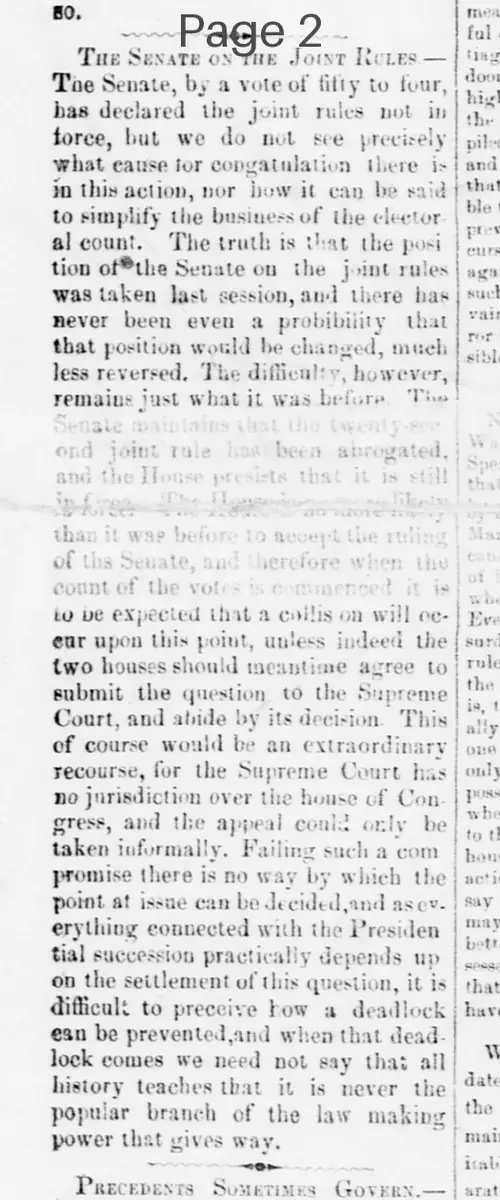
The Senate, by a vote of fifty to four, has declared the joint rules not in force, but we do not see precisely what cause for congratulation there is in this action, nor how it can be said to simplify the business of the electoral count. The truth is that the position of the Senate on the joint rules was taken last session, and there has never been even a probability that that position would be changed, much less reversed. The difficulty, however, remains just what it was before.
The second joint rule has been abrogated, and the House of Representatives is still of the opinion that it is in force. It is to be expected that a collision will occur upon this point, unless indeed the two houses should meantime agree to submit the question to the Supreme Court, and abide by its decision. This of course would be an extraordinary recourse, for the Supreme Court has no jurisdiction over the house of Congress, and the appeal could only be taken informally. Failing such a compromise there is no way by which the point at issue can be decided, and as everything connected with the Presidential succession practically depends upon the settlement of this question, it is difficult to perceive how a deadlock can be prevented, and when that deadlock comes we need not say that all history teaches that it is never the popular branch of the law-making power that gives way.
The Senate, by a vote of fifty to four, has declared the joint rules not in force, but we do not see precisely what cause for congratulation there is in this action, nor how it can be said to simplify the business of the electoral count. The truth is that the position of the Senate on the joint rules was taken last session, and there has never been even a probability that that position would be changed, much less reversed. The difficulty, however, remains just what it was before.
The second joint rule has been abrogated, and the House of Representatives is still of the opinion that it is in force. It is to be expected that a collision will occur upon this point, unless indeed the two houses should meantime agree to submit the question to the Supreme Court, and abide by its decision. This of course would be an extraordinary recourse, for the Supreme Court has no jurisdiction over the house of Congress, and the appeal could only be taken informally. Failing such a compromise there is no way by which the point at issue can be decided, and as everything connected with the Presidential succession practically depends upon the settlement of this question, it is difficult to perceive how a deadlock can be prevented, and when that deadlock comes we need not say that all history teaches that it is never the popular branch of the law-making power that gives way.
What sub-type of article is it?
Historical Event
What themes does it cover?
Justice
Catastrophe
What keywords are associated?
Senate Vote
Joint Rules
Electoral Count
House Collision
Presidential Succession
Deadlock
Where did it happen?
United States Congress
Story Details
Location
United States Congress
Story Details
Senate votes 50-4 against joint rules in force for electoral count, clashing with House opinion, risking deadlock in presidential succession without Supreme Court intervention or compromise.