Thank you for visiting SNEWPapers!
Sign up free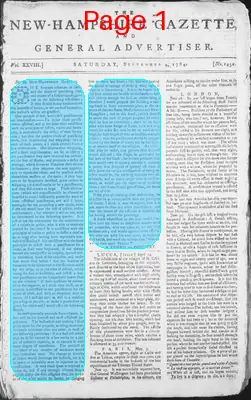
Letter to Editor
September 4, 1784
The New Hampshire Gazette And General Advertiser
Portsmouth, Exeter, Rockingham County, New Hampshire
What is this article about?
A letter critiquing the ineffectiveness and inhumanity of current punishments for theft (whipping and short imprisonment) and proposing forced labor in nail-making as a reformative alternative, to be implemented in a joint Massachusetts-New Hampshire facility.
Clipping
OCR Quality
98%
Excellent
Full Text
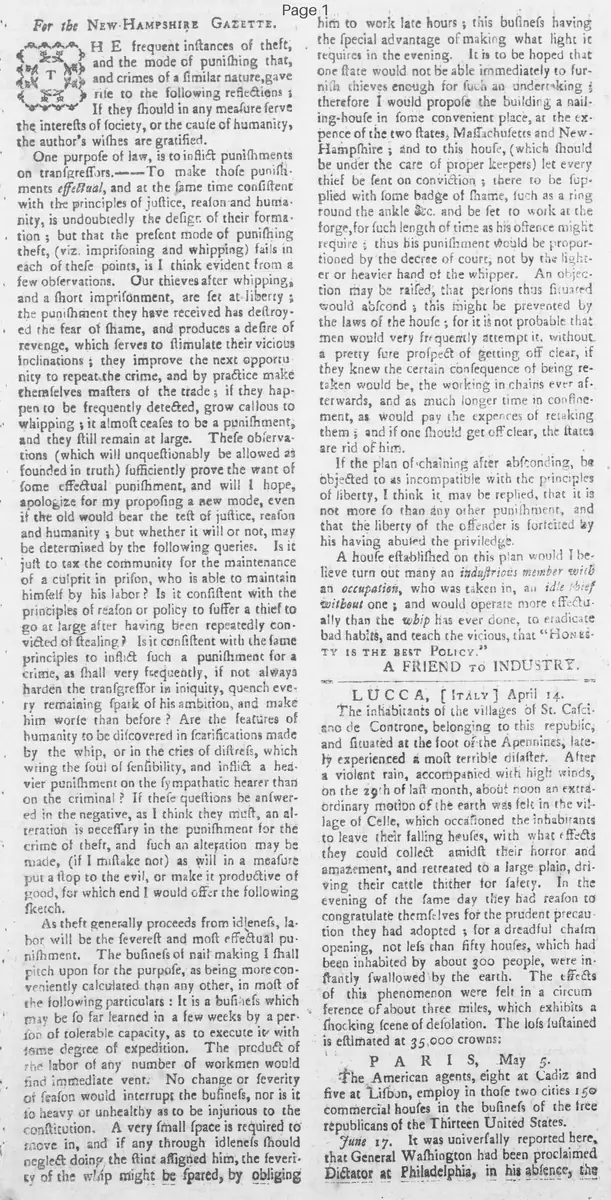
For the New-Hampshire Gazette.
The frequent instances of theft; and the mode of punishing that, and crimes of a similar nature, gave rise to the following reflections.
If they should in any measure serve the interests of society, or the cause of humanity, the author's wishes are gratified.
One purpose of law, is to inflict punishments on transgressors.--To make those punishments effectual, and at the same time consistent with the principles of justice, reason and humanity, is undoubtedly the design of their formation; but that the present mode of punishing theft, (viz. imprisoning and whipping) fails in each of these points, is I think evident from a few observations. Our thieves after whipping, and a short imprisonment, are set at liberty; the punishment they have received has destroyed the fear of shame, and produces a desire of revenge, which serves to stimulate their vicious inclinations; they improve the next opportunity to repeat the crime, and by practice make themselves masters of the trade; if they happen to be frequently detected, grow callous to whipping; it almost ceases to be a punishment, and they still remain at large. These observations (which will unquestionably be allowed as founded in truth) sufficiently prove the want of some effectual punishment, and will I hope, apologize for my proposing a new mode, even if the old would bear the test of justice, reason and humanity; but whether it will or not, may be determined by the following queries. Is it just to tax the community for the maintenance of a culprit in prison, who is able to maintain himself by his labor? Is it consistent with the principles of reason or policy to suffer a thief to go at large after having been repeatedly convicted of stealing? Is it consistent with the same principles to inflict such a punishment for a crime, as shall very frequently, if not always harden the transgressor in iniquity, quench every remaining spark of his ambition, and make him worse than before? Are the features of humanity to be discovered in scarifications made by the whip, or in the cries of distress, which wring the soul of sensibility, and inflict a heavier punishment on the sympathetic hearer than on the criminal? If these questions be answered in the negative, as I think they must, an alteration is necessary in the punishment for the crime of theft, and such an alteration may be made, (if I mistake not) as will in a measure put a stop to the evil, or make it productive of good, for which end I would offer the following sketch.
As theft generally proceeds from idleness, labor will be the severest and most effectual punishment. The business of nail making I shall pitch upon for the purpose, as being more conveniently calculated than any other, in most of the following particulars: It is a business which may be so far learned in a few weeks by a person of tolerable capacity, as to execute it with some degree of expedition. The product of the labor of any number of workmen would find immediate vent. No change or severity of season would interrupt the business, nor is it so heavy or unhealthy as to be injurious to the constitution. A very small space is required to move in, and if any through idleness should neglect doing the stint assigned him, the severity of the whip might be spared, by obliging him to work late hours; this business having the special advantage of making what light it requires in the evening. It is to be hoped that one state would not be able to furnish thieves enough for such an undertaking therefore I would propose the building, a nailing-house in some convenient place, at the expense of the two states, Massachusetts and New-Hampshire; and to this house, (which should be under the care of proper keepers) let every thief be sent on conviction: there to be supplied with some badge of shame, such as a ring round the ankle &c. and be set to work at the forge, for such length of time as his offence might require; thus his punishment would be proportioned by the decree of court, not by the lighter or heavier hand of the whipper. An objection may be raised, that persons thus situated would abscond: this might be prevented by the laws of the house: for it is not probable that men would very frequently attempt it, without a pretty sure prospect of getting off clear, if they knew the certain consequence of being retaken would be, the working in chains ever afterwards, and as much longer time in confinement, as would pay the expenses of retaking them; and if one should get off clear, the states are rid of him. If the plan of chaining after absconding, be objected to as incompatible with the principles of liberty, I think it may be replied, that it is not more so than any other punishment, and that the liberty of the offender is forfeited by his having abused the privilege. A house established on this plan would I believe turn out many an industrious member with an occupation, who was taken in, an idle thief without one; and would operate more effectually than the whip has ever done, to eradicate bad habits, and teach the vicious, that "HONESTY IS THE BEST POLICY."
A FRIEND TO INDUSTRY.
The frequent instances of theft; and the mode of punishing that, and crimes of a similar nature, gave rise to the following reflections.
If they should in any measure serve the interests of society, or the cause of humanity, the author's wishes are gratified.
One purpose of law, is to inflict punishments on transgressors.--To make those punishments effectual, and at the same time consistent with the principles of justice, reason and humanity, is undoubtedly the design of their formation; but that the present mode of punishing theft, (viz. imprisoning and whipping) fails in each of these points, is I think evident from a few observations. Our thieves after whipping, and a short imprisonment, are set at liberty; the punishment they have received has destroyed the fear of shame, and produces a desire of revenge, which serves to stimulate their vicious inclinations; they improve the next opportunity to repeat the crime, and by practice make themselves masters of the trade; if they happen to be frequently detected, grow callous to whipping; it almost ceases to be a punishment, and they still remain at large. These observations (which will unquestionably be allowed as founded in truth) sufficiently prove the want of some effectual punishment, and will I hope, apologize for my proposing a new mode, even if the old would bear the test of justice, reason and humanity; but whether it will or not, may be determined by the following queries. Is it just to tax the community for the maintenance of a culprit in prison, who is able to maintain himself by his labor? Is it consistent with the principles of reason or policy to suffer a thief to go at large after having been repeatedly convicted of stealing? Is it consistent with the same principles to inflict such a punishment for a crime, as shall very frequently, if not always harden the transgressor in iniquity, quench every remaining spark of his ambition, and make him worse than before? Are the features of humanity to be discovered in scarifications made by the whip, or in the cries of distress, which wring the soul of sensibility, and inflict a heavier punishment on the sympathetic hearer than on the criminal? If these questions be answered in the negative, as I think they must, an alteration is necessary in the punishment for the crime of theft, and such an alteration may be made, (if I mistake not) as will in a measure put a stop to the evil, or make it productive of good, for which end I would offer the following sketch.
As theft generally proceeds from idleness, labor will be the severest and most effectual punishment. The business of nail making I shall pitch upon for the purpose, as being more conveniently calculated than any other, in most of the following particulars: It is a business which may be so far learned in a few weeks by a person of tolerable capacity, as to execute it with some degree of expedition. The product of the labor of any number of workmen would find immediate vent. No change or severity of season would interrupt the business, nor is it so heavy or unhealthy as to be injurious to the constitution. A very small space is required to move in, and if any through idleness should neglect doing the stint assigned him, the severity of the whip might be spared, by obliging him to work late hours; this business having the special advantage of making what light it requires in the evening. It is to be hoped that one state would not be able to furnish thieves enough for such an undertaking therefore I would propose the building, a nailing-house in some convenient place, at the expense of the two states, Massachusetts and New-Hampshire; and to this house, (which should be under the care of proper keepers) let every thief be sent on conviction: there to be supplied with some badge of shame, such as a ring round the ankle &c. and be set to work at the forge, for such length of time as his offence might require; thus his punishment would be proportioned by the decree of court, not by the lighter or heavier hand of the whipper. An objection may be raised, that persons thus situated would abscond: this might be prevented by the laws of the house: for it is not probable that men would very frequently attempt it, without a pretty sure prospect of getting off clear, if they knew the certain consequence of being retaken would be, the working in chains ever afterwards, and as much longer time in confinement, as would pay the expenses of retaking them; and if one should get off clear, the states are rid of him. If the plan of chaining after absconding, be objected to as incompatible with the principles of liberty, I think it may be replied, that it is not more so than any other punishment, and that the liberty of the offender is forfeited by his having abused the privilege. A house established on this plan would I believe turn out many an industrious member with an occupation, who was taken in, an idle thief without one; and would operate more effectually than the whip has ever done, to eradicate bad habits, and teach the vicious, that "HONESTY IS THE BEST POLICY."
A FRIEND TO INDUSTRY.
What sub-type of article is it?
Persuasive
Ethical Moral
What themes does it cover?
Crime Punishment
Morality
What keywords are associated?
Theft Punishment
Forced Labor
Nail Making
Criminal Reform
Justice Humanity
Idleness Theft
Whipping Ineffectiveness
What entities or persons were involved?
A Friend To Industry.
New Hampshire Gazette
Letter to Editor Details
Author
A Friend To Industry.
Recipient
New Hampshire Gazette
Main Argument
the current punishments for theft (imprisonment and whipping) are ineffective, unjust, and inhumane, often hardening criminals; instead, thieves should be sentenced to forced labor in nail-making to reform them through industry and proportion punishment to the offense.
Notable Details
Queries Challenging Justice Of Taxing Community For Prisoner Maintenance
Proposal For Joint Massachusetts And New Hampshire Nailing House
Badge Of Shame Like Ankle Ring
Chaining For Escape Attempts
Emphasis On Honesty As Best Policy