Thank you for visiting SNEWPapers!
Sign up free
The Lancaster Ledger
Lancaster, Lancaster County, South Carolina
What is this article about?
Cadet John D. Wylie delivers an oration at the Citadel Academy in Charleston before the Cadet Fourth of July Association, addressing the political crisis in the U.S., sectional conflicts, and the need for Southerners to defend state rights under the Constitution.
Clipping
OCR Quality
Full Text
BEFORE THE CADET FOURTH OF JULY ASSOCIATION.
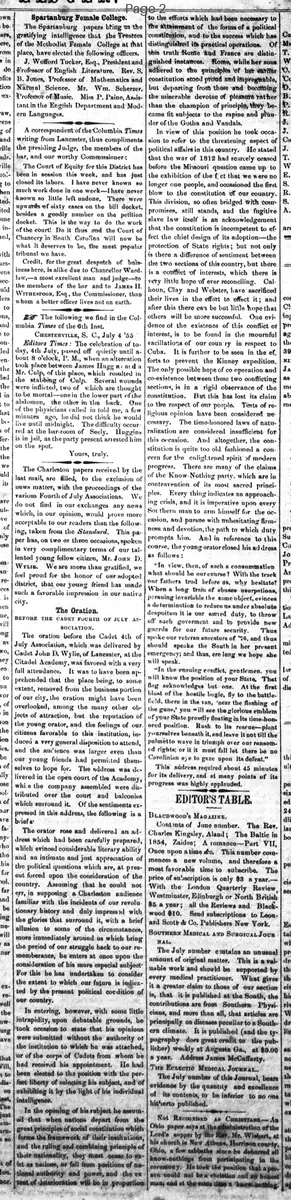
The oration before the Cadet 4th of July Association, which was delivered by Cadet John D. Wylie, of Lancaster, at the Citadel Academy, was favored with a very full attendance. It was to have been apprehended that the place being, to some extent, removed from the business portion of our city, the oration might have been overlooked, among the many other objects of attraction, but the reputation of the young orator, and the feelings of our citizens favorable to this institution, induced a very general disposition to attend, and the audience was larger even than our young friends had permitted themselves to hope for. The address was delivered in the open court of the Academy, while the company assembled were distributed over the court and balconies which surround it. Of the sentiments expressed in this address, the following is a brief:
The orator rose and delivered an address which had been carefully prepared, which evinced considerable literary ability and an intimate and just appreciation of the political questions which are, at present forced upon the consideration of the country. Assuming that he could not err, in supposing a Charleston audience familiar with the incidents of our revolutionary history and duly impressed with the glories that surround it, with a brief allusion to some of the circumstances, more immediately around us which bring the period of our struggle back to our remembrance, he enters at once upon the consideration of his more especial subject—For this he has undertaken to consider the extent to which our future is indicated by the present political condition of our country.
In entering, however, with some little intrepidity, upon debatable grounds, he took occasion to state that his opinions were submitted without the authority of the institution to which he was attached, or of the corps of Cadets from whom he had received his appointment. He had been elected to the position with the perfect liberty of selecting his subject, and of exhibiting it by the light of his individual intelligence.
In the opening of his subject he assumed that when nations depart from the great principles of social constitution which forms the framework of their institutions, and the ruling and combining principle of their nationality, they must cease to exist as nations, or fall from positions of national authority and power, and the extent of deterioration will be in proportion to the efforts which had been necessary to the attainment of the forms of a political constitution, and to the success which has distinguished its practical operations. Of this truth Rome and France are distinguished instances. Rome, while her sons adhered to the principles of her charter constitution stood proud and impregnable, but departing from these and becoming the miserable devotee of pleasure rather than the champion of principle, they became fit subjects to the rapine and plunder of the Goths and Vandals.
In view of this position he took occasion to refer to the threatening aspect of political affairs in this country. He stated that the war of 1812 had scarcely ceased before the Missouri question came up to the exhibition of the fact that we were no longer one people, and occasioned the first blow to the constitution of our country.
This division, so often bridged with compromise, still stands, and the fugitive slave law itself is an acknowledgement that the constitution is incompetent to effect the chief design of its adoption—the protection of State rights; but not only is there a difference of sentiment between the two sections of this country, but there is a conflict of interests, which there is very little hope of ever reconciling. Calhoun, Clay and Webster, have sacrificed their lives in the effort to effect it: and after this there can but little hope that others will be more successful. One evidence of the existence of this conflict of interest, is to be found in the mournful vacillations of our country in respect to Cuba. It is further to be seen in the efforts to prevent the Kinney expedition.
The only possible hope of co-operation and co-existence between these two conflicting sections, is in a rigid observance of the constitution. But this has lost its claim to the respect of our people. Tests of religious opinion have been considered necessary. The time-honored laws of naturalization are considered insufficient for this occasion. And altogether, the constitution is quite too old fashioned a concern for the enlightened spirit of modern progress. There are many of the claims of the Know-Nothing party, which are in contravention of its most sacred principles. Every thing indicates an approaching crisis, and it is imperative upon every Southern man to arm himself for the occasion, and pursue with unhesitating firmness and devotion, the path to which duty prompts him. And in reference to this course, the young orator closed his address as follows:
"In view, then, of such a consummation what should be our course? With the track our fathers trod before us, why hesitate! When a long train of abuses and usurpations, pursuing invariably the same object, evinces a determination to reduce us under absolute despotism it is our sacred duty, to throw off such government and to provide new guards for our future security. Thus spoke our veteran ancestors of '76, and thus should speak the South in her present emergency; and thus, ere long we hope she will speak.
"In the ensuing conflict, gentlemen, you will know the position of your State. That flag acknowledges but one. At the first blast of the hostile bugle, fly to the battle-field, there in the van, 'near the flashing of the guns,' you will see the glorious emblem of your State proudly floating in its time-honored position. Rush to its rescue—plant yourselves beneath it, and leave it not till the palmetto wave in triumph over our ransomed rights; or if it must fall let there be no Carolinian eye to gaze upon its defeat."
This address required about 45 minutes for its delivery, and at many points of its progress was highly applauded.
What sub-type of article is it?
What themes does it cover?
What keywords are associated?
What entities or persons were involved?
Where did it happen?
Story Details
Key Persons
Location
Citadel Academy, Charleston
Event Date
Fourth Of July
Story Details
Cadet John D. Wylie delivers a prepared oration on the political condition of the country, warning of sectional conflicts, the weakening of the Constitution, and the need for Southerners to defend state rights, drawing parallels to historical examples like Rome and referencing events such as the Missouri question and the Know-Nothing party.