Thank you for visiting SNEWPapers!
Sign up free
Literary
April 21, 1842
Martinsburg Gazette
Martinsburg, Berkeley County, West Virginia
What is this article about?
An artist's letter from Rome, Jan. 25, 1842, details a walking tour from Florence through vintage-rich vineyards to Pisa, describing its melancholic decline, leaning tower, and architecture, then to neat Lucca under oppressive rule. Notes hospitality, history, and personal reflections on writing.
Clipping
OCR Quality
95%
Excellent
Full Text
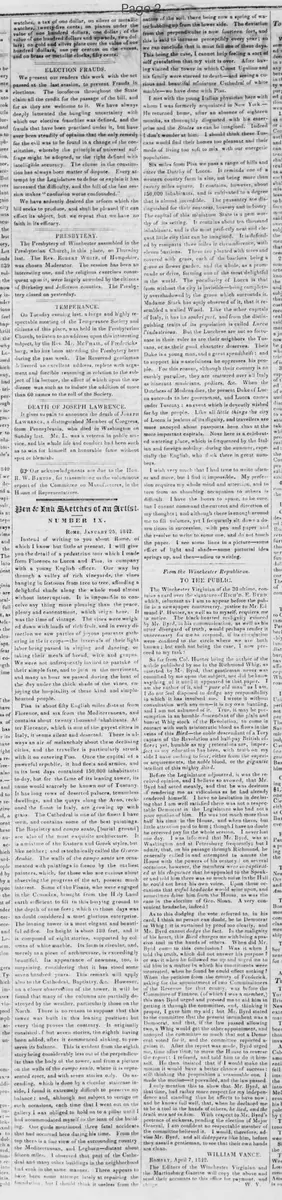
Men and Women Sketches of an Artist.
NUMBER IX.
Rome, January 25, 1842.
Instead of writing to you about Rome, of which I know but little at present, I will give you the detail of a pedestrian tour which I made from Florence to Lucca and Pisa, in company with a young English officer. Our way lay through a valley of rich vineyards, the vines hanging in festoons from tree to tree, affording a delightful shade along the whole road almost without interruption. It is impossible to conceive any thing more pleasing than the peace, plenty and contentment, which reign here. It was the time of vintage. The vines were weighed down with loads of rich fruit, and in every direction we saw parties of joyous peasants gathering in their crops—the intervals of their light labor being passed in singing and dancing, or taking their meals of bread, wine and grapes. We were not unfrequently invited to partake of their simple fare, and to join in the merriment, and many an hour we passed during the heat of the day under the thick shade of the vines, enjoying the hospitality of these kind and simple hearted people.
Pisa is about fifty English miles distant from Florence, and six from the Mediterranean, and contains about twenty thousand inhabitants. After Florence, which is one of the gayest cities in Italy, it seems silent and deserted. There is always an air of melancholy about these declining cities, and the traveller is particularly struck with it on entering Pisa. Once the capital of a powerful republic, it had fleets and armies, and in its best days contained 150,000 inhabitants: to-day, but for the fame of its leaning tower, its name would scarcely be known out of Tuscany. It has long rows of deserted palaces, tenantless dwellings, and the quays along the Arno, reckoned the finest in Italy, are growing up with grass. The Cathedral is one of the finest I have seen, and contains some of the best paintings. The Baptistry and campo santo, [burial ground] are also of the most exquisite architecture. It is a mixture of the Eastern and Greek styles, but like neither; and is technically called the Græco Arabic. The walls of the campo santo are ornamented with paintings in fresco by the earliest painters, which, for those who are curious about observing the progress of the art, possess much interest. Some of the Pisans, who were engaged in the Crusades, brought from the Holy Land earth sufficient to fill in this burying ground to the depth of nine feet; which in those days was no doubt considered a most glorious enterprise.
The leaning tower is a most elegant and beautiful edifice. Its height is about 180 feet, and it is composed of eight stories, supported by columns of white marble. Its form is circular, and, merely as a piece of architecture, is exceedingly beautiful. Its appearance of newness, too, is surprising, considering that it has stood some seven hundred years. This remark will apply also to the Cathedral, Baptistry, &c. However, on a closer observation of the tower, it will be found that many of the columns are partially destroyed by the weather, particularly those on the North. There is no reason to suppose that this tower was built in this leaning position; but every thing proves the contrary. It originally consisted of but seven stories, the eighth having been added, after it commenced sinking, to preserve its balance. This is evident from the eighth story being considerably less out of the perpendicular than the body of the tower, and from a picture on the walls of the campo santo, where it is represented erect, and with seven stories only. On ascending, which is done by a circular staircase inside, I found it extremely difficult to preserve my balance; and, although not subject to vertigo on such occasions, each time that I went out on the gallery I was obliged to hold on to a pillar until I had accommodated myself to the lean of the building. Our guide mentioned three fatal accidents that had occurred here during his time. From the top there is a fine view of the surrounding country the Mediterranean, and Leghorn—distant about fifteen miles. I observed that part of the Cathedral and many other buildings in the neighborhood had sunk in the same manner. There appears to have been some attempt lately at repairing the foundation but I should think it useless from the nature of the soil, there being now a spring of water bubbling up from the lower side. The deviation from the perpendicular is now fourteen feet, and this is said to increase perceptibly every year; so we can conclude that it must fall one of these days. This being the case, I cannot help feeling a sort of self gratulation that my visit is over. After having visited the tower in which Count Ugolino and his family were starved to death—and seeing a curious and beautiful miniature Cathedral of white marble—we have done with Pisa.
I met with the young Italian physician here with whom I was formerly acquainted in New York.—He returned home, after an absence of eighteen months, as thoroughly disgusted with his enterprise and the States as can be imagined. Indeed I don't wonder at him. I should think these Tuscans would find their homes too pleasant and their mode of living too soft to mix with our energetic population.
Six miles from Pisa we pass a range of hills and enter the Duchy of Lucca. It reminds one of a western country farm in size, not being more than twenty miles square. It contains, however, about 150,000 inhabitants, and is cultivated to a degree that is almost incredible. The peasantry are distinguished for their neatness, honesty and industry The capital of this miniature State is a gem worthy of its setting. It contains about ten thousand inhabitants, and is the most perfectly neat and elegant little city that can be imagined. It is defended by ramparts three miles in circumference, with eleven bastions. These are planted with trees and covered with grass, each of the bastions being a grove or flower garden, and the whole, as a promenade or drive, forming one of the most delightful in the world. The peculiarity of Lucca is that from without the city is invisible—being completely overshadowed by the grove which surrounds it. Madame Stark has aptly observed of it, that it resembled a walled Wood. Like the other capitals of Italy, it has its soubriquet, and from the distinguishing traits of its population is called Lucca l'industriosa. But the Lucchese are not so fortunate in their ruler as are their neighbors the Tuscans, or as their good character deserves. Their Duke is a young man, and a great spendthrift: and to support his wastefulness he oppresses his people. For this reason, although their country is an earthly paradise, they are scattered over all Italy as itinerant musicians, pedlars, &c. When the Duchess of Modena dies, the present Duke of Lucca succeeds to her government, and Lucca comes under Tuscany : an event which is devoutly wished for by the people. Like all little things the city of Lucca is jealous of its dignity, and travellers are more annoyed about passports here than at the more important capitals. Near here is a celebrated watering place, which is frequented by the Italian and foreign nobility during the summer, especially the English, who flock there in great numbers.
I wish very much that I had time to write oftener and more, but I find it impossible. My profession requires my whole mind and attention, and to turn from an absorbing occupation to others is difficult: I have the hours to spare, to be sure. but I cannot command the current and direction of my thoughts; and although there is enough around me to fill volumes, yet I frequently sit down a dozen times in succession, with pen and paper and the resolve to write to some one, and do not touch the paper. I see some lines in a picture—some effect of light and shade—some pictorial idea springs up, and then—adieu to writing.
NUMBER IX.
Rome, January 25, 1842.
Instead of writing to you about Rome, of which I know but little at present, I will give you the detail of a pedestrian tour which I made from Florence to Lucca and Pisa, in company with a young English officer. Our way lay through a valley of rich vineyards, the vines hanging in festoons from tree to tree, affording a delightful shade along the whole road almost without interruption. It is impossible to conceive any thing more pleasing than the peace, plenty and contentment, which reign here. It was the time of vintage. The vines were weighed down with loads of rich fruit, and in every direction we saw parties of joyous peasants gathering in their crops—the intervals of their light labor being passed in singing and dancing, or taking their meals of bread, wine and grapes. We were not unfrequently invited to partake of their simple fare, and to join in the merriment, and many an hour we passed during the heat of the day under the thick shade of the vines, enjoying the hospitality of these kind and simple hearted people.
Pisa is about fifty English miles distant from Florence, and six from the Mediterranean, and contains about twenty thousand inhabitants. After Florence, which is one of the gayest cities in Italy, it seems silent and deserted. There is always an air of melancholy about these declining cities, and the traveller is particularly struck with it on entering Pisa. Once the capital of a powerful republic, it had fleets and armies, and in its best days contained 150,000 inhabitants: to-day, but for the fame of its leaning tower, its name would scarcely be known out of Tuscany. It has long rows of deserted palaces, tenantless dwellings, and the quays along the Arno, reckoned the finest in Italy, are growing up with grass. The Cathedral is one of the finest I have seen, and contains some of the best paintings. The Baptistry and campo santo, [burial ground] are also of the most exquisite architecture. It is a mixture of the Eastern and Greek styles, but like neither; and is technically called the Græco Arabic. The walls of the campo santo are ornamented with paintings in fresco by the earliest painters, which, for those who are curious about observing the progress of the art, possess much interest. Some of the Pisans, who were engaged in the Crusades, brought from the Holy Land earth sufficient to fill in this burying ground to the depth of nine feet; which in those days was no doubt considered a most glorious enterprise.
The leaning tower is a most elegant and beautiful edifice. Its height is about 180 feet, and it is composed of eight stories, supported by columns of white marble. Its form is circular, and, merely as a piece of architecture, is exceedingly beautiful. Its appearance of newness, too, is surprising, considering that it has stood some seven hundred years. This remark will apply also to the Cathedral, Baptistry, &c. However, on a closer observation of the tower, it will be found that many of the columns are partially destroyed by the weather, particularly those on the North. There is no reason to suppose that this tower was built in this leaning position; but every thing proves the contrary. It originally consisted of but seven stories, the eighth having been added, after it commenced sinking, to preserve its balance. This is evident from the eighth story being considerably less out of the perpendicular than the body of the tower, and from a picture on the walls of the campo santo, where it is represented erect, and with seven stories only. On ascending, which is done by a circular staircase inside, I found it extremely difficult to preserve my balance; and, although not subject to vertigo on such occasions, each time that I went out on the gallery I was obliged to hold on to a pillar until I had accommodated myself to the lean of the building. Our guide mentioned three fatal accidents that had occurred here during his time. From the top there is a fine view of the surrounding country the Mediterranean, and Leghorn—distant about fifteen miles. I observed that part of the Cathedral and many other buildings in the neighborhood had sunk in the same manner. There appears to have been some attempt lately at repairing the foundation but I should think it useless from the nature of the soil, there being now a spring of water bubbling up from the lower side. The deviation from the perpendicular is now fourteen feet, and this is said to increase perceptibly every year; so we can conclude that it must fall one of these days. This being the case, I cannot help feeling a sort of self gratulation that my visit is over. After having visited the tower in which Count Ugolino and his family were starved to death—and seeing a curious and beautiful miniature Cathedral of white marble—we have done with Pisa.
I met with the young Italian physician here with whom I was formerly acquainted in New York.—He returned home, after an absence of eighteen months, as thoroughly disgusted with his enterprise and the States as can be imagined. Indeed I don't wonder at him. I should think these Tuscans would find their homes too pleasant and their mode of living too soft to mix with our energetic population.
Six miles from Pisa we pass a range of hills and enter the Duchy of Lucca. It reminds one of a western country farm in size, not being more than twenty miles square. It contains, however, about 150,000 inhabitants, and is cultivated to a degree that is almost incredible. The peasantry are distinguished for their neatness, honesty and industry The capital of this miniature State is a gem worthy of its setting. It contains about ten thousand inhabitants, and is the most perfectly neat and elegant little city that can be imagined. It is defended by ramparts three miles in circumference, with eleven bastions. These are planted with trees and covered with grass, each of the bastions being a grove or flower garden, and the whole, as a promenade or drive, forming one of the most delightful in the world. The peculiarity of Lucca is that from without the city is invisible—being completely overshadowed by the grove which surrounds it. Madame Stark has aptly observed of it, that it resembled a walled Wood. Like the other capitals of Italy, it has its soubriquet, and from the distinguishing traits of its population is called Lucca l'industriosa. But the Lucchese are not so fortunate in their ruler as are their neighbors the Tuscans, or as their good character deserves. Their Duke is a young man, and a great spendthrift: and to support his wastefulness he oppresses his people. For this reason, although their country is an earthly paradise, they are scattered over all Italy as itinerant musicians, pedlars, &c. When the Duchess of Modena dies, the present Duke of Lucca succeeds to her government, and Lucca comes under Tuscany : an event which is devoutly wished for by the people. Like all little things the city of Lucca is jealous of its dignity, and travellers are more annoyed about passports here than at the more important capitals. Near here is a celebrated watering place, which is frequented by the Italian and foreign nobility during the summer, especially the English, who flock there in great numbers.
I wish very much that I had time to write oftener and more, but I find it impossible. My profession requires my whole mind and attention, and to turn from an absorbing occupation to others is difficult: I have the hours to spare, to be sure. but I cannot command the current and direction of my thoughts; and although there is enough around me to fill volumes, yet I frequently sit down a dozen times in succession, with pen and paper and the resolve to write to some one, and do not touch the paper. I see some lines in a picture—some effect of light and shade—some pictorial idea springs up, and then—adieu to writing.
What sub-type of article is it?
Epistolary
Journey Narrative
Essay
What themes does it cover?
Agriculture Rural
Political
Nature
What keywords are associated?
Travel Letter
Tuscan Vineyards
Pisa Decline
Leaning Tower
Lucca Duchy
Literary Details
Title
Men And Women Sketches Of An Artist. Number Ix.
Subject
Pedestrian Tour From Florence To Lucca And Pisa
Key Lines
Instead Of Writing To You About Rome, Of Which I Know But Little At Present, I Will Give You The Detail Of A Pedestrian Tour Which I Made From Florence To Lucca And Pisa, In Company With A Young English Officer.
It Is Impossible To Conceive Any Thing More Pleasing Than The Peace, Plenty And Contentment, Which Reign Here. It Was The Time Of Vintage.
Once The Capital Of A Powerful Republic, It Had Fleets And Armies, And In Its Best Days Contained 150,000 Inhabitants: To Day, But For The Fame Of Its Leaning Tower, Its Name Would Scarcely Be Known Out Of Tuscany.
The Deviation From The Perpendicular Is Now Fourteen Feet, And This Is Said To Increase Perceptibly Every Year; So We Can Conclude That It Must Fall One Of These Days.
Like All Little Things The City Of Lucca Is Jealous Of Its Dignity, And Travellers Are More Annoyed About Passports Here Than At The More Important Capitals.