Thank you for visiting SNEWPapers!
Sign up free
Editorial
February 6, 1864
Springfield Weekly Republican
Springfield, Hampden County, Massachusetts
What is this article about?
Editorial examines Civil War geography, noting Confederacy's initial positional edge east of Mississippi and Union's decisive gain from capturing the river, urging a focused offensive from one point to crush the rebellion swiftly.
Clipping
OCR Quality
98%
Excellent
Full Text
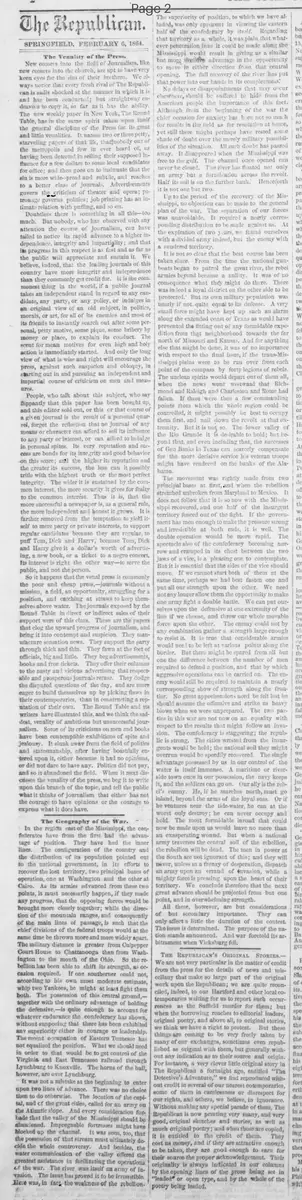
The Geography of the War.
In the region east of the Mississippi, the confederates have from the first had the advantage of position. They have had the inner lines. The configuration of the country and the distribution of its population pointed out to the national government, in its efforts to recover the lost territory, two principal bases of operation, one at Washington and the other at Cairo. As its armies advanced from these two points, it must necessarily happen, if they made any progress, that the opposing forces would be brought more closely together; while the direction of the mountain ranges, and consequently of the main lines of passage, is such that the chief divisions of the federal troops would at the same time be thrown more and more widely apart.
The military distance is greater from Culpepper Court House to Chattanooga than from Washington to the mouth of the Ohio. So the rebellion has been able to shift its strength, as occasion required. If one southerner could not, according to his own most moderate estimate, whip two Yankees, he might at least fight them both. The possession of this central ground—together with the ordinary advantage of holding the defensive—is quite enough to account for whatever endurance the confederacy has shown, without supposing that there has been exhibited any superiority either in courage or leadership.
The recent occupation of Eastern Tennessee has not equalized the position. What we should need in order to that would be to get control of the Virginia and East Tennessee railroad through Lynchburg to Knoxville. The horns of the bull, however, are over Lynchburg.
It was not a mistake at the beginning to enter upon two lines of advance. There was no choice then to do otherwise. The location of the capital, and of the great cities, called for an army on the Atlantic slope. And every consideration forbade that the valley of the Mississippi should be abandoned. Impregnable fortresses might have blocked up the channel. It was seen, too, that the possession of that stream must ultimately decide the whole controversy. And besides, the water communication of the valley offered the greatest assistance in facilitating the operations of the war. The river was itself an army of invasion. The issue has proved it to be irresistible. Here was, in fact, the weakness of the rebellion.
The superiority of position, to which we have alluded, was only apparent in viewing the eastern half of the confederacy by itself. Regarding that territory as a whole, it was plain that whatever penetration into it could be made along the Mississippi would result in giving us a similar but more decisive advantage in the opportunity to move in either direction from that central opening. The full recovery of the river has put that power into our hands in its completeness.
No delays or disappointments that may occur elsewhere should be suffered to hide from the American people the importance of this fact. Although from the beginning of the war the chief occasion for anxiety has been not so much for results in the field as for resolution at home, yet still there might perhaps have rested some shade of doubt over the merely military possibilities of the situation. All such doubt has passed away. It disappeared when the Mississippi was free to the gulf. The channel once opened can never be closed. The river has floated not only an army but a fortification across the revolt. Half its soil is on the further bank. Henceforth it is not one but two.
Up to the period of the recovery of the Mississippi, no objection can be made to the general plan of the war. The separation of our forces was unavoidable. It required a nearly corresponding distribution to be made against us. At the expiration of two years, we found ourselves with a divided army indeed, but the enemy with a sundered territory.
It is not so clear that the best course has been taken since. From the time the national gunboats began to patrol the great river, the rebel armies beyond became a nullity. It was of no consequence what they might do there. There was indeed a loyal district on the other side to be protected. But its own military population was nearly if not quite equal to its defense. A very small force might have kept up such an alarm along the extended coast of Texas as would have prevented the fitting out of any formidable expedition from that neighborhood towards the far north of Missouri and Kansas. And for anything else that might be done, it was of no importance with respect to the final issue, if the trans-Mississippi plains were to be run over from each point of the compass by forty legions of rebels.
The unclean spirits would depart out of them all, when the news went westward that Richmond and Raleigh and Charleston and Rome had fallen. If there were then a few commanding points from which the whole region could be controlled, it might possibly be best to occupy them first, and nail down the revolt at that extremity. But it is not so. The lower valley of the Rio Grande it is desirable to hold; but beyond that, and even including that, the successes of Gen. Banks in Texas can scarcely compensate for the more decisive service his veteran troops might have rendered on the banks of the Alabama.
The movement was rightly made from two principal bases at first, and when the rebellion stretched unbroken from Maryland to Mexico. It does not follow that it is so now with the Mississippi recovered, and one half of the insurgent territory fenced out of the fight. If the government has men enough to make the pressure strong and irresistible at both ends, it is well. The double operation would be more rapid. The spectacle also of the confederacy becoming narrow and cramped in its chest between the two jaws of a vice, is a pleasing one to contemplate.
But it is essential that the sides of the vice should move. If we cannot start both of them at the same time, perhaps we had best fasten one and put all our strength upon the other. We need not any longer allow them the opportunity to make one army fight a double battle. We can put ourselves upon the defensive at one extremity of the line if we choose, and throw our whole movable force upon the other. The enemy could not by any combination gather a strength large enough to resist it. It is true that considerable armies would need to be left at various points along the border. But there might be spared from all but one the difference between the number of men required to defend a position, and that by which aggressive operations can be carried on. The enemy would still be required to maintain a nearly corresponding show of strength along the frontier. No great apprehensions need be felt lest he should assume the offensive and strike us heavy blows when we were unprepared. The two parties in this war are not now on an equality with respect to the results that might follow an invasion. The confederacy is staggering; the republic is strong. The cities wrested from the insurgents would be held; the national soil they might overrun would be speedily recovered. The single advantage possessed by us in our control of the water is itself immense. A maritime or riverside town once in our possession, the navy keeps it, and the soldiers can go on. Our ally is the rebel's enemy. He, if he marches north, must go inland, beyond the arms of the loyal seas. Or if he ventures near the tide-water, he can at the worst only destroy; he can never occupy and hold. The most formidable inroad that could now be made upon us would leave no more than an exasperating wound. But when a national army traverses the central soil of the rebellion, the rebellion will be dead. The men in power at the South are not ignorant of this; and they will never, unless in a frenzy of desperation, dispatch an army upon an errand of invasion, while a mighty force is pressing upon the heart of their territory. We conclude therefore that the next great advance should be projected from but one point, and in overwhelming strength.
All these, however, are but considerations of but secondary importance. They can only affect a little the duration of the contest. The issue is determined. The purpose of the nation stands announced. And war foretold its arbitrament when Vicksburg fell.
In the region east of the Mississippi, the confederates have from the first had the advantage of position. They have had the inner lines. The configuration of the country and the distribution of its population pointed out to the national government, in its efforts to recover the lost territory, two principal bases of operation, one at Washington and the other at Cairo. As its armies advanced from these two points, it must necessarily happen, if they made any progress, that the opposing forces would be brought more closely together; while the direction of the mountain ranges, and consequently of the main lines of passage, is such that the chief divisions of the federal troops would at the same time be thrown more and more widely apart.
The military distance is greater from Culpepper Court House to Chattanooga than from Washington to the mouth of the Ohio. So the rebellion has been able to shift its strength, as occasion required. If one southerner could not, according to his own most moderate estimate, whip two Yankees, he might at least fight them both. The possession of this central ground—together with the ordinary advantage of holding the defensive—is quite enough to account for whatever endurance the confederacy has shown, without supposing that there has been exhibited any superiority either in courage or leadership.
The recent occupation of Eastern Tennessee has not equalized the position. What we should need in order to that would be to get control of the Virginia and East Tennessee railroad through Lynchburg to Knoxville. The horns of the bull, however, are over Lynchburg.
It was not a mistake at the beginning to enter upon two lines of advance. There was no choice then to do otherwise. The location of the capital, and of the great cities, called for an army on the Atlantic slope. And every consideration forbade that the valley of the Mississippi should be abandoned. Impregnable fortresses might have blocked up the channel. It was seen, too, that the possession of that stream must ultimately decide the whole controversy. And besides, the water communication of the valley offered the greatest assistance in facilitating the operations of the war. The river was itself an army of invasion. The issue has proved it to be irresistible. Here was, in fact, the weakness of the rebellion.
The superiority of position, to which we have alluded, was only apparent in viewing the eastern half of the confederacy by itself. Regarding that territory as a whole, it was plain that whatever penetration into it could be made along the Mississippi would result in giving us a similar but more decisive advantage in the opportunity to move in either direction from that central opening. The full recovery of the river has put that power into our hands in its completeness.
No delays or disappointments that may occur elsewhere should be suffered to hide from the American people the importance of this fact. Although from the beginning of the war the chief occasion for anxiety has been not so much for results in the field as for resolution at home, yet still there might perhaps have rested some shade of doubt over the merely military possibilities of the situation. All such doubt has passed away. It disappeared when the Mississippi was free to the gulf. The channel once opened can never be closed. The river has floated not only an army but a fortification across the revolt. Half its soil is on the further bank. Henceforth it is not one but two.
Up to the period of the recovery of the Mississippi, no objection can be made to the general plan of the war. The separation of our forces was unavoidable. It required a nearly corresponding distribution to be made against us. At the expiration of two years, we found ourselves with a divided army indeed, but the enemy with a sundered territory.
It is not so clear that the best course has been taken since. From the time the national gunboats began to patrol the great river, the rebel armies beyond became a nullity. It was of no consequence what they might do there. There was indeed a loyal district on the other side to be protected. But its own military population was nearly if not quite equal to its defense. A very small force might have kept up such an alarm along the extended coast of Texas as would have prevented the fitting out of any formidable expedition from that neighborhood towards the far north of Missouri and Kansas. And for anything else that might be done, it was of no importance with respect to the final issue, if the trans-Mississippi plains were to be run over from each point of the compass by forty legions of rebels.
The unclean spirits would depart out of them all, when the news went westward that Richmond and Raleigh and Charleston and Rome had fallen. If there were then a few commanding points from which the whole region could be controlled, it might possibly be best to occupy them first, and nail down the revolt at that extremity. But it is not so. The lower valley of the Rio Grande it is desirable to hold; but beyond that, and even including that, the successes of Gen. Banks in Texas can scarcely compensate for the more decisive service his veteran troops might have rendered on the banks of the Alabama.
The movement was rightly made from two principal bases at first, and when the rebellion stretched unbroken from Maryland to Mexico. It does not follow that it is so now with the Mississippi recovered, and one half of the insurgent territory fenced out of the fight. If the government has men enough to make the pressure strong and irresistible at both ends, it is well. The double operation would be more rapid. The spectacle also of the confederacy becoming narrow and cramped in its chest between the two jaws of a vice, is a pleasing one to contemplate.
But it is essential that the sides of the vice should move. If we cannot start both of them at the same time, perhaps we had best fasten one and put all our strength upon the other. We need not any longer allow them the opportunity to make one army fight a double battle. We can put ourselves upon the defensive at one extremity of the line if we choose, and throw our whole movable force upon the other. The enemy could not by any combination gather a strength large enough to resist it. It is true that considerable armies would need to be left at various points along the border. But there might be spared from all but one the difference between the number of men required to defend a position, and that by which aggressive operations can be carried on. The enemy would still be required to maintain a nearly corresponding show of strength along the frontier. No great apprehensions need be felt lest he should assume the offensive and strike us heavy blows when we were unprepared. The two parties in this war are not now on an equality with respect to the results that might follow an invasion. The confederacy is staggering; the republic is strong. The cities wrested from the insurgents would be held; the national soil they might overrun would be speedily recovered. The single advantage possessed by us in our control of the water is itself immense. A maritime or riverside town once in our possession, the navy keeps it, and the soldiers can go on. Our ally is the rebel's enemy. He, if he marches north, must go inland, beyond the arms of the loyal seas. Or if he ventures near the tide-water, he can at the worst only destroy; he can never occupy and hold. The most formidable inroad that could now be made upon us would leave no more than an exasperating wound. But when a national army traverses the central soil of the rebellion, the rebellion will be dead. The men in power at the South are not ignorant of this; and they will never, unless in a frenzy of desperation, dispatch an army upon an errand of invasion, while a mighty force is pressing upon the heart of their territory. We conclude therefore that the next great advance should be projected from but one point, and in overwhelming strength.
All these, however, are but considerations of but secondary importance. They can only affect a little the duration of the contest. The issue is determined. The purpose of the nation stands announced. And war foretold its arbitrament when Vicksburg fell.
What sub-type of article is it?
Military Affairs
War Or Peace
What keywords are associated?
Civil War Geography
Mississippi River Control
Union Strategy
Confederate Advantages
Military Operations
What entities or persons were involved?
Confederates
National Government
Federal Troops
Gen. Banks
Mississippi River
Editorial Details
Primary Topic
Geographical And Strategic Analysis Of The Civil War
Stance / Tone
Optimistic Advocacy For Concentrated Union Offensive
Key Figures
Confederates
National Government
Federal Troops
Gen. Banks
Mississippi River
Key Arguments
Confederates Held Inner Lines East Of Mississippi
Union Bases At Washington And Cairo Led To Divided Forces
Control Of Mississippi Provides Decisive Central Advantage
Rebel Armies West Of Mississippi Are Nullity Post River Recovery
Advocate Single Point Overwhelming Advance Over Dual Operations