Thank you for visiting SNEWPapers!
Sign up free
Norfolk Gazette And Publick Ledger
Norfolk, Virginia
What is this article about?
Pseudonymous letter 'Fabius No. I' from Charleston Courier urges President James Madison to emulate George Washington's virtuous administration and avoid Thomas Jefferson's erroneous policies, including the Louisiana Purchase, Burr conspiracy suppression, and Embargo, which caused national decline.
Merged-components note: Sequential reading order and text continuation ('affects' to 'people') indicate these are parts of the same FABIUS open letter; relabeled to letter_to_editor as it is addressed directly to the President like a reader submission
Clippings
1 of 2
OCR Quality
Full Text
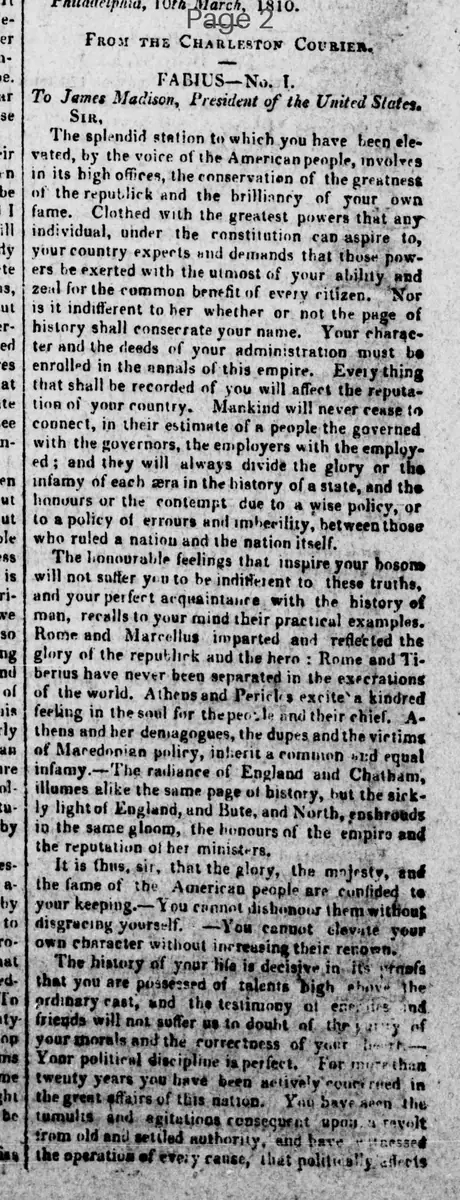
FABIUS-No. I.
To James Madison, President of the United States.
SIR,
The splendid station to which you have been elevated, by the voice of the American people, involves in its high offices, the conservation of the greatness of the republic and the brilliancy of your own fame. Clothed with the greatest powers that any individual, under the constitution can aspire to, your country expects and demands that those powers be exerted with the utmost of your ability and zeal for the common benefit of every citizen. Nor is it indifferent to her whether or not the page of history shall consecrate your name. Your character and the deeds of your administration must be enrolled in the annals of this empire. Every thing that shall be recorded of you will affect the reputation of your country. Mankind will never cease to connect, in their estimate of a people the governed with the governors, the employers with the employed; and they will always divide the glory or the infamy of each era in the history of a state, and the honours or the contempt due to a wise policy, or to a policy of errors and imbecility, between those who ruled a nation and the nation itself.
The honourable feelings that inspire your bosom will not suffer you to be indifferent to these truths, and your perfect acquaintance with the history of man, recalls to your mind their practical examples.
Rome and Marcellus imparted and reflected the glory of the republic and the hero: Rome and Tiberius have never been separated in the execrations of the world. Athens and Pericles excite a kindred feeling in the soul for the people and their chief. Athens and her demagogues, the dupes and the victims of Macedonian policy, inherit a common and equal infamy. The radiance of England and Chatham, illumes alike the same page of history, but the sickly light of England, and Bute, and North, enshrouds in the same gloom, the honours of the empire and the reputation of her ministers.
It is thus, sir, that the glory, the majesty, and the fame of the American people are confided to your keeping. You cannot dishonour them without disgracing yourself. You cannot elevate your own character without increasing their renown.
The history of your life is decisive in its verdict that you are possessed of talents high above the ordinary cast, and the testimony of enemies and friends will not suffer us to doubt of the purity of your morals and the correctness of your faith. Your political discipline is perfect. For more than twenty years you have been actively concerned in the great affairs of this nation. You have seen the tumults and agitations consequent upon a revolt from old and settled authority, and have witnessed the operation of every cause, that politically affects
people, i.e. the temporary substitutes for the power that was destroyed, and in the infinite combinations that government displays in its progress, from the first rude draught to the last finish of the statesman. Practical lessons of a similar nature from beyond the Atlantick have instructed you still more, in the science of, what is sufficient, useful or dangerous in the modification of the constituted authorities of a state. They have shewn you the iniquities that the career of unbridled passion entails upon a nation; and have opened to your view all the arts and wiles of demagogues, who seek for power by rendering the multitude the slaves of opinion. At one time, a colleague with the advocates of federal maxims of policy, and then a principal in the councils of your country among their adversaries, your experience in the two great branches into which American politicks have been separated, is coeval and commensurate with the parties that, at this day divide upon their respective principles and doctrines.
You have improved all these advantages, springing from the political æra in which it was your destiny to flourish, by useful and uninterrupted study: and it is no adulation to say, that, in learning and experience you are among the most enlightened statesmen of the age.
With this reputation, and with these acknowledged virtues and undisputed excellencies you have reached the great object of your laudable ambition. You are the chief magistrate of this people. Your country can do no more for you than she has done already: you can repay her only by devoting yourself to the honourable labour of restoring her to the state from which she has fallen; a state of prosperity and glory.
Two eminent examples, sir, are pointed out by the history of our own times for your instruction and for the guidance of the future presidents of this country. In the one there is every thing to imitate, in the other there is every thing to avoid. The one will stand a positive, the other a negative example forever.
The administration of Washington was made up of wise patriotic measures, faultless in plan and execution and ruled by a spirit that quickened every good thing into wholesome activity for American happiness and that checked the growth of every evil that budded for its annoyance. History furnishes no parallel to the perfect system of his policy. It was complete in all its parts. No corruption approached it, no imbecility disgraced it, no duplicity enveloped its character in doubt. That great man knew nothing of double-dealing. Every action of his life was noble frank and manly. While he ruled this country the people always knew, precisely, on what ground they stood; for he was incapable of using the power of concealing the information which his situation gave him for the purpose of tricking the nation into the schemes of party aggrandizement. He had no state secrets but national ones, and he kept nothing hid from the publick eye to effect the private views of his political friends. Conscious of the integrity of his conduct he never was backward in telling the world what he had done, nor did he ever abuse the confidence of his countrymen by false expositions of his foreign policy.
You, Sir, are a witness to attest the truth and faithfulness of these characteristics of the administration of the father of this country. You were a witness, too, of the glorious issue that crowned the labours of such patriotick excellence. You saw what one great man is able to accomplish in raising the character and in making the happiness of a whole people. You saw the benefits that the nation derived from wisdom and virtue clothed with power; and you are not to be told, that when Washington retired from office, he left his country high in reputation, respectable in resources and the subject of applause and honourable mention throughout the globe.
Behold! Sir, the reverse of all this in the history of your predecessor.
The administration of Jefferson was founded in error, drew its nourishment from the impure sources that party hatred makes fruitful, and ripened into a fulness of mischief that has prostrated the nation to poverty and shame. Its policy was in all points original. Reason never yielded her approving voice to one of its acts, and every truth in the annals of mankind is a satire upon its maxims. It was secret in all things but its destructive effects; was powerful in working evil and impotent to every good. It took no lessons from the experience of the governments of the world, but launched into an unknown sea of conjecture and theory, without compass or chart, and made shipwreck of the nation's prosperity in a voyage of bewildered speculation.
There was not any show of boldness in this adventure to compensate us, in vanity for our courage, for the ruin of our greatness. The nation was carried she knew not whither, to accomplish projects that she could not understand. An invisible hand seemed to propel her, and when she had reached her last point of progression, she was astonished at the folly of her rulers and her own infatuation.
Never was there an administration so profuse in professions of the publick good; but the reality was always to come. The people were amused in the midst of actual suffering by schemes of imaginary benefit. In every exigency assurances of coming relief were given; but difficulties have increased upon us, and we are less able to remove the aggregate of evil, than we were the individual mischiefs as they rose, that have contributed to make the deadly load that now presses us to the earth.
There was no certainty in this administration. The decisions of intrepid wisdom did not rule its councils. The sailing of a British packet from this country, or the expected arrival of European advices gave it a character, for the moment, that changed with the wind, and was afterwards lost or resumed according as the fluctuating and unimportant events of the day.
I appeal, Sir, to your own heart and to your own understanding to say, whether or not the three prominent acts of Mr. Jefferson's administration have not issued in the nation's disgrace and to the ruin of the country's resources?
The purchase of Louisiana has exposed us to the jesuiting chicanery of Rome, and has alarmed us with the prospect of a Spanish war. It has thrown over us the infamy of suffering a territory legislated upon in our own national councils, on American ground by right of purchase, to be wrested from us by a Spanish banditti. It gives us in perspective, the perplexity of settling hereafter, and with contending proprietors, our claim to any and to every part of the ceded.
The suppression of the conspiracy of Burr, was effected by the prostration of civil law under the bayonets of a standing army and by a dear-bought proof, that the great safeguard of American freedom against arbitrary imprisonments, the writ of habeas corpus may be violated with impunity and applause.
The embargo and the political monsters that issued from its womb, have devoured American commerce--have annihilated American character, have beggared the people and their country, and have delivered us bound hand and foot, to the first enemy that shall fall upon us.
Thus, sir, has it happened that you have come to preside over this republick in inauspicious times. Your predecessor had broken down the fabrick of the empire, and he surrendered to your charge a depressed and suffering people.
FABIUS.
What sub-type of article is it?
What themes does it cover?
What keywords are associated?
What entities or persons were involved?
Letter to Editor Details
Author
Fabius
Recipient
James Madison, President Of The United States
Main Argument
president madison must emulate washington's wise and transparent administration to restore national prosperity and glory, while avoiding the secretive and erroneous policies of jefferson that led to poverty, shame, and ruin through the louisiana purchase, burr conspiracy suppression, and the embargo.
Notable Details